
Years
2001 in History
2001 is remembered for one morning: on 11 September nineteen al-Qaeda hijackers seized four airliners and struck the World Trade Center and the Pentagon, killing 2,977 victims. Within a month American and British forces were bombing Afghanistan, the Taliban fell within two months, and a war began that lasted twenty years — dividing the century into before and after.
At a Glance
- Defining event
- The September 11 attacks — 2,977 victims killed, a figure officially put by the memorial authorities
- Response
- U.S.-led attack on Afghanistan begins, 7 October; the Taliban regime falls within two months
- New institutions
- President Bush creates the Office of Homeland Security, 8 October
- Launched
- Wikipedia, 15 January — a free encyclopedia anyone can edit; the iPod, 23 October
- Trade
- China formally joins the World Trade Organization, 11 December
- Closed the year
- Enron files for bankruptcy, 2 December, then America's largest corporate failure
The defining story: September 11
On a clear Tuesday morning, 11 September 2001, four American passenger jets were hijacked almost simultaneously by teams of al-Qaeda operatives who had trained as pilots in the United States. At 8:46 a.m. American Airlines Flight 11 struck the North Tower of the World Trade Center in New York. Seventeen minutes later United Airlines Flight 175 hit the South Tower, live on television. A third aircraft, American Airlines Flight 77, was flown into the Pentagon, the headquarters of the American military; the fourth plane fell in Pennsylvania. Nineteen hijackers in all seized the four airliners, and 2,977 victims were killed, a figure officially put by the memorial authorities. The first identified casualty was Mychal Judge, the New York Fire Department chaplain.
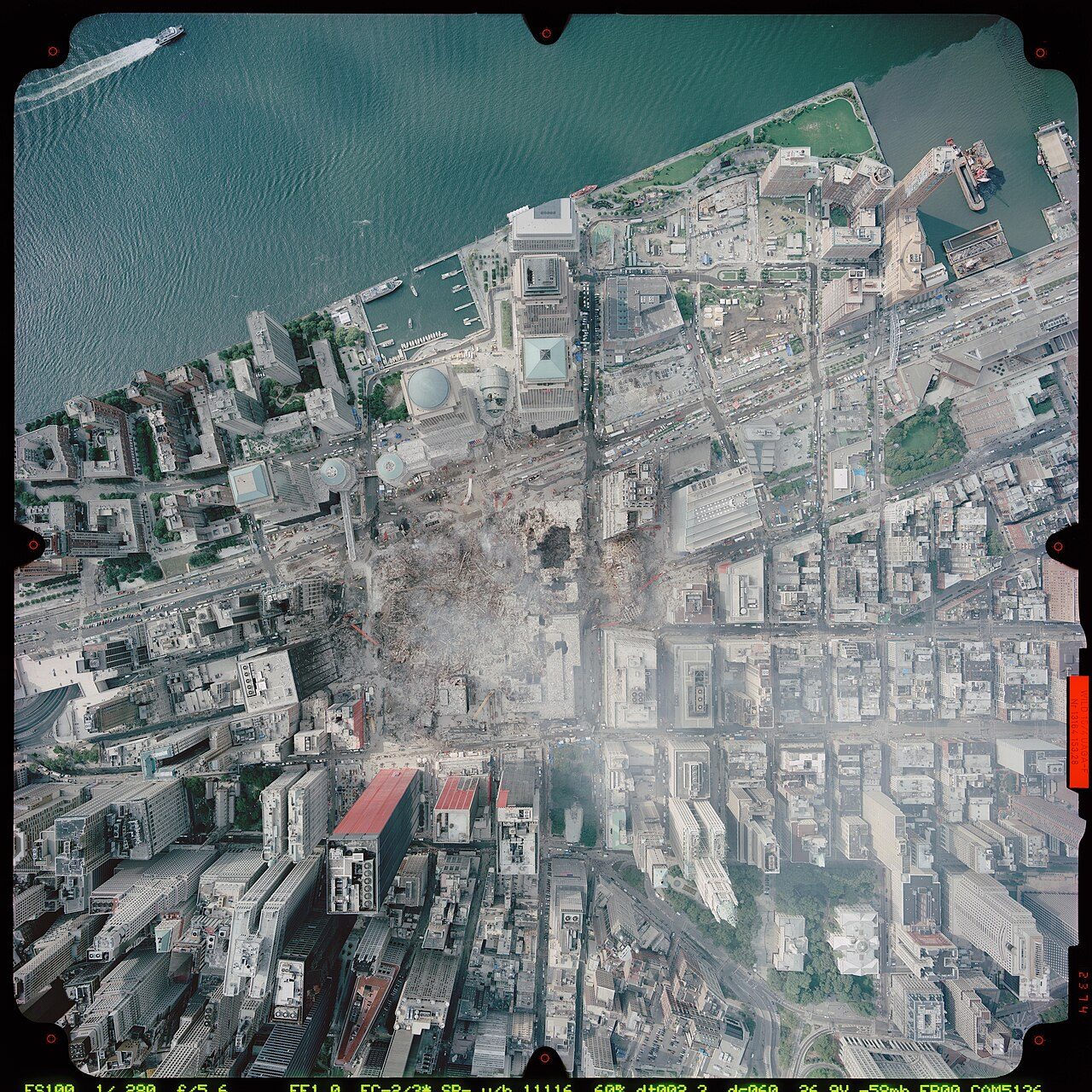
The towers the hijackers destroyed had been officially opened in 1973, then the tallest buildings in the world; the aerial photograph taken by a NOAA aircraft on 23 September, twelve days after the attacks, shows their remains amid the damaged buildings of lower Manhattan. The Pentagon — the third target — had itself been begun on this same date exactly sixty years earlier: ground was broken for the building on 11 September 1941, and the damaged section struck by Flight 77 had only just been renovated.
The response came in twenty-six days. The Taliban, who ruled Afghanistan, refused to surrender Osama bin Laden, and on the night of 7 October American and British forces bombed Taliban and al-Qaeda targets across the country, opening the war in Afghanistan. The same aircraft that bombed targets on the first night also dropped thousands of packaged food rations for Afghan civilians — the bombing campaign and a humanitarian air drop deliberately flown together from the first hours. On 8 October President George W. Bush created the Office of Homeland Security. The Taliban regime fell within two months — Northern Alliance forces entered Kabul on 13 November as the Taliban fled — but the war lasted twenty years.
The year had begun in a different world. On 9 January Apple introduced iTunes, reorganising the music industry around digital downloads; on 15 January Wikipedia launched, a free encyclopedia anyone can edit, which grew into the largest reference work ever made. The Russian space station Mir, in orbit for fifteen years, burned up over the South Pacific on 23 March, and on 23 October Apple introduced the iPod, promising 1,000 songs in your pocket. On 2 December Enron filed for bankruptcy protection, then the largest corporate failure in American history, and on 11 December China formally joined the World Trade Organization — the globalised, networked century arriving even as its security order collapsed.
Timeline of 2001
- 9 January
Apple introduces iTunes, the software that reorganises the music industry around digital downloads.
- 15 January
Wikipedia launches — a free encyclopedia anyone can edit, which grows into the largest reference work ever made.
- 26 January
An earthquake of magnitude 7.7 strikes Gujarat, India, devastating Bhuj and killing an estimated 20,000 people.
- 18 February
FBI agent Robert Hanssen is arrested after more than twenty years of spying for Moscow.
- 23 March
The Russian space station Mir burns up over the South Pacific in a controlled re-entry after fifteen years in orbit.
- 11 June
Timothy McVeigh is executed by lethal injection for the 1995 Oklahoma City bombing, which killed 168 people.
- 11 September
Al-Qaeda hijackers crash airliners into the World Trade Center and the Pentagon; a fourth plane falls in Pennsylvania.
- 7 October
American and British forces begin air strikes on Taliban and al-Qaeda targets in Afghanistan.
- 8 October
President George W. Bush creates the Office of Homeland Security in response to the September 11 attacks.
- 23 October
Apple introduces the iPod, a pocket-sized player promising '1,000 songs in your pocket'.
- 12 November
American Airlines Flight 587 crashes into a Queens neighbourhood shortly after leaving New York, killing 265 people.
- 13 November
Northern Alliance forces enter Kabul as the Taliban flee the Afghan capital.
- 2 December
Enron files for bankruptcy protection, then the largest corporate failure in American history.
- 11 December
China formally joins the World Trade Organization, binding the world's most populous country into the global trading system.
Why 2001 still matters
September 11 divided the century the way few single days have. The attacks killed 2,977 people, destroyed the World Trade Center, and brought a superpower to war within a month; the Office of Homeland Security created in October was the first piece of a security architecture that still shapes travel, surveillance and law. The war in Afghanistan, opened on 7 October with bombing and food drops flown together, outlasted the century's first two decades and ended where it began, with the Taliban back in Kabul — the longest war in American history, begun in this year's autumn.
Yet the year's other launches quietly built the world that now remembers it. Wikipedia, started in January as an editable encyclopedia, became the largest reference work ever made and the first draft of almost every historical question — including, in time, accounts of 2001 itself. iTunes in January and the iPod in October reorganised music around downloads and pockets, and China's entry into the World Trade Organization in December bound the world's most populous country into the global trading system, accelerating the economic shift of the following decades.
Enron's collapse in December, then America's largest corporate failure, closed the year with a second kind of warning — about accounting, energy markets and trust — while the Leaning Tower of Pisa reopened on 15 December after eleven years of stabilisation, a small proof that some falls can be arrested. 2001 is therefore two years in one: the last year of the old security world, ending on a September morning, and the first year of the networked one that has documented everything since. On 5 October Barry Bonds hit his 71st and 72nd home runs of the season, breaking Mark McGwire's single-season record — a reminder, two days before the bombing of Afghanistan began, of the ordinary autumn the attacks had interrupted.
2001 on The History Trail
Two featured stories belong to 2001 on The History Trail, and they are the year's whole story in miniature.
- September 11 in History — The September 11 attacks on the World Trade Center and the Pentagon.
- October 7 in History — The U.S.-led attack on Afghanistan begins, twenty-six days later.
- January 15 in History — Wikipedia launches, a free encyclopedia anyone can edit.
- October 23 in History — Apple introduces the iPod, promising 1,000 songs in your pocket.
- December 11 in History — China formally joins the World Trade Organization.
- November 16 in History — Harry Potter and the Philosopher's Stone opens in cinemas.
Sources
- Encyclopaedia Britannica — On This Day: January 9
- HISTORY — What Happened on January 15
- Encyclopaedia Britannica — On This Day: January 26
- Encyclopaedia Britannica — September 11 attacks
- HISTORY — U.S.-Led Attack on Afghanistan Begins
- George W. Bush White House Archives — Statement of 7 October 2001
- Encyclopaedia Britannica — On This Day: October 23
The facts on this page were checked against these sources on 19 November 2026. The History Trail's permanent pages are researched and written for this site; the live profiles elsewhere on The History Trail are assembled automatically from Wikipedia and Wikidata.
About the Author
Researched and written by the The History Trail Editorial Team — the accountable editorial function behind this site's permanent story pages. The team works from the published sources cited on each page; it does not invent historians, reviewers or credentials, and it corrects errors openly.
Fact Check
Every load-bearing fact on this page traces to one of the sources listed above, and significant claims link to their source in the text. Our checking method is described on the methodology page; errors can be reported via the corrections page.
Sources & Citations
Cite this page as: The History Trail Editorial Team, The History Trail — this article's title, publication and update dates are shown beneath its headline. The full source list appears under Sources above; the site's source standards are on the sources page.