
On This Day
October 23 in History
On 23 October 1956 the people of Budapest rose against Communist rule and Soviet domination, beginning the Hungarian Revolution — crushed within weeks, but never forgotten. October 23 is also the day the first National Women's Rights Convention met, the Beirut barracks were bombed, the iPod was unveiled, and Pelé was born.
Choose another date: open the On This Day calendar to browse events, births and deaths for any day of the year.
At a Glance
- The trigger
- On 23 October 1956 a student protest in Budapest against Communist rule and Soviet domination turned into a national uprising
- The first response
- Soviet troops entered Budapest on 24 October at the Hungarian government's request; reformer Imre Nagy became prime minister
- The false dawn
- A ceasefire on 28 October and Soviet withdrawal from the capital raised hopes of free elections and neutrality
- The crushing
- Soviet forces returned in force in early November; an estimated 2,500 Hungarians and 700 Soviet soldiers died
- The aftermath
- Some 200,000 Hungarians fled abroad; over 300 participants were later executed, including Nagy in 1958
Events on this day
- 1739Britain declares war on Spain, opening the War of Jenkins' Ear — named for a British captain whose ear, allegedly cut off by the Spanish in 1731, had been exhibited to Parliament.
- 1850The first National Women's Rights Convention opens in Worcester, Massachusetts, drawing more than a thousand delegates from eleven states.
- 1941Walt Disney's Dumbo, the story of a flying baby elephant, is released in American cinemas.
- 1942The Second Battle of El Alamein begins in Egypt, as Montgomery's Eighth Army opens its offensive against Rommel's Afrika Korps.
- 1956Hungary rises in revolt against Communist rule and Soviet domination; the uprising is crushed within weeks — the featured story above.
- 1958Boris Pasternak is awarded the Nobel Prize in Literature for Doctor Zhivago; Soviet pressure soon forces him to refuse it.
- 1983Two truck bombs destroy the barracks of U.S. and French peacekeepers in Beirut, killing 241 American servicemen and 58 French troops.
- 1989An explosion at the Phillips Petroleum plant in Pasadena, Texas, kills 23 workers.
- 1998Britney Spears releases her debut single, '…Baby One More Time', which becomes one of the best-selling singles of all time.
- 2001Apple introduces the iPod, a pocket-sized player promising '1,000 songs in your pocket'.
- 2002Armed Chechen rebels seize a Moscow theatre during a musical performance, taking some 800 people hostage.
Born on this day
- 1925Johnny Carson — American television host who fronted The Tonight Show for three decades.
- 1940Pelé — Brazilian footballer, born Edson Arantes do Nascimento, three times a World Cup winner and the game's first global superstar.
- 1956Dwight Yoakam — American country singer and actor, a leader of the honky-tonk revival.
- 1959“Weird Al” Yankovic — American comedy musician famed for his song parodies.
Died on this day
- 42 BCMarcus Junius Brutus — Roman senator who helped assassinate Julius Caesar, dead by his own hand after defeat at the second battle of Philippi.
- 1915W. G. Grace — English cricketer, the dominant figure of the Victorian game, dead at 67.
- 1950Al Jolson — Lithuanian-born American singer and actor, star of The Jazz Singer, the first talking picture.
The featured story: Hungary rises against Soviet rule, 23 October 1956
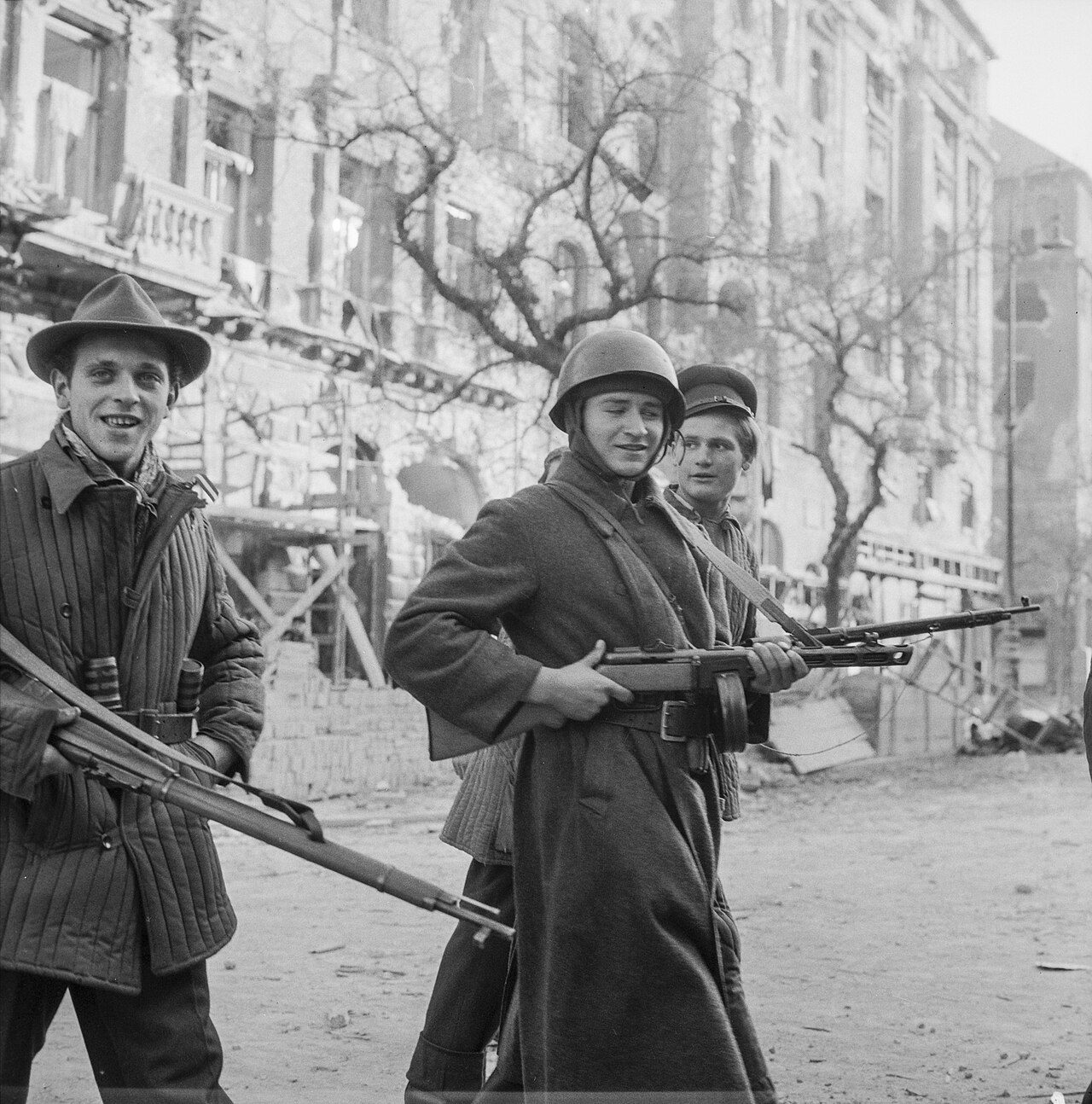
On 23 October 1956, the people of Budapest rose against their Communist government and its Soviet masters, beginning the Hungarian Revolution — the first great armed revolt against Soviet domination of Eastern Europe. The spark was struck in Moscow: earlier that year Nikita Khrushchev had denounced Stalin's crimes in his 'secret speech', and the admission loosened fear across the Soviet bloc. In Hungary, resentment of the hated security police, of censorship, shortages and the presence of Soviet troops had been building for a decade. When students marched through Budapest demanding reforms and the withdrawal of Soviet forces, crowds swelled behind them, and by evening the demonstration had become an uprising. Protesters toppled the enormous statue of Stalin and clashed with the security police; shots were fired, and the revolt turned to war.
The government of Ernő Gerő answered by calling in Soviet troops, who entered Budapest on 24 October. But the revolution would not be put down so easily. Imre Nagy, a reform Communist sidelined by the hardliners, was brought back as prime minister, and Hungarians — workers, students, soldiers who changed sides — fought tanks in the streets with rifles and petrol bombs. For a few astonishing days it seemed to work: a ceasefire was agreed on 28 October, Soviet forces pulled back from the capital, political prisoners were freed and Nagy promised free elections and Hungary's withdrawal from the Warsaw Pact. Hungary appeared to have won its freedom in twelve days.
It was an illusion. In early November the Soviet Union returned in overwhelming force, determined that no satellite state would be allowed to leave its camp. Budapest was bombarded and stormed, and the revolution was crushed in days of street fighting. About 2,500 Hungarians and some 700 Soviet soldiers are estimated to have died. Around 200,000 Hungarians fled the country, most of them across the border into Austria. János Kádár was installed as the head of a loyal government, and the reprisals that followed lasted years: more than 300 participants were executed, among them, in June 1958, Imre Nagy himself, hanged after a secret trial.
The revolution failed, and Hungary remained behind the Iron Curtain for another three decades. But 1956 exposed the truth that Soviet power in Eastern Europe rested on tanks, and it became a permanent symbol of Hungarian nationhood. When Hungary finally broke with communism in 1989, Nagy was ceremonially reburied as a national hero — and 23 October, the day the students marched, is now Hungary's national holiday, honouring both the revolution and the republic proclaimed on the same date in 1989.
Why this date matters
October 23 has repeatedly been a day when people test the limits of the powerful. In 1850 a thousand delegates gathered in Worcester to demand rights for women that the law denied them; in 1956 Budapest's students demanded freedom from an empire and paid for it in blood. The date also bookends the Cold War's cruelties — Pasternak crushed for a novel in 1958, peacekeepers murdered in Beirut in 1983 — and yet it keeps a lighter register too: Dumbo took flight on it, the iPod was unveiled on it, and the world's greatest footballer was born on it. Defiance, in many costumes, is this day's recurring theme.
Sources
- Encyclopaedia Britannica — On This Day: October 23
- HISTORY — What Happened on October 23
- Encyclopaedia Britannica — Hungarian Revolution of 1956
- Wikipedia — W. G. Grace
- Wikimedia — On This Day feed: October 23
The facts on this page were checked against these sources on 19 November 2026. The History Trail's permanent pages are researched and written for this site; the live profiles elsewhere on The History Trail are assembled automatically from Wikipedia and Wikidata.
About the Author
Researched and written by the The History Trail Editorial Team — the accountable editorial function behind this site's permanent story pages. The team works from the published sources cited on each page; it does not invent historians, reviewers or credentials, and it corrects errors openly.
Fact Check
Every load-bearing fact on this page traces to one of the sources listed above, and significant claims link to their source in the text. Our checking method is described on the methodology page; errors can be reported via the corrections page.
Sources & Citations
Cite this page as: The History Trail Editorial Team, The History Trail — this article's title, publication and update dates are shown beneath its headline. The full source list appears under Sources above; the site's source standards are on the sources page.