
On This Day
December 11 in History
On 11 December 1936 the abdication of Edward VIII took effect: the king who had reigned for less than a year gave up the British throne to marry Wallis Simpson, an American divorcée, and his brother became George VI. December 11 is also the day Germany and Italy declared war on the United States, UNICEF was founded, and Apollo 17 made the last Apollo landing on the Moon.
Choose another date: open the On This Day calendar to browse events, births and deaths for any day of the year.
At a Glance
- Reign
- 20 January to 11 December 1936 — begun on the death of George V and ended the same year, one of the shortest British reigns
- Instrument signed
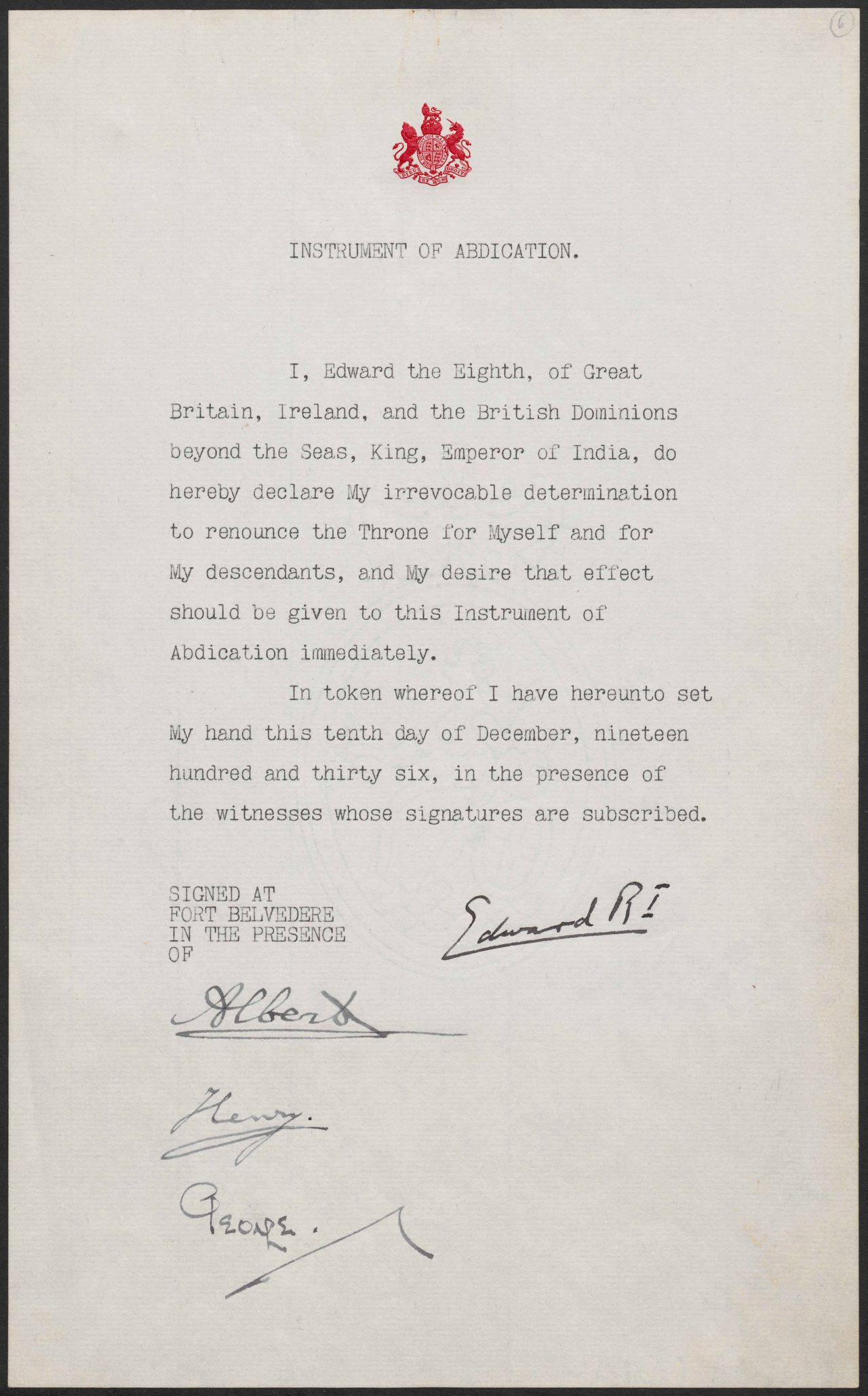
- 10 December 1936 at Fort Belvedere, witnessed by his three brothers
- Takes effect
- 11 December 1936, once Parliament had endorsed the instrument; Edward broadcast his farewell to the nation that evening
- His explanation
- 'I have found it impossible to carry the heavy burden of responsibility… without the help and support of the woman I love'
- Succeeded by
- His brother Albert, Duke of York, as George VI; Edward was created Duke of Windsor on 12 December 1936
- Marriage
- Edward married Wallis Simpson in France on 3 June 1937
- Unique in British history
- The only British sovereign ever to voluntarily resign the throne
Events on this day
- 1282Llywelyn ap Gruffudd, the last native prince of Wales, is killed at Cilmeri, ending Welsh resistance to Edward I of England.
- 1816Indiana is admitted to the Union as the 19th U.S. state.
- 1917British general Edmund Allenby enters Jerusalem on foot through the Jaffa Gate, two days after the Ottoman garrison surrendered the city.
- 1931The Statute of Westminster is enacted, granting full legislative independence to the self-governing dominions of the British Empire.
- 1936Edward VIII's abdication takes effect, the only voluntary surrender of the throne by a British sovereign — the featured story above.
- 1941Germany and Italy declare war on the United States, four days after the American declaration of war on Japan.
- 1946UNICEF, the United Nations Children's Fund, is founded to aid children in countries devastated by the Second World War.
- 1972Apollo 17 lands on the Moon, the sixth and final landing of the Apollo programme; no human has walked on the Moon since.
- 1978Thieves steal more than $5 million in cash and about $1 million in jewels from the Lufthansa cargo terminal at New York's JFK airport, then the largest cash robbery in U.S. history.
- 1994Russian forces enter Chechnya in an attempt to crush its independence movement, beginning the First Chechen War.
- 1997The Kyoto Protocol on climate change is adopted in Japan, committing industrialised countries to cut greenhouse-gas emissions.
- 2001China formally joins the World Trade Organization, binding the world's most populous country into the global trading system.
- 2008Financier Bernard Madoff is arrested in New York; his investment business is exposed as the largest Ponzi scheme in history.
Born on this day
- 1475Pope Leo X — Medici pope whose sale of indulgences helped provoke Martin Luther's Reformation.
- 1803Hector Berlioz — French composer of the Symphonie fantastique, a pioneer of Romantic orchestral music.
- 1843Robert Koch — German bacteriologist who identified the microbes behind tuberculosis and cholera and won the Nobel Prize.
- 1882Max Born — German physicist, a founder of quantum mechanics, whose statistical reading of the wave function won the Nobel Prize.
- 1911Naguib Mahfouz — Egyptian novelist, the first Arabic-language writer to win the Nobel Prize in Literature.
- 1918Aleksandr Solzhenitsyn — Russian writer whose works exposed the Soviet Gulag and who won the Nobel Prize in Literature.
- 1931Rita Moreno — Puerto Rican actress and singer, one of the few performers to win an Emmy, Grammy, Oscar and Tony.
Died on this day
- 1964Sam Cooke — American soul singer of 'A Change Is Gonna Come', shot dead in a Los Angeles motel at 33.
- 2012Galina Vishnevskaya — Russian soprano, one of the great operatic voices of the Soviet era.
- 2012Ravi Shankar — Indian sitar master who carried Indian classical music to the world and influenced the Beatles.
- 2021Anne Rice — American novelist whose Vampire Chronicles, beginning with Interview with the Vampire, revived Gothic fiction.
The featured story: Edward VIII's abdication takes effect, 11 December 1936
Edward VIII had been king for less than eleven months when his reign ended. He came to the throne on 20 January 1936, on the death of his father, George V, popular, unmarried and already determined to marry Wallis Simpson, an American who had been divorced once and was divorcing her second husband. To the British government, and to the Church of England of which the king was head, the match was impossible: a twice-divorced woman whose former husbands were still living could not become queen, and the dominion governments agreed. Through the autumn of 1936 the crisis deepened in private while the British press kept silent, until at the start of December the story broke and the country learned that its king intended to choose marriage over the crown.
Every compromise failed. Edward proposed a morganatic marriage, in which Simpson would be his wife but not queen; the cabinet and the dominions rejected it. On 10 December 1936, at Fort Belvedere, his home near Windsor, he signed the Instrument of Abdication, witnessed by his three brothers. The document could not take effect on his signature alone: an abdication had to be enacted by Parliament. On 11 December Parliament endorsed the instrument, Edward gave his royal assent to the act as his final act of state, and the reign was over. That evening he broadcast to the nation and the empire from Windsor Castle, explaining himself in words that became famous: 'I have found it impossible to carry the heavy burden of responsibility and to discharge my duties as King as I would wish to do without the help and support of the woman I love.'
He left Britain that night, a king turned private citizen in a single day. His brother Albert, Duke of York, succeeded him as George VI, a shy man with a stammer who had never expected the throne. Edward was created Duke of Windsor on 12 December 1936, and after Simpson's divorce became final he married her in France on 3 June 1937, at the Château de Candé. No member of the royal family attended. The couple lived most of the rest of their lives in exile in France, and Edward never held public office again, apart from a wartime posting as governor of the Bahamas.
The abdication remains unique in British history: Edward VIII is the only British sovereign ever to have voluntarily resigned the throne. It reshaped the monarchy he left behind. The institution survived by demonstrating that it could discard a king who would not accept its constraints, and George VI's dutiful, unglamorous reign — followed by that of his daughter, Elizabeth II — rebuilt its standing on exactly the qualities Edward had lacked. The crisis also left a permanent mark on the constitution: since 1936, no British monarch's marriage has been a private matter, and the events of that December are still the monarchy's standing lesson in what happens when duty and inclination collide.
Why this date matters
December 11 is a day on which old orders hand over to new ones. It begins with the death of the last native prince of Wales in 1282 and runs through Allenby walking into Jerusalem in 1917 and the Statute of Westminster loosening the bonds of empire in 1931. Its centre is the strangest handover of all: a king who gave his throne away for love, on the same date that, five years later, widened a world war, and that later still saw humanity's last Moon landing and the founding of the world's children's fund. Power on this date is rarely seized; it is surrendered, transferred or laid down.
Sources
- Encyclopaedia Britannica — On This Day: December 11
- HISTORY — This Day in History: December 11
- Encyclopaedia Britannica — Edward VIII
- Wikipedia — December 11
The facts on this page were checked against these sources on 19 November 2026. The History Trail's permanent pages are researched and written for this site; the live profiles elsewhere on The History Trail are assembled automatically from Wikipedia and Wikidata.
About the Author
Researched and written by the The History Trail Editorial Team — the accountable editorial function behind this site's permanent story pages. The team works from the published sources cited on each page; it does not invent historians, reviewers or credentials, and it corrects errors openly.
Fact Check
Every load-bearing fact on this page traces to one of the sources listed above, and significant claims link to their source in the text. Our checking method is described on the methodology page; errors can be reported via the corrections page.
Sources & Citations
Cite this page as: The History Trail Editorial Team, The History Trail — this article's title, publication and update dates are shown beneath its headline. The full source list appears under Sources above; the site's source standards are on the sources page.