
On This Day
September 11 in History
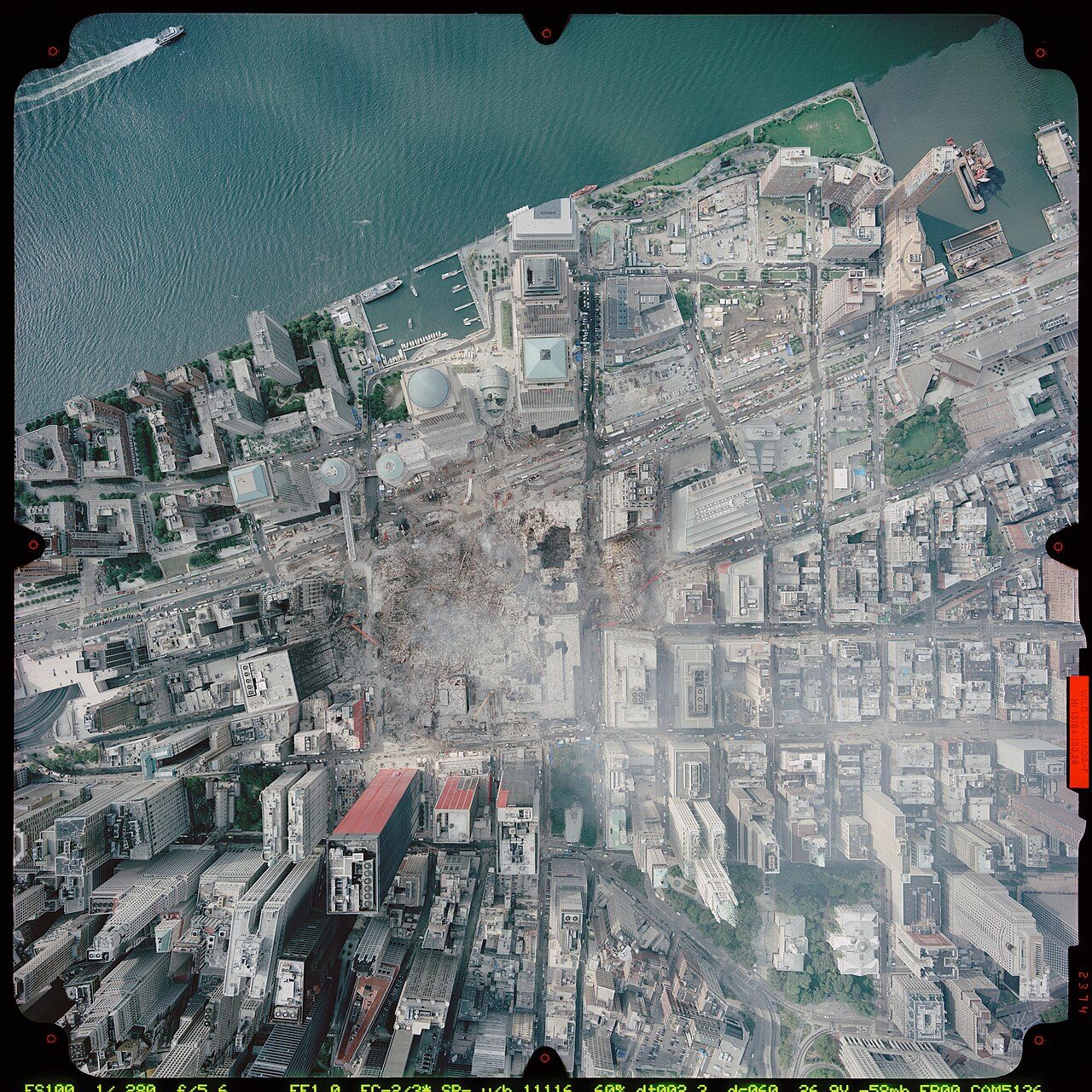
On the morning of 11 September 2001, 19 al-Qaeda hijackers seized four American airliners and flew two of them into the twin towers of the World Trade Center in New York and a third into the Pentagon; the fourth crashed in Pennsylvania after its passengers fought back. September 11 is also the date of the Battle of Plattsburgh, the Chilean coup of 1973 and Pete Rose's record-breaking hit.
Choose another date: open the On This Day calendar to browse events, births and deaths for any day of the year.
At a Glance
- The date
- Tuesday, 11 September 2001 — four US airliners hijacked in a coordinated al-Qaeda operation
- The targets
- The twin towers of the World Trade Center in New York and the Pentagon near Washington, D.C.
- The fourth plane
- United Airlines Flight 93 crashed near Shanksville, Pennsylvania, after passengers resisted the hijackers
- The toll
- The attacks killed 2,977 victims, a figure officially put by the 9/11 Commission and the memorial authorities, excluding the 19 hijackers
- The first identified victim
- Father Mychal Judge, a New York Fire Department chaplain, killed by falling debris when the South Tower collapsed
- The response
- The United States invoked collective self-defence, and within a month led an invasion of Afghanistan, whose Taliban rulers had sheltered al-Qaeda
Events on this day
- 1649Oliver Cromwell's army storms Drogheda in Ireland, massacring much of its garrison and many civilians in one of the most notorious episodes of the Cromwellian conquest.
- 1697At the Battle of Zenta, Prince Eugene of Savoy destroys an Ottoman army crossing the Tisza River, a victory that breaks Ottoman power in Hungary.
- 1777British forces under General William Howe defeat George Washington's army at the Battle of Brandywine in Pennsylvania, opening the road to Philadelphia.
- 1812Russian settlers dedicate Fort Ross on the coast north of San Francisco, Russia's first stronghold in California.
- 1814An American fleet under Thomas Macdonough defeats a British squadron on Lake Champlain at Plattsburgh, forcing a British invasion force to retreat into Canada.
- 1851In the Christiana Resistance in Pennsylvania, Black residents and white abolitionists fight off a Maryland slaveholder's posse seeking four fugitive enslaved men.
- 1857In the Mountain Meadows Massacre in Utah, Mormon militiamen and Paiute allies murder some 120 emigrants in a wagon train bound for California.
- 1973Chile's armed forces overthrow President Salvador Allende, who dies as the presidential palace in Santiago is bombed; General Augusto Pinochet takes power.
- 1985Pete Rose of the Cincinnati Reds collects his 4,192nd career hit, breaking Ty Cobb's long-standing Major League Baseball record.
- 2001Al-Qaeda hijackers crash airliners into the World Trade Center and the Pentagon, and a fourth plane falls in Pennsylvania — the featured story above.
Born on this day
- 1862O. Henry — American short-story writer, born William Sidney Porter, master of the twist ending in tales such as The Gift of the Magi.
- 1885D. H. Lawrence — English novelist and poet, author of Sons and Lovers and Lady Chatterley's Lover.
- 1917Ferdinand Marcos — president of the Philippines from 1965 to 1986, whose rule ended in the People Power Revolution.
- 1945Franz Beckenbauer — German footballer 'Der Kaiser', who won the World Cup as both captain and coach.
- 1978Ed Reed — American football safety, a Super Bowl winner with the Baltimore Ravens and one of the game's great ball hawks.
Died on this day
- 1823David Ricardo — English political economist, one of the founders of classical economics and the theory of comparative advantage.
- 1948Muhammad Ali Jinnah — founder of Pakistan and its first governor-general, dead a year after the state he created came into being.
- 1971Nikita Khrushchev — former leader of the Soviet Union, architect of de-Stalinisation and a central figure of the early Cold War.
- 1973Salvador Allende — president of Chile, who died in the presidential palace in Santiago during the military coup that overthrew him.
- 2001Mychal Judge — New York Fire Department chaplain, the first identified casualty of the September 11 attacks.
The featured story: the September 11 attacks, 11 September 2001
On a clear Tuesday morning, four American passenger jets were hijacked almost simultaneously by teams of al-Qaeda operatives who had trained as pilots in the United States. At 8:46 a.m. American Airlines Flight 11 struck the North Tower of the World Trade Center in New York. Seventeen minutes later United Airlines Flight 175 hit the South Tower, live on television. A third aircraft, American Airlines Flight 77, was flown into the Pentagon, the headquarters of the US Department of Defense, at 9:37. The fourth, United Flight 93, was apparently aimed at Washington as well, but its passengers, alerted by phone calls to what had already happened, stormed the cockpit; the plane crashed in a field near Shanksville, Pennsylvania, at 10:03.
The South Tower, though struck second, collapsed first, at 9:59 a.m., and the North Tower followed at 10:28. Between the impacts and the collapses, thousands of office workers, firefighters, police officers and passers-by were caught in the towers and the streets below. The attacks killed 2,977 victims — a total officially put by the National September 11 Memorial and the 9/11 Commission, and one that excludes the 19 hijackers. Among the dead were 343 New York firefighters. The first identified casualty, as Britannica records, was Father Mychal Judge, the Fire Department's Catholic chaplain, who had rushed to the scene after the first impact and was killed by debris from the South Tower's collapse; firefighters carried his body out of the rubble, in one of the day's defining images.
Responsibility was traced within days to al-Qaeda, the network led by Osama bin Laden from sanctuary in Afghanistan. The United States demanded that the Taliban regime hand bin Laden over; when it refused, a US-led coalition invaded Afghanistan in October 2001 and drove the Taliban from power, though bin Laden himself escaped and was not found and killed until 2011, in Pakistan. At home, the attacks produced the Department of Homeland Security, the Patriot Act, a new intelligence structure and a generation of airport security. NATO invoked its Article 5 collective-defence clause for the first time in its history.
The date has since been fixed in American memory as Patriot Day, and the site of the towers is now the National September 11 Memorial, its two reflecting pools set in the footprints of the fallen buildings. The attacks also reframed older anniversaries on this date: 11 September had already been the day of a famous American naval victory in 1814 and of the Chilean military coup in 1973, but after 2001 the date belongs, in the world's mind, to a single morning.
Why this date matters
September 11 was a consequential date long before 2001: Eugene's victory at Zenta in 1697 redrew the map of Hungary, Macdonough's win on Lake Champlain in 1814 helped end a war, and in 1973 the date brought a coup in Chile whose shadow still falls across that country. But the hijackings of 2001 were of another order — a single morning that killed nearly three thousand people, brought down the tallest buildings in New York and set the course of the following two decades. Few dates carry their meaning so completely in one event; September 11 is remembered first, and overwhelmingly, for 2001.
Sources
- Encyclopaedia Britannica — On This Day: September 11
- HISTORY — This Day in History: September 11
- Encyclopaedia Britannica — September 11 attacks
- HISTORY — Nikita Khrushchev dies (September 11, 1971)
The facts on this page were checked against these sources on 19 November 2026. The History Trail's permanent pages are researched and written for this site; the live profiles elsewhere on The History Trail are assembled automatically from Wikipedia and Wikidata.
About the Author
Researched and written by the The History Trail Editorial Team — the accountable editorial function behind this site's permanent story pages. The team works from the published sources cited on each page; it does not invent historians, reviewers or credentials, and it corrects errors openly.
Fact Check
Every load-bearing fact on this page traces to one of the sources listed above, and significant claims link to their source in the text. Our checking method is described on the methodology page; errors can be reported via the corrections page.
Sources & Citations
Cite this page as: The History Trail Editorial Team, The History Trail — this article's title, publication and update dates are shown beneath its headline. The full source list appears under Sources above; the site's source standards are on the sources page.