
Trails
The Speed Trail
Seven machines, two centuries, one obsession: follow the bicycle, the locomotive, the first people's car, the first aeroplane, a wartime fighter, a supersonic airliner and a Moon rocket.
The trail at a glance
Every stop, in chronological order:
Why Speed Shrinks the World
Speed is the oldest technology race of all, because it shrinks the world. Each generation in this trail moved a person, a message, a cargo or a crew faster than the one before — and journeys that took days collapsed into hours, then minutes, then a climb out of the atmosphere altogether. Human muscle gives way to steam, petrol, piston engines at their peak, jet travel at twice the speed of sound, and finally a rocket that carried people to the Moon.
The trail is not a straight line of records. Some machines were fastest because they were powerful; others because they were cheap enough to be everywhere, which is its own kind of speed — the speed at which a whole society moves.
Seven Stops, in Chronological Order
- 1829
Stephenson's Rocket and the Steam Locomotive
Steam took speed off the road and put it on rails, where it could scale. The emblematic machine is Robert Stephenson's Rocket, built in Newcastle in 1829 for the Rainhill Trials of the Liverpool and Manchester Railway. Rocket combined a multi-tube boiler, a separate firebox and a blast pipe using exhaust steam to draw the fire — innovations that let it raise steam faster than any rival. It alone completed the trials, reaching 30 mph: the first time crowds could travel faster than a galloping horse, to a timetable.
Read the full story of Stephenson's Rocket and the Steam Locomotive →
- 1885
The Rover Safety Bicycle
The bicycle is where personal speed begins. Early machines like the penny-farthing were fast but dangerous, perched high above a huge front wheel. In 1885 John Kemp Starley of Coventry produced the Rover 'Safety' bicycle: a diamond frame, a chain driving the rear wheel, and wheels of equal size that put the rider close to the ground. The Science Museum notes it carried all the basic features of the modern bicycle. A rider could suddenly travel several times faster than walking, on a machine they owned outright.
- 1903
The Wright Flyer at Kitty Hawk
Flight added a dimension to speed: the straight line. The Wright Flyer's numbers sound modest — a 12-horsepower engine, four flights on 17 December 1903, the longest covering 852 feet in 59 seconds — but the Smithsonian calls them the world's first successful flights of a powered, heavier-than-air machine with a pilot aboard. The Wrights' real contribution was control: the three-axis system that let a pilot command the machine rather than merely ride it. Speed in the air began not with power, but with the ability to steer.
- 1908
Ford Model T, the Car for the Multitude
The Model T's contribution was not velocity but velocity of adoption. Its 20-horsepower engine managed about 40 mph on a good road, a figure The Henry Ford records without embarrassment, because the revolution was elsewhere: a moving assembly line from 1913 that cut the price from $850 to under $300 and put over 15 million cars on the road. Speed stopped being a railway company's product and became a private possession — and the average speed of ordinary life rose further than any record attempt achieved.
Read the full story of Ford Model T, the Car for the Multitude →
- 1936
Supermarine Spitfire
Within one generation the aeroplane went from 59-second hops to the Spitfire, whose Merlin-engined first marks exceeded 360 mph. Designed by R. J. Mitchell from a lineage of racing seaplanes, it first flew on 5 March 1936 and entered RAF service in 1938; by the Battle of Britain in 1940 its speed and climb were matters of national survival. Development never stopped — later engines more than doubled the original 1,030 horsepower — and over 20,000 were built. Speed had become strategic, measured in minutes to intercept.
- 1969
Saturn V, the Moon Rocket
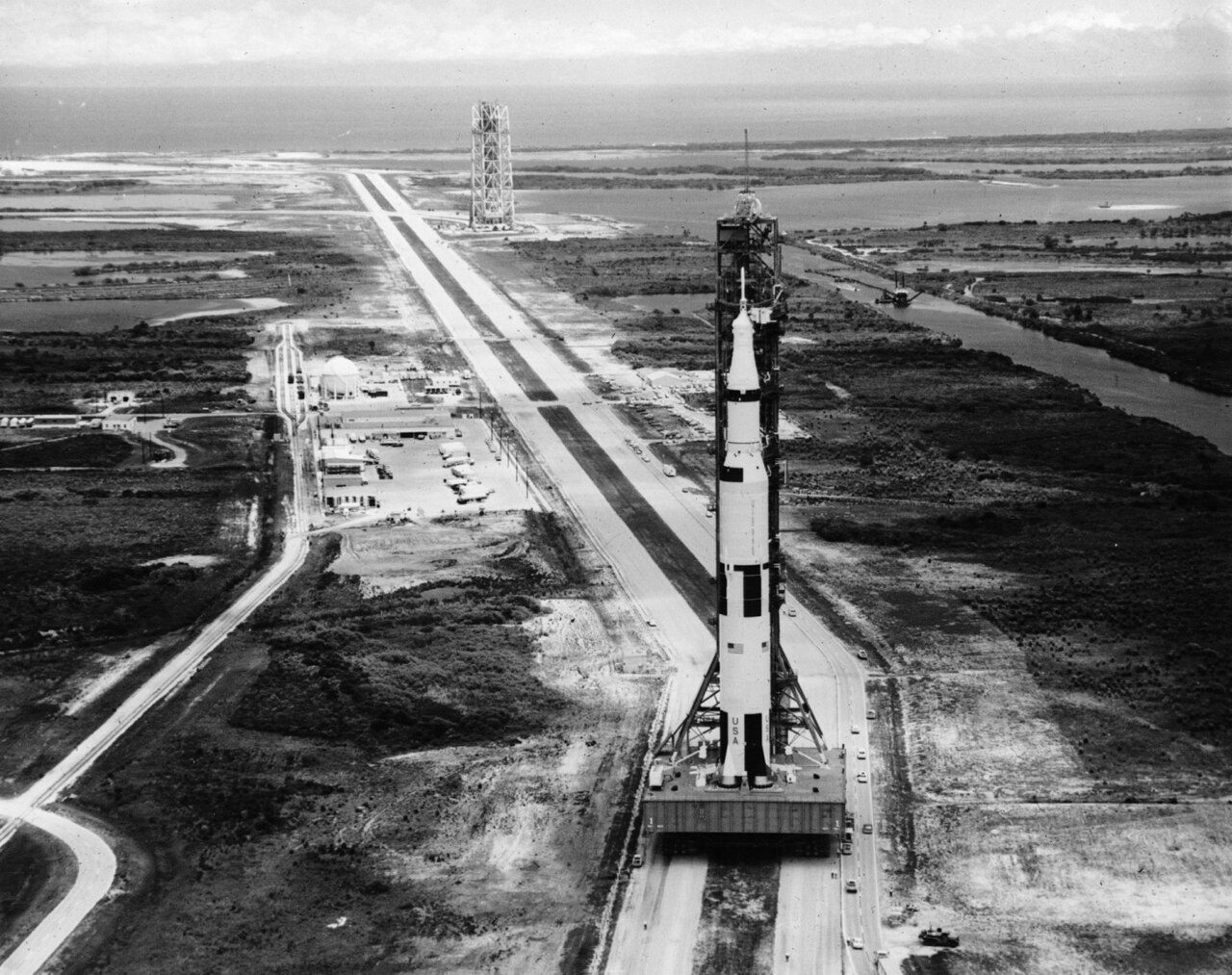
The trail ends where speed escapes the atmosphere. NASA's Saturn V stood 363 feet tall and generated 7.6 million pounds of thrust at launch — more power, NASA notes, than 85 Hoover Dams. First launched uncrewed as Apollo 4 on 9 November 1967, it flew thirteen times between 1967 and 1973 without losing a crew or payload; nine flights carried twenty-four astronauts towards the Moon, Apollo 11 departing on 16 July 1969. After Saturn V, the question was no longer how fast humans could travel, but how far they would go.
- 1976
Concorde, the Supersonic Airliner
Concorde turned wartime speed into a scheduled passenger service. Developed jointly by Britain and France, it first flew on 2 March 1969 and entered service on 21 January 1976, cruising at Mach 2.04 — about 1,350 mph — at up to 60,000 feet. The Design Museum records its fastest Atlantic crossing: New York to London in 2 hours, 52 minutes and 59 seconds, on 7 February 1996. Only twenty were built, fourteen entering airline service. When Concorde retired in 2003, commercial aviation became slower than it had been in 1976.
What the trail shows
Read together, these stops describe two kinds of progress. The first is raw performance: 30 mph at Rainhill, 362 mph over Kent, Mach 2 over the Atlantic. The second is distribution: the bicycle and the Model T changed more lives than Concorde and Saturn V combined, because they put speed into millions of hands rather than a few hundred seats.
Twice on this trail, speed went backwards: Concorde's retirement left airliners slower than in 1976, and no crewed vehicle has travelled as far since the 1970s. Speed is not a ratchet. It lasts only as long as societies keep deciding it is worth its price — less a ladder, in the end, than a series of choices.
Sources
- Science Museum Group Collection — Rover 'Safety' Bicycle, 1885
- Science Museum — 3D scan reveals intricate detail of iconic locomotive (Stephenson's Rocket)
- The Henry Ford — Ford's Model T: A Car for the Great Multitude
- Smithsonian National Air and Space Museum — 1903 Wright Flyer
- Design Museum — Concorde
- NASA — What Was the Saturn V?
- Royal Air Force Museum — Supermarine Spitfire Mk I K9942 individual history
The facts on this page were checked against these sources on 18 November 2026. The History Trail's permanent pages are researched and written for this site; the live profiles elsewhere on The History Trail are assembled automatically from Wikipedia and Wikidata.
About the Author
Researched and written by the The History Trail Editorial Team — the accountable editorial function behind this site's permanent story pages. The team works from the published sources cited on each page; it does not invent historians, reviewers or credentials, and it corrects errors openly.
Fact Check
Every load-bearing fact on this page traces to one of the sources listed above, and significant claims link to their source in the text. Our checking method is described on the methodology page; errors can be reported via the corrections page.
Sources & Citations
Cite this page as: The History Trail Editorial Team, The History Trail — this article's title, publication and update dates are shown beneath its headline. The full source list appears under Sources above; the site's source standards are on the sources page.