
Years
1991 in History
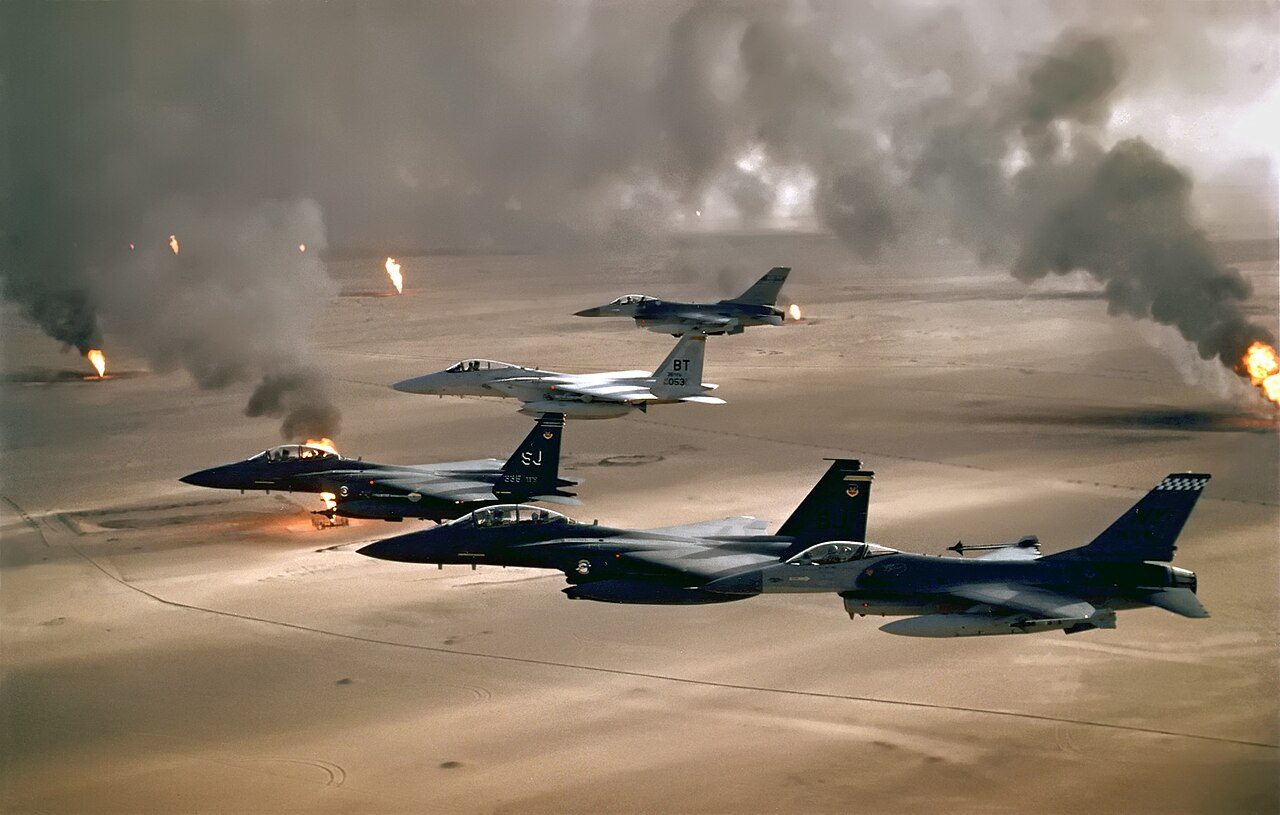
1991 is remembered for the end of the state that had defined the century: after a failed hardline coup in August, the republics declared independence one by one, the Belovezha Accords declared the Soviet Union had ceased to exist, and on 26 December the Supreme Soviet formally dissolved the USSR. The year had opened with the Gulf War, as a coalition liberated Kuwait in a hundred-hour ground campaign.
At a Glance
- Defining event
- The Soviet Union is dissolved, 26 December, completing its end begun by the republics' declarations
- War
- Operation Desert Storm begins 16 January; the hundred-hour ground campaign liberates Kuwait from 24 February
- Coup
- Soviet hardliners detain Gorbachev, 19 August; the coup collapses in three days
- The Web
- Tim Berners-Lee makes the World Wide Web publicly available, 6 August
- Wars begin
- Yugoslav forces move into Slovenia, 27 June, beginning Yugoslavia's disintegration
- Culture
- Nirvana release Nevermind; Freddie Mercury dies on 24 November, a day after confirming his illness
The defining story: the Soviet Union dissolves
The year opened with the first war of the post-Cold War world. Iraq had invaded Kuwait in August 1990 and declared it its nineteenth province, and over five months American and allied forces poured into Saudi Arabia under Operation Desert Shield while the United Nations set a deadline: Iraq must be out of Kuwait by 15 January 1991. As the deadline expired, on 16 January by the clock in Washington — the early hours of 17 January in Baghdad — a coalition of more than thirty nations opened Operation Desert Storm, a vast air campaign watched live on television around the world. The ground offensive began on 24 February, the hundred-hour land campaign that liberated Kuwait; retreating Iraqi forces set fire to Kuwait's oil wells, more than 600 of them by the Kuwait Petroleum Company's count, and the last was not capped until November.
In Moscow the centre was already failing. On 12 June Boris Yeltsin was elected president of the Russian republic, the first democratically chosen leader in Russia's history — a rival power inside the Soviet state itself. On 19 August, with a new union treaty about to be signed, Soviet hardliners announced that Mikhail Gorbachev had been removed from power, beginning the August Coup. It collapsed in three days, fatally weakening the Soviet Union and destroying what authority Gorbachev had left; Yeltsin, who had defied the tanks, emerged as the real power. On 29 August the Soviet parliament suspended the Communist Party itself.
Then the republics walked out, one declaration at a time. Latvia declared its full independence restored on 21 August, Ukraine declared independence on 24 August — the decisive step — and Moldova, Kyrgyzstan and Uzbekistan followed within the month, with Turkmenistan in October. Leningrad voted to restore its original name, Saint Petersburg, on 6 September. On 8 December the leaders of Russia, Ukraine and Belarus met in a Belarusian forest lodge and signed the Belovezha Accords, declaring that the Soviet Union 'has ceased to exist' and founding the Commonwealth of Independent States in its place.
On 26 December the Supreme Soviet formally dissolved the Union of Soviet Socialist Republics, completing the end begun by the republics' declarations, and on 31 December the remaining institutions of the Soviet Union ceased functioning as the state formally ended. The Cold War — the open yet restricted rivalry that from 1947 had organised almost everything in international life, divided Europe with a wall and put men on the Moon — was over, ended not in battle but in paperwork, forty-four years after it began. The same year, almost unnoticed, on 6 August Tim Berners-Lee made the World Wide Web publicly available: the next era announced itself in the old one's final summer.
Timeline of 1991
- 16 January
Operation Desert Storm begins: the coalition air campaign opens the Gulf War as the UN deadline expires.
- 24 February
The coalition ground offensive begins, opening the hundred-hour land campaign that liberates Kuwait.
- 14 March
The Birmingham Six are freed after 16 years in prison, their convictions quashed as unsafe.
- 31 March
The Warsaw Pact's military organisation is dissolved at Prague, closing the alliance that faced NATO through the Cold War.
- 29 April
A catastrophic cyclone strikes Bangladesh, killing an estimated 138,000 people.
- 21 May
Former Indian prime minister Rajiv Gandhi is assassinated by a suicide bomber while campaigning in Tamil Nadu.
- 12 June
Boris Yeltsin is elected president of the Russian republic, the first democratically chosen leader in Russia's history.
- 27 June
Yugoslav forces move into Slovenia, beginning the Ten-Day War, the first conflict of Yugoslavia's disintegration.
- 6 August
Tim Berners-Lee makes the World Wide Web publicly available.
- 19 August
Soviet hardliners announce Gorbachev's removal, beginning the August Coup.
- 21 August
The attempted coup collapses in Moscow after three days; Latvia declares its full independence restored.
- 24 August
Ukraine declares independence from the Soviet Union, a decisive step in the USSR's dissolution.
- 8 December
Russia, Ukraine and Belarus sign the Belovezha Accords, declaring the Soviet Union has ceased to exist.
- 26 December
The Supreme Soviet formally dissolves the Union of Soviet Socialist Republics.
Why 1991 still matters
The dissolution of the Soviet Union is the century's great peaceful ending — and its most consequential loose end. Fifteen new states emerged from a nuclear superpower without a general war, the Warsaw Pact dissolved itself in March, and the Cold War's alliance system closed down on both sides. But the borders, debts, arsenals and grievances of the USSR were inherited, not settled, and the wars of Yugoslavia's disintegration — begun in Slovenia in June 1991, and at Vukovar, captured after an 87-day siege in November — showed in Europe itself how violent the post-Cold War settlement could turn.
The Gulf War set the template and the warning for the new order: a broad coalition, a United Nations mandate, a war watched live on television, and a victory that left Saddam Hussein in power and Kuwait's oil fires burning for months. The liberation of Kuwait proved collective security could work; the decision to stop at a hundred hours stored up the argument that returned in 2003.
Quietly, the year's most-used invention arrived without headlines. The Web Berners-Lee released in August ran on the internet built from the ARPANET of 1969, and within a generation it reorganised commerce, media and memory — including how years like 1991 are now recorded. Nirvana's Nevermind, the Birmingham Six walking free after sixteen years, and Freddie Mercury's death a day after he confirmed his illness all belong to the same crowded year: an empire ending, a network beginning, and a culture changing key. On 19 September hikers in the Ötztal Alps, on the Austria–Italy border, found a frozen body in the ice: Ötzi, a Copper Age man dead for more than 5,000 years — the year's oldest story, arriving in its busiest autumn.
1991 on The History Trail
The Cold War's last year is gathered here on The History Trail, from the Gulf to the Belovezha forest.
- January 16 in History — Operation Desert Storm begins as the UN deadline for Iraq expires.
- August 19 in History — Soviet hardliners announce Gorbachev's removal — the August Coup begins.
- August 6 in History — Tim Berners-Lee makes the World Wide Web publicly available.
- December 8 in History — The Belovezha Accords declare the Soviet Union has ceased to exist.
- December 26 in History — The Supreme Soviet formally dissolves the USSR.
- Cold War — Forty-four years on the brink, 1947–1991 — the rivalry that ended this year.
- Bohemian Rhapsody — Queen's 1975 single, back at number one after Freddie Mercury's death in 1991.
Sources
- Encyclopaedia Britannica — On This Day: January 16
- U.S. Department of Defense — Nation Observes Anniversary of Operation Desert Storm
- Encyclopaedia Britannica — On This Day: February 24
- Encyclopaedia Britannica — On This Day: March 31
- Encyclopaedia Britannica — On This Day: June 12
- Encyclopaedia Britannica — On This Day: August 19
- Encyclopaedia Britannica — On This Day: August 24
The facts on this page were checked against these sources on 19 November 2026. The History Trail's permanent pages are researched and written for this site; the live profiles elsewhere on The History Trail are assembled automatically from Wikipedia and Wikidata.
About the Author
Researched and written by the The History Trail Editorial Team — the accountable editorial function behind this site's permanent story pages. The team works from the published sources cited on each page; it does not invent historians, reviewers or credentials, and it corrects errors openly.
Fact Check
Every load-bearing fact on this page traces to one of the sources listed above, and significant claims link to their source in the text. Our checking method is described on the methodology page; errors can be reported via the corrections page.
Sources & Citations
Cite this page as: The History Trail Editorial Team, The History Trail — this article's title, publication and update dates are shown beneath its headline. The full source list appears under Sources above; the site's source standards are on the sources page.