
On This Day
November 16 in History
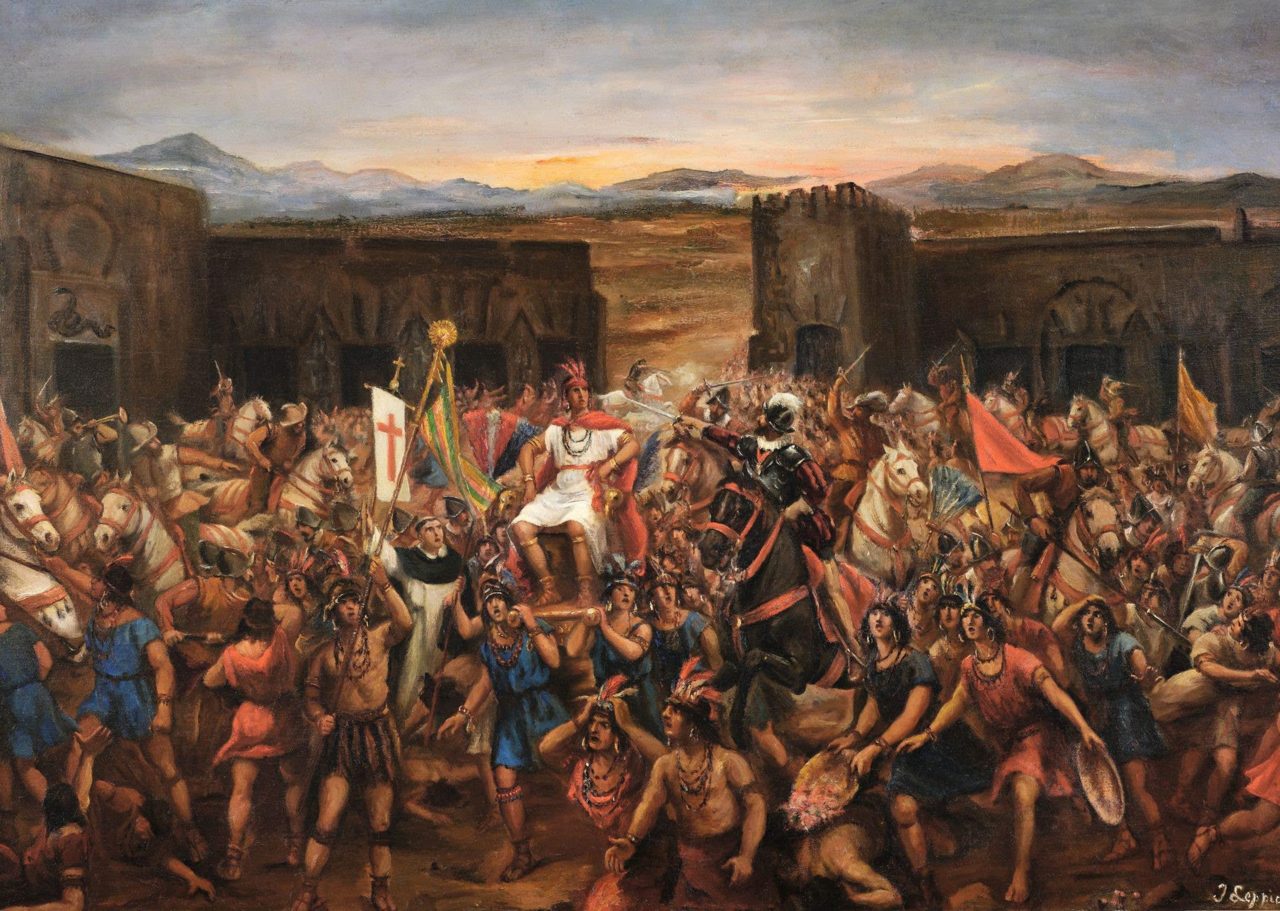
On 16 November 1532, in the great square of Cajamarca in the Peruvian Andes, fewer than 200 Spaniards under Francisco Pizarro ambushed the Inca emperor Atahualpa, killed thousands of his unarmed attendants and took the ruler of the largest empire in the Americas prisoner. It remains the most lopsided capture in recorded history. November 16 is also the day UNESCO was founded, Oklahoma became a state and Gustavus Adolphus fell at Lützen.
Choose another date: open the On This Day calendar to browse events, births and deaths for any day of the year.
At a Glance
- The forces
- About 168 Spaniards — 62 of them horsemen — against an Inca army camped nearby numbering in the tens of thousands
- The setting
- The plaza of Cajamarca, where Atahualpa entered in state with several thousand mostly unarmed attendants
- The spark
- Friar Vicente de Valverde's demand that Atahualpa accept Christianity and Spanish rule; the emperor's rejection of the book he was handed
- The ransom
- Atahualpa offered to fill a room once with gold and twice with silver — the largest ransom on record
- The outcome
- The ransom was paid and melted down; Atahualpa was nevertheless executed in 1533
- The context
- The Inca Empire was already weakened by civil war between Atahualpa and his half-brother Huáscar, and by European diseases that had run ahead of the Spaniards
Events on this day
- 534The second, definitive edition of Justinian's Code, the great codification of Roman law, is published in Constantinople.
- 1532Francisco Pizarro's small Spanish force seizes the Inca emperor Atahualpa at Cajamarca — the featured story above.
- 1632King Gustavus Adolphus of Sweden is killed leading a cavalry charge at the Battle of Lützen, though his army wins the day.
- 1776British and Hessian troops capture Fort Washington on Manhattan, taking some 2,800 American prisoners.
- 1821William Becknell reaches Santa Fe from Missouri, opening the trade route that becomes the Santa Fe Trail.
- 1849A Russian court sentences the novelist Fyodor Dostoevsky to death for anti-government activities; the sentence is commuted at the scaffold.
- 1907Oklahoma, formed from Oklahoma Territory and Indian Territory, enters the Union as the 46th state.
- 1938Swiss chemist Albert Hofmann first synthesises LSD at the Sandoz laboratories in Basel.
- 1945The constitution of UNESCO, the UN's educational, scientific and cultural agency, is adopted in London.
- 1974The Arecibo message — a radio transmission describing humanity — is beamed toward the star cluster M13.
- 1988Benazir Bhutto's party wins Pakistan's general election; she becomes the first woman to lead a Muslim-majority country.
- 2001Harry Potter and the Philosopher's Stone opens in cinemas, launching the most successful film series of its era.
Born on this day
- 42 BCTiberius — second Roman emperor, successor to Augustus.
- 1717Jean le Rond d'Alembert — French mathematician and co-editor of the Encyclopédie.
- 1873W. C. Handy — American composer known as the Father of the Blues.
- 1895Paul Hindemith — German composer and violist.
- 1904Nnamdi Azikiwe — nationalist leader who became Nigeria's first president.
- 1907Burgess Meredith — American actor, from Of Mice and Men to Rocky.
- 1922José Saramago — Portuguese novelist and Nobel laureate, author of Blindness.
Died on this day
- 1625Sofonisba Anguissola — Italian Renaissance painter famed across Europe for her portraits.
- 1885Louis Riel — Canadian Métis leader, hanged for treason after the North-West Rebellion.
- 1960Clark Gable — American actor, the 'King of Hollywood', dead of a heart attack at 59.
- 1961Sam Rayburn — the longest-serving Speaker of the U.S. House of Representatives.
- 1973Alan Watts — British-American philosopher who popularised Eastern thought in the West.
- 1999Daniel Nathans — American microbiologist who shared the Nobel Prize for restriction enzymes.
The featured story: Pizarro captures Atahualpa at Cajamarca, 16 November 1532
The empire Pizarro walked into in 1532 was the largest in the pre-Columbian Americas — and it was already bleeding. Smallpox, travelling faster than the Europeans themselves, had killed the emperor Huayna Capac and his heir, and his sons Atahualpa and Huáscar had fought a savage civil war for the throne. Atahualpa had just won it when word came of bearded strangers on the coast. Pizarro, a veteran conquistador in his fifties, had about 168 men. He marched inland to the highland town of Cajamarca, where Atahualpa was resting at nearby hot springs with his victorious army, and sent word requesting a meeting. The emperor, curious and contemptuous in roughly equal measure, agreed to come the next day.
On the afternoon of 16 November, Atahualpa entered the plaza of Cajamarca in full state, carried on a litter, surrounded by several thousand attendants in ceremonial dress, mostly unarmed — this was, in his understanding, a diplomatic audience, not a battle. The Spaniards were hidden in the long buildings around the square, with their few cannon and horses out of sight. A Dominican friar, Vicente de Valverde, came forward with an interpreter and read the requerimiento, the formal Spanish demand that Atahualpa accept Christianity and the sovereignty of Charles V, offering him a book — a Bible or breviary. Atahualpa examined it, and threw it to the ground. It was the signal, or the excuse. Cannon fired, cavalry burst from the doorways, and steel, horses and gunpowder fell on a crowd that had nowhere to run.
Within about two hours thousands of Inca attendants were dead — Spanish accounts, the only ones that survive in detail, put the number in the thousands and Spanish losses at effectively none. Pizarro himself seized Atahualpa from his litter, taking a knife cut on the hand in the process, the only Spanish wound of the day by his own men's telling. Modern historians at the University of Texas and elsewhere caution that Cajamarca was less a battle than a violent betrayal of an ongoing diplomatic encounter, and that the conquest of Peru still took decades of war. But the capture was decisive in a way battles rarely are: the Inca state was a pyramid with the emperor as its living keystone, and the Spaniards now held the keystone in a stone room.
From captivity Atahualpa still ruled — his generals obeyed orders relayed through his captors — and he used that authority to make the most famous offer in the history of ransom: a room filled once with gold to the height of his raised hand, and another filled twice with silver. For months, llama trains brought the accumulated art of an empire to Cajamarca, including the gold sheeting of the Coricancha, the Temple of the Sun at Cuzco; the Spaniards melted masterpieces into ingots, roughly six tonnes of gold and twelve of silver. The ransom was paid in full by the summer of 1533. Pizarro had him executed anyway — garrotted, after a show trial, on charges including the murder of Huáscar. An empire of perhaps ten million people had been decapitated in an afternoon, and the rest was a long, brutal epilogue.
Why this date matters
November 16 is a date of captures and foundings. An emperor is seized in his own square; a fort falls on Manhattan; a king dies winning his battle in the Saxon mist; a Métis leader is hanged in Canada. Against those seizures stand the day's constructions — a codification of Roman law, a new American state, a UN agency for education and culture, and a message deliberately beamed at the stars. It is a date that asks what power is for, from both ends of the question.
Sources
- Encyclopaedia Britannica — On This Day: November 16
- HISTORY — What Happened on November 16
- University of Texas at Austin — Reading between the Lines at Cajamarca
- Wikimedia — On This Day feed: November 16
The facts on this page were checked against these sources on 19 November 2026. The History Trail's permanent pages are researched and written for this site; the live profiles elsewhere on The History Trail are assembled automatically from Wikipedia and Wikidata.
About the Author
Researched and written by the The History Trail Editorial Team — the accountable editorial function behind this site's permanent story pages. The team works from the published sources cited on each page; it does not invent historians, reviewers or credentials, and it corrects errors openly.
Fact Check
Every load-bearing fact on this page traces to one of the sources listed above, and significant claims link to their source in the text. Our checking method is described on the methodology page; errors can be reported via the corrections page.
Sources & Citations
Cite this page as: The History Trail Editorial Team, The History Trail — this article's title, publication and update dates are shown beneath its headline. The full source list appears under Sources above; the site's source standards are on the sources page.