
Years
1934 in History
1934 is remembered above all for Germany's summer of consolidation: on 30 June Adolf Hitler murdered the leadership of his own SA in the Night of the Long Knives, and on 2 August, on President Hindenburg's death, he merged the presidency with the chancellorship to become Führer. The same year saw China's Communists begin the Long March, and in America the Depression-era outlaw era close as Bonnie and Clyde, John Dillinger and Pretty Boy Floyd were all killed.
At a Glance
- Defining event
- Night of the Long Knives, 30 June 1934 — Hitler purges the SA leadership and other opponents
- Turning point
- Hitler becomes Führer on 2 August 1934, merging president and chancellor after Hindenburg's death
- Confirmed by vote
- About 90 per cent vote yes in the 19 August plebiscite confirming Hitler as Führer
- In China
- Communist forces begin the Long March from Jiangxi on 16 October
- In America
- Bonnie and Clyde, Dillinger and Pretty Boy Floyd are all killed in 1934
- Closed the year
- Sergei Kirov is murdered in Leningrad on 1 December; Stalin uses it as pretext for the Terror that followed
The defining story: the purge and the Führer
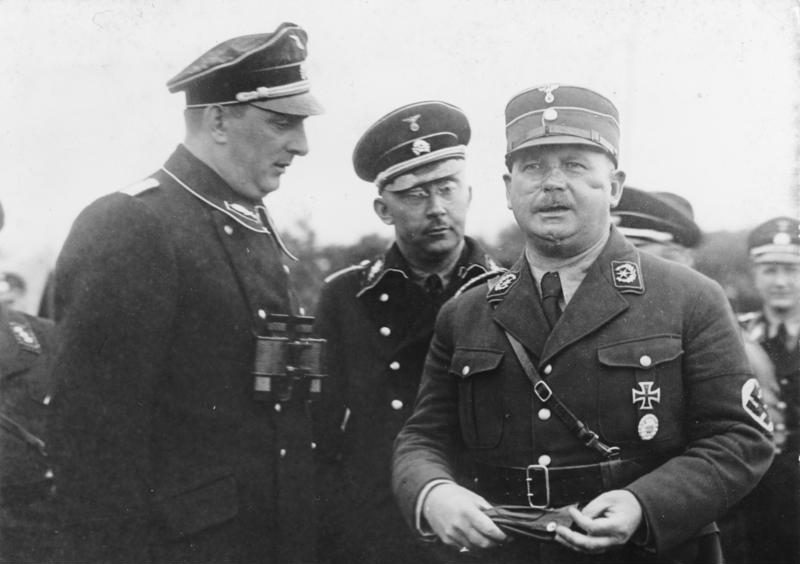
Adolf Hitler had been chancellor since 1933, but in the summer of 1934 his power still had rivals inside his own movement. The SA, the Nazi Party's brownshirted stormtroopers, stood four million strong under their chief of staff Ernst Rohm, Hitler's oldest comrade. Rohm wanted the SA to absorb the regular army and carry the Nazi revolution further. The army's generals, whose support Hitler needed, wanted the SA destroyed as a rival. Hitler chose the generals, and the instrument he used was Heinrich Himmler's SS, together with the Gestapo.
In the early hours of 30 June 1934 Hitler flew to Munich, having summoned the SA's senior leaders to a hotel at Bad Wiessee, ostensibly for a conference. Arriving before dawn with SS men, he personally confronted Rohm and had the assembled commanders arrested; several were shot the same day. Rohm himself was held at Stadelheim prison in Munich and, the following day, offered a pistol with which to kill himself. He refused, and was shot by two SS officers. The killing did not stop with the SA: Gregor Strasser, leader of the party's left wing, was murdered in Berlin, and former chancellor Kurt von Schleicher was shot at home with his wife.
The official death toll was later put at 85; historians' estimates run from around 150 to several hundred, with some as high as 1,000. What followed mattered as much as the murders themselves. On 3 July the cabinet passed a law declaring the killings legal acts of state self-defence, and the army, its rival destroyed, bound itself closer to Hitler. When President Paul von Hindenburg died on 2 August, Hitler merged the offices of president and chancellor and proclaimed himself Führer. On 19 August Germans voted in a plebiscite to confirm the merger, with about 90 per cent voting yes.
Elsewhere, 1934 turned on different axes. In Austria, Chancellor Engelbert Dollfuss was assassinated by Nazi gunmen in a failed coup in Vienna on 25 July. In China, Communist forces in Jiangxi began the Long March on 16 October, the year-long retreat that carried Mao Zedong to leadership of the party. In the Soviet Union, the murder of Leningrad party chief Sergei Kirov on 1 December gave Stalin the pretext for the Great Terror that followed.
Timeline of 1934
- 3 March
John Dillinger escapes from the jail at Crown Point, Indiana, reportedly with a wooden gun blackened with shoe polish.
- 21 April
The surgeon's photograph of the Loch Ness monster is published in the Daily Mail; six decades later it is admitted to have been a hoax.
- 23 May
Bonnie Parker and Clyde Barrow are shot dead by police near Gibsland, Louisiana, ending a 21-month crime spree.
- 28 May
The Dionne quintuplets are born near Corbeil, Ontario, the first quintuplets known to survive infancy.
- 9 June
Donald Duck makes his screen debut, in the Walt Disney cartoon The Wise Little Hen.
- 19 June
Congress passes the Communications Act, creating the Federal Communications Commission.
- 30 June
Hitler purges the SA leadership and other opponents in the Night of the Long Knives.
- 22 July
John Dillinger, America's first Public Enemy No. 1, is shot dead by FBI agents outside the Biograph Theater in Chicago.
- 2 August
On Hindenburg's death, Hitler merges the presidency with the chancellorship and becomes Führer.
- 11 August
Alcatraz federal prison receives its first civilian prisoners, fourteen men from McNeil Island.
- 19 August
Germans vote in a plebiscite to confirm Hitler as Führer; about 90 per cent vote yes.
- 16 October
Communist forces in Jiangxi begin the Long March across China.
- 1 December
Sergei Kirov is shot dead in Leningrad; Stalin uses his murder as the pretext for the Great Terror that followed.
Why 1934 still matters
The Night of the Long Knives is conventionally read as the moment the Nazi regime consumed its own revolution and consolidated into a dictatorship answerable to one man. Within a fortnight, the law, the army and the party leadership had all formally blessed murder as governance: the cabinet declared the killings legal, Hitler told the Reichstag he had been the supreme court of the German people, and when Hindenburg died the armed forces swore a personal oath of loyalty to Hitler by name. The SA survived only as a shell, while the SS, rewarded with independence from it, grew into the regime's central instrument of terror.
China's Long March worked in the opposite direction, turning defeat into survival. The retreat from Jiangxi carried Mao Zedong to leadership of the Communist Party, preserving the movement that would win the Chinese Civil War fifteen years later. In the United States, the year's killings of Bonnie and Clyde, Dillinger and Pretty Boy Floyd closed the brief, glamorised era of the Depression outlaw, while quieter institutions endured: the Communications Act created the Federal Communications Commission, and Alcatraz received its first prisoners.
The year's births sketch the century to come: Hank Aaron, Bill Russell, Gloria Steinem, Wole Soyinka, Sophia Loren, Leonard Cohen, Brigitte Bardot, Carl Sagan, Yuri Gagarin and Maggie Smith were all born in 1934, alongside the Dionne quintuplets, the first quintuplets known to survive infancy. A teenage Ella Fitzgerald also sang, instead of dancing, at Harlem's Apollo Theater on 21 November and won Amateur Night, launching one of the great careers in jazz.
1934 on The History Trail
The purge summer dominates 1934 on The History Trail, from Bad Wiessee to the Führer plebiscite.
- June 30 in History — The Night of the Long Knives, Hitler's purge of the SA, told in full.
- August 2 in History — Hindenburg dies and Hitler proclaims himself Führer.
- August 19 in History — Germans vote to confirm Hitler as Führer.
- May 23 in History — Bonnie and Clyde are killed in Louisiana.
- July 22 in History — Dillinger is shot outside the Biograph Theater in Chicago.
- October 16 in History — The Long March begins in Jiangxi.
- December 1 in History — Kirov is murdered in Leningrad.
Sources
- HISTORY — Hitler purges members of his own Nazi party in Night of the Long Knives
- United States Holocaust Memorial Museum — History Unfolded: Hitler purges the SA
- Encyclopaedia Britannica — On This Day: June 30
- HISTORY — What Happened on August 2
- Encyclopaedia Britannica — On This Day: August 19
- Encyclopaedia Britannica — On This Day: October 16
- Encyclopaedia Britannica — On This Day: December 1
The facts on this page were checked against these sources on 19 November 2026. The History Trail's permanent pages are researched and written for this site; the live profiles elsewhere on The History Trail are assembled automatically from Wikipedia and Wikidata.
About the Author
Researched and written by the The History Trail Editorial Team — the accountable editorial function behind this site's permanent story pages. The team works from the published sources cited on each page; it does not invent historians, reviewers or credentials, and it corrects errors openly.
Fact Check
Every load-bearing fact on this page traces to one of the sources listed above, and significant claims link to their source in the text. Our checking method is described on the methodology page; errors can be reported via the corrections page.
Sources & Citations
Cite this page as: The History Trail Editorial Team, The History Trail — this article's title, publication and update dates are shown beneath its headline. The full source list appears under Sources above; the site's source standards are on the sources page.