
On This Day
June 30 in History
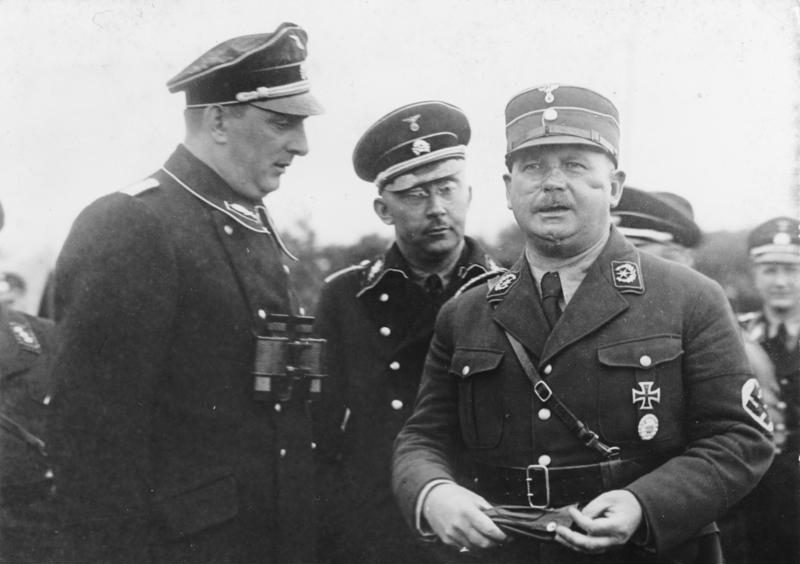
On 30 June 1934 Adolf Hitler turned on his own movement: in the purge remembered as the Night of the Long Knives, the SS arrested and murdered the leadership of the SA and a roll of other enemies, and Germany's cabinet then declared the killings legal. June 30 is also the day of the Tunguska explosion, Einstein's relativity paper and Blondin's tightrope crossing of Niagara.
Choose another date: open the On This Day calendar to browse events, births and deaths for any day of the year.
At a Glance
- The purge
- 30 June to 2 July 1934, carried out mainly by the SS and Gestapo on Hitler's orders
- The main target
- Ernst Rohm and the leadership of the SA, the party's four-million-strong stormtrooper army
- The bargain
- Destroying the SA won Hitler the regular army, whose leaders feared Rohm's plan to absorb it
- Other victims
- Former chancellor Kurt von Schleicher, Gregor Strasser and Gustav von Kahr, among others
- The toll
- Officially put at 85; historians estimate roughly 150 to 200 documented victims, with higher contemporary claims
- The legalisation
- On 3 July 1934 the cabinet declared the murders lawful acts of state self-defence
Events on this day
- 1859The French acrobat Charles Blondin crosses Niagara Falls on a tightrope, the first of his many crossings.
- 1860At Oxford, Samuel Wilberforce and T. H. Huxley clash over Darwin's theory in the famous evolution debate.
- 1905Albert Einstein's paper 'On the Electrodynamics of Moving Bodies', setting out special relativity, is received by the journal Annalen der Physik.
- 1908A colossal explosion flattens some 2,000 square kilometres of Siberian forest in the Tunguska event, the largest impact event in recorded history.
- 1934Hitler purges the SA leadership and other opponents in the Night of the Long Knives — the featured story above.
- 1936Margaret Mitchell's Gone with the Wind is published in the United States.
- 1966The National Organization for Women is founded in Washington, becoming the flagship of American feminism's second wave.
- 1971The three cosmonauts of Soyuz 11 are found dead on landing, killed by a loss of cabin air — the only deaths in space itself.
- 1972The first leap second is added to coordinated universal time, keeping atomic clocks in step with the Earth's rotation.
- 1990East and West Germany merge their economies, adopting a common currency as the practical first step to reunification.
- 2012Mohamed Morsi is sworn in as president of Egypt, the country's first democratically elected head of state.
Born on this day
- 1685John Gay — English poet and dramatist of The Beggar's Opera.
- 1911Czeslaw Milosz — Polish poet and essayist, Nobel laureate in Literature, witness to his century's extremes.
- 1917Lena Horne — American singer and actress whose career broke racial barriers in Hollywood and on stage.
- 1966Mike Tyson — American boxer, the youngest heavyweight champion in history at twenty.
- 1985Michael Phelps — American swimmer, the most decorated Olympian of all time with 28 medals.
Died on this day
- 1934Kurt von Schleicher — German general and former chancellor, murdered with his wife in the Night of the Long Knives.
- 1934Gregor Strasser — leader of the Nazi Party's left wing, murdered in Berlin during the purge.
- 1974Vannevar Bush — American engineer who directed wartime science and imagined the Memex, an ancestor of the web.
- 1984Lillian Hellman — American playwright of The Little Foxes and The Children's Hour, dead at 79.
The featured story: the Night of the Long Knives, 30 June 1934
In the early hours of 30 June 1934 Adolf Hitler flew to Munich and began arresting the leaders of his own movement. The purge that unfolded over the next three days — remembered as the Night of the Long Knives — was, as HISTORY summarises it, Hitler's bloody purge of his own political party, assassinating hundreds of Nazis whom he believed had the potential to become political enemies. Its principal target was the SA, the Nazi Party's brownshirted stormtroopers, four million strong under their chief of staff Ernst Rohm. Rohm, Hitler's oldest comrade, wanted the SA to absorb the regular army and carry the Nazi revolution further. The army's generals, whose support Hitler needed, wanted the SA destroyed as a rival. Hitler chose the generals.
The instrument was the SS, Heinrich Himmler's guard, together with the Gestapo. Hitler had summoned the SA's senior leaders to a hotel at Bad Wiessee, a spa town south of Munich, ostensibly for a conference. Arriving before dawn with SS men, he personally confronted Rohm and had the assembled commanders arrested; several were shot the same day, some taken from their beds. Rohm himself was held at Stadelheim prison in Munich and, the following day, offered a pistol with which to kill himself. He refused — 'If I am to be killed, let Adolf do it himself', he is reported to have said — and was shot by two SS officers, Theodor Eicke and Michael Lippert. The United States Holocaust Memorial Museum's account records the same sequence: the SA leaders surprised at Bad Wiessee on the morning of 30 June and carried to Stadelheim, where Eicke shot Rohm in his cell.
The killing did not stop with the SA. The purge settled every outstanding account the regime held. Gregor Strasser, the leader of the party's left wing and a rival of long standing, was murdered in a Gestapo cellar. Gustav von Kahr, who had crushed Hitler's beer-hall putsch in 1923, was hacked to death. Most brazenly, General Kurt von Schleicher, Hitler's predecessor as chancellor, was shot at his home with his wife — a serving general of the Reichswehr murdered by the government the army was being asked to serve. Vice-Chancellor Franz von Papen escaped, though his staff were killed and he was placed under house arrest. The official death toll was later put at 85; historians' estimates, as the reference accounts note, run from around 150 to several hundred, with some as high as 1,000.
The consequences were immediate and structural. On 3 July the cabinet passed a law declaring the murders legal acts of state self-defence, retroactively. On 13 July Hitler told the Reichstag that for twenty-four hours he had been 'the supreme court of the German people', and the Reichstag applauded. The army, its rival destroyed, bound itself closer: when President Hindenburg died on 2 August, the armed forces swore a personal oath of loyalty to Hitler by name. The SA survived as a shell; the SS, rewarded with independence from it, grew into the regime's central instrument of terror. The Night of the Long Knives is therefore conventionally read as the moment the Nazi regime consumed its own revolution and consolidated into a dictatorship answerable to one man — with the law, the army and the party leadership all, within a fortnight, formally blessing murder as governance.
Why this date matters
June 30, the year's midpoint, is a date of violent clarifications and quiet revolutions in how the world is measured. Einstein's relativity paper and the first leap second both concern the nature of time; the Tunguska blast flattened a forest the size of a small country without a single confirmed death; Blondin walked a rope over Niagara for no reason but that it could be done. Against those stands the date's darkness: a government murdering its own founders and calling it law, and three cosmonauts dead in a capsule that landed, by every external sign, safely. It is a day that shows systems — legal, scientific, political — revealing what they truly are under pressure.
Sources
- Encyclopaedia Britannica — On This Day: June 30
- HISTORY — What Happened on June 30
- HISTORY — Hitler purges members of his own Nazi party in Night of the Long Knives
- United States Holocaust Memorial Museum — History Unfolded: Hitler purges the SA
The facts on this page were checked against these sources on 19 November 2026. The History Trail's permanent pages are researched and written for this site; the live profiles elsewhere on The History Trail are assembled automatically from Wikipedia and Wikidata.
About the Author
Researched and written by the The History Trail Editorial Team — the accountable editorial function behind this site's permanent story pages. The team works from the published sources cited on each page; it does not invent historians, reviewers or credentials, and it corrects errors openly.
Fact Check
Every load-bearing fact on this page traces to one of the sources listed above, and significant claims link to their source in the text. Our checking method is described on the methodology page; errors can be reported via the corrections page.
Sources & Citations
Cite this page as: The History Trail Editorial Team, The History Trail — this article's title, publication and update dates are shown beneath its headline. The full source list appears under Sources above; the site's source standards are on the sources page.