
Years
1933 in History
1933 is remembered for two handovers of power in the depths of the Great Depression. In Germany, Adolf Hitler was appointed chancellor on 30 January by politicians who believed they could control him; within eight weeks the Reichstag fire and the Enabling Act had made him a dictator in law. In the United States, Franklin D. Roosevelt took the oath on 4 March promising that 'the only thing we have to fear is fear itself', and began the New Deal. The year ended with Prohibition repealed.
At a Glance
- Defining event
- Hitler appointed chancellor, 30 January; Enabling Act passed 441 to 94, 23 March
- The pretext
- Reichstag fire, 27 February; the Fire Decree suspends civil liberties the next morning
- America's answer
- Roosevelt inaugurated 4 March — 'the only thing we have to fear is fear itself'
- New Deal begins
- First fireside chat 12 March; Banking Act creates the FDIC, 16 June
- Secret police
- Göring establishes the Gestapo in Prussia, 26 April
- Closed the year
- Utah ratifies the Twenty-first Amendment, 5 December, ending national Prohibition
The defining story: a republic hands itself over
On 30 January 1933 Adolf Hitler was sworn in as chancellor of Germany. There had been no coup and no election that made him head of government: the leader of the Nazi Party was appointed, in full constitutional form, by the 85-year-old President Paul von Hindenburg — the outcome of weeks of backstairs intrigue among conservative politicians who believed they could use Hitler's mass movement while controlling the man at its head. Franz von Papen, who took the vice-chancellorship, boasted that they had 'hired' Hitler and would push him into a corner until he squeaked. The arithmetic seemed to support them: the Nazis had peaked at 37.3 percent of the vote in July 1932 and fallen back in November, and only three of the twelve ministers in Hitler's first cabinet were Nazis.
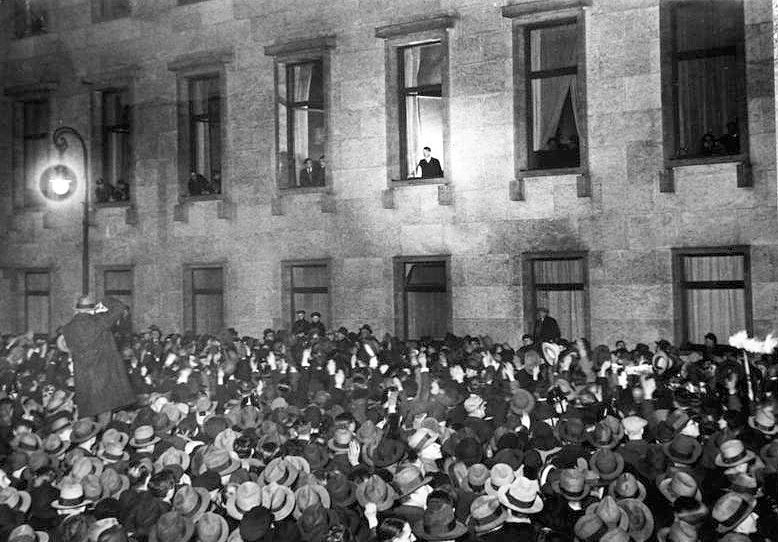
What the conservatives had discounted was what those posts commanded: Wilhelm Frick controlled the Reich's police apparatus, and Hermann Göring controlled the police of Prussia, Germany's largest state. That evening thousands of SA stormtroopers marched in a torchlight parade through the Brandenburg Gate, past the Chancellery window where Hitler stood acknowledging the cheers. A month later the machinery turned. On the night of 27 February the Reichstag building burned; a young Dutchman, Marinus van der Lubbe, was arrested inside and confessed to setting the fire alone, as a protest. The Nazis declared instantly, without waiting for evidence, that the fire was the signal for a communist uprising — and the next morning Hindenburg signed the Decree for the Protection of People and State, suspending Germany's civil liberties.
Five days after the fire, on 4 March, the other democracy in crisis changed its leader. With banks failing across the country and an estimated quarter of the workforce unemployed, Franklin D. Roosevelt took the oath as 32nd president — the last inauguration ever held on 4 March — and told the nation that 'the only thing we have to fear is fear itself'. On 12 March he delivered his first fireside chat, speaking directly to Americans by radio about the banking crisis; on 22 March he signed the Beer and Wine Revenue Act, the first legislative step toward ending Prohibition.
In Berlin the legal end came a day later. On 23 March the Reichstag, meeting in the Kroll Opera House because its own chamber had burned, with armed SA and SS men in and around the chamber and its 81 Communist deputies excluded, in camps or in hiding, passed the Enabling Act by 441 votes to 94. Only the Social Democrats voted no. The act let Hitler's cabinet legislate without parliament or president — even laws deviating from the constitution — and provided the legal basis of the Nazi dictatorship. By July every German political party except the Nazis had been abolished; Göring had established the Gestapo on 26 April, and on 10 May Nazi students burned some 25,000 books in Berlin and in university towns across Germany.
Timeline of 1933
- 5 January
Construction begins on the Golden Gate Bridge in San Francisco; it opens in 1937.
- 30 January
Adolf Hitler is appointed chancellor of Germany by President Hindenburg.
- 15 February
Giuseppe Zangara fires at President-elect Roosevelt in Miami; Roosevelt is unhurt, Mayor Cermak fatally wounded.
- 27 February
Fire guts the Reichstag building in Berlin; the Fire Decree suspends civil liberties the next morning.
- 4 March
Franklin D. Roosevelt is inaugurated as 32nd president at the depth of the Great Depression.
- 12 March
Roosevelt delivers his first 'fireside chat', speaking to Americans by radio about the banking crisis.
- 23 March
The Reichstag passes the Enabling Act, 441 to 94, giving Hitler's cabinet power to legislate without parliament.
- 26 April
Hermann Göring establishes the Gestapo, the Nazi regime's secret police, in Prussia.
- 10 May
Nazi students burn some 25,000 books in Berlin's Opernplatz and in university towns across Germany.
- 16 June
Roosevelt signs the Banking Act, creating federal deposit insurance through the FDIC.
- 14 July
Hitler's Gleichschaltung decree abolishes every German political party except the Nazis.
- 17 October
Albert Einstein arrives in the United States, a refugee from Nazi Germany, to take up his post at Princeton.
- 5 December
Utah becomes the 36th state to ratify the Twenty-first Amendment, ending national Prohibition.
Why 1933 still matters
1933 is the standing lesson in how democracies end — and how they can be defended. Germany's republic was not overthrown; it was appointed, decreed and voted away in eight weeks, each step dressed in legality: an emergency decree that was never repealed, an election held amid terror, an Enabling Act passed by a parliament from which the opposition had been removed by force. The men who handed Hitler the chancellorship believed they were the ones doing the using; von Papen's promise that Hitler would be pushed into a corner and squeak within two months is the year's most quoted misjudgement. Within eighteen months the Weimar Republic was destroyed.
America's 1933 ran the other way, and the contrast is the point. Roosevelt took office in a deeper economic emergency — banks closed in most states, a quarter of the workforce idle — and answered with speed, radio and legislation rather than emergency rule: the fireside chats, the Banking Act's federal deposit insurance through the FDIC, which still guarantees American deposits, and the Civilian Conservation Corps, created on 5 April, which put millions of young men to work. Even the calendar changed: 4 March 1933 was the last inauguration held on that date, the four-month lame-duck gap having proved part of the paralysis of the winter before.
The year's exiles and endings marked the divergence. On 17 October Albert Einstein arrived in the United States, a refugee from Nazi Germany, to take up his post at Princeton; he never returned to Europe. The book burnings of 10 May announced what the regime intended for German culture. And on 5 December Utah's ratification ended national Prohibition after thirteen years — the only constitutional amendment ever repealed outright, repealed by the same democratic machinery that, across the Atlantic, had just voted itself out of existence.
1933 on The History Trail
All four of this year's featured days are here — the appointment, the fire, the inauguration and the Enabling Act.
- January 30 in History — Hitler is appointed chancellor of Germany by President Hindenburg.
- February 27 in History — The Reichstag fire, and the decree that suspended Germany's civil liberties.
- March 4 in History — Franklin D. Roosevelt is inaugurated at the depth of the Great Depression.
- March 23 in History — The Enabling Act passes 441 to 94 in the Kroll Opera House.
- December 5 in History — Utah ratifies the Twenty-first Amendment, ending national Prohibition.
- May 10 in History — Nazi students burn some 25,000 books across Germany.
Sources
- Encyclopaedia Britannica — On This Day: January 30
- Encyclopaedia Britannica — On This Day: February 27
- Encyclopaedia Britannica — On This Day: March 4
- Encyclopaedia Britannica — On This Day: March 23
- Encyclopaedia Britannica — On This Day: December 5
- Encyclopaedia Britannica — On This Day: May 10
The facts on this page were checked against these sources on 19 November 2026. The History Trail's permanent pages are researched and written for this site; the live profiles elsewhere on The History Trail are assembled automatically from Wikipedia and Wikidata.
About the Author
Researched and written by the The History Trail Editorial Team — the accountable editorial function behind this site's permanent story pages. The team works from the published sources cited on each page; it does not invent historians, reviewers or credentials, and it corrects errors openly.
Fact Check
Every load-bearing fact on this page traces to one of the sources listed above, and significant claims link to their source in the text. Our checking method is described on the methodology page; errors can be reported via the corrections page.
Sources & Citations
Cite this page as: The History Trail Editorial Team, The History Trail — this article's title, publication and update dates are shown beneath its headline. The full source list appears under Sources above; the site's source standards are on the sources page.