
Years
1936 in History
1936 is remembered for the abdication of Edward VIII, the only British sovereign ever to give up the throne voluntarily, surrendering it in December to marry Wallis Simpson. It was also the year civil war began in Spain, Jesse Owens won four gold medals at the Berlin Olympics, and the Crystal Palace burned down in a single London night.
At a Glance
- Defining event
- The abdication of Edward VIII takes effect, 11 December 1936
- Reign ended
- Less than eleven months after Edward came to the throne on the death of George V, 20 January 1936
- War begins
- A rising of nationalist officers in Spanish Morocco begins the Spanish Civil War, 17 July
- Olympic story
- Jesse Owens wins four gold medals at the Berlin Olympics, the fourth on 9 August
- New head of state
- Francisco Franco is named head of state of Nationalist Spain, 1 October
- Born this year
- Pope Francis, born Jorge Mario Bergoglio in Buenos Aires, 17 December
The defining story: the abdication of Edward VIII
Edward VIII had been king for less than eleven months when his reign ended. He came to the throne on 20 January 1936, on the death of his father, George V: popular, unmarried and already determined to marry Wallis Simpson, an American who had been divorced once and was divorcing her second husband. To the British government, and to the Church of England of which the king was head, the match was impossible: a twice-divorced woman whose former husbands were still living could not become queen, and the dominion governments agreed. Through the autumn the crisis deepened in private while the British press kept silent, until at the start of December the story broke and the country learned that its king intended to choose marriage over the crown.
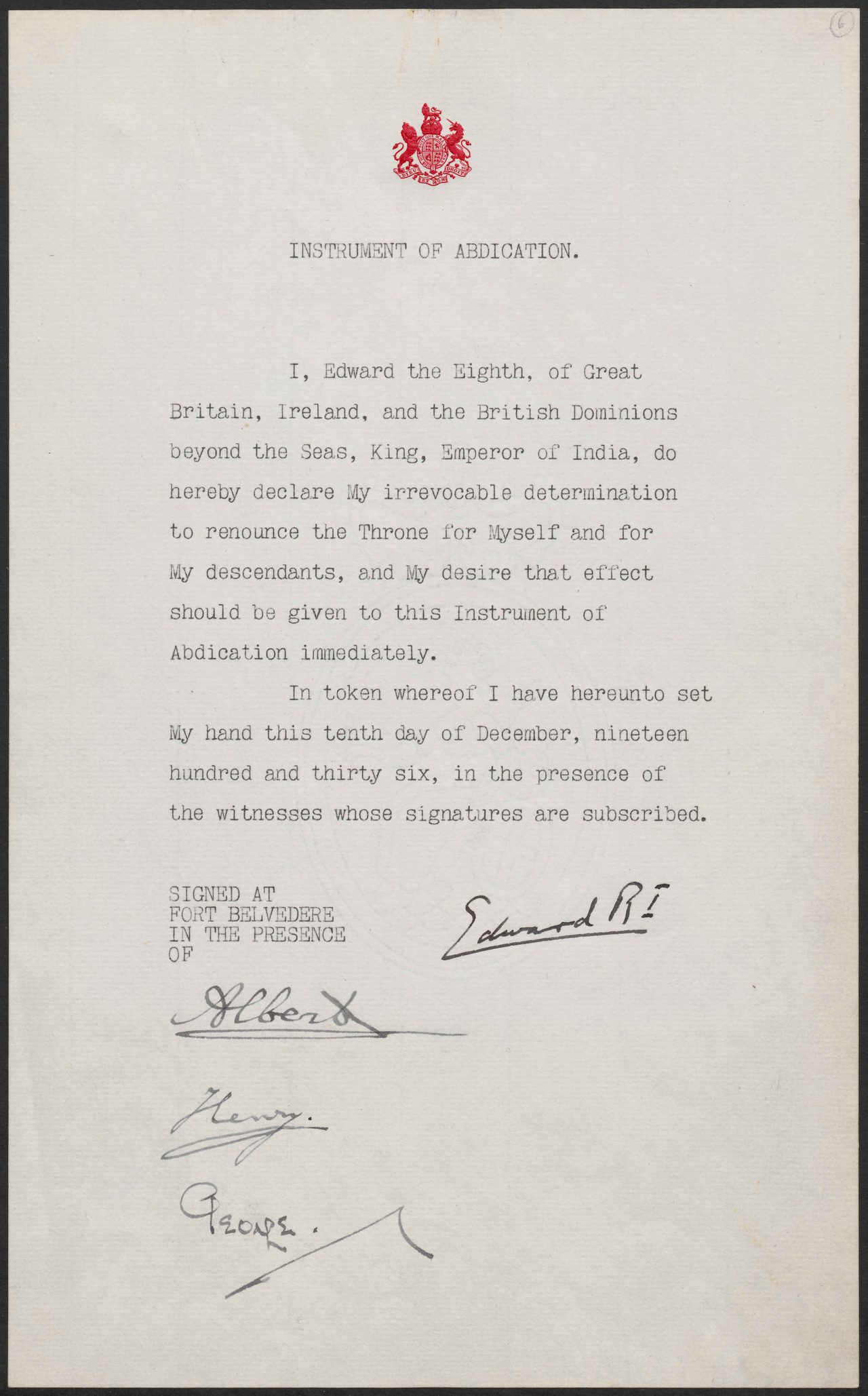
Every compromise failed. Edward proposed a morganatic marriage, in which Simpson would be his wife but not queen; the cabinet and the dominions rejected it. On 10 December 1936, at Fort Belvedere, his home near Windsor, he signed the Instrument of Abdication, witnessed by his three brothers, the document whose signed original illustrates this page. But a signature alone could not end a reign: an abdication had to be enacted by Parliament. On 11 December Parliament endorsed the instrument, Edward gave his royal assent to the act as his final act of state, and the reign was over. That evening he broadcast to the nation and the empire from Windsor Castle, explaining that he could not discharge his duties as king without the help and support of the woman he loved, and he left Britain that night, a king turned private citizen in a single day.
His brother Albert, Duke of York, succeeded him as George VI, a shy man with a stammer who had never expected the throne. Edward was created Duke of Windsor the next day, and after Simpson's divorce became final he married her in France on 3 June 1937, with no member of the royal family present. The abdication remains unique in British history: Edward VIII is the only British sovereign ever to have voluntarily resigned the throne.
The rest of the year ran toward war and spectacle. On 17 July a rising of nationalist officers in Spanish Morocco began the Spanish Civil War, and by 1 October Francisco Franco had been named head of state of Nationalist Spain. In August Adolf Hitler opened the Olympic Games in Berlin, where the American athlete Jesse Owens won four gold medals, his second in the long jump on 4 August and his fourth on 9 August. In November the Crystal Palace in London, the vast glass hall of the Great Exhibition of 1851, was destroyed by fire in a single night, and the first issue of Life magazine appeared in the United States.
Timeline of 1936
- 18 January
Rudyard Kipling, author of The Jungle Book and Kim and the first English-language Nobel laureate in literature, dies.
- 29 January
The first five men elected to the Baseball Hall of Fame are announced: Ty Cobb, Babe Ruth, Honus Wagner, Christy Mathewson and Walter Johnson.
- 27 February
Ivan Pavlov, the Russian physiologist whose experiments with dogs founded the study of classical conditioning, dies in Leningrad at 86.
- 30 June
Margaret Mitchell's Gone with the Wind is published in the United States.
- 17 July
A rising of nationalist officers in Spanish Morocco begins the Spanish Civil War.
- 1 August
Adolf Hitler opens the Olympic Games in Berlin.
- 9 August
Jesse Owens wins his fourth gold medal of the Berlin Olympics.
- 1 October
Francisco Franco is named head of state of Nationalist Spain as the civil war gathers force.
- 23 November
The first issue of Life magazine is published in the United States.
- 30 November
The Crystal Palace in London, the glass hall of the Great Exhibition of 1851, is destroyed by fire in a single night.
- 10 December
Edward VIII signs the Instrument of Abdication at Fort Belvedere, witnessed by his three brothers.
- 11 December
Edward VIII's abdication takes effect, the only voluntary surrender of the throne by a British sovereign.
- 12 December
In the Xi'an Incident, Chiang Kai-shek is seized by his own generals and forced to ally with the Communists against Japan.
Why 1936 still matters
The abdication reshaped the monarchy it left behind. The institution survived by demonstrating that it could discard a king who would not accept its constraints, and George VI's dutiful, unglamorous reign, followed by that of his daughter Elizabeth II, rebuilt its standing on exactly the qualities his brother had lacked. The constitutional lesson also endured: a British sovereign reigns within limits set by Parliament and government, and 1936 is the year those limits were tested to destruction and held.
Spain's year pointed the other way. The rising of July 1936 began a civil war that was still gathering force when Franco was named head of the Nationalist state in October, and the conflict became the rehearsal ground, in arms and ideology, for the wider European war that followed three years later. Berlin's Olympics, meanwhile, fixed the modern template of the Games as a stage for national prestige, and Owens's four gold medals remain their most retold sporting story. Even the year's publishing endured: Gone with the Wind, issued in June, became the defining American novel of its era, and its film, premiered in 1939, the highest-grossing of its time.
1936 on The History Trail
The abdication carries a featured story on The History Trail, alongside the days that opened Spain's civil war and Berlin's Games.
- July 17 in History — A rising of nationalist officers in Spanish Morocco begins the Spanish Civil War.
- August 1 in History — Adolf Hitler opens the Olympic Games in Berlin.
- October 1 in History — Francisco Franco is named head of state of Nationalist Spain.
- December 11 in History — Edward VIII's abdication takes effect and his brother becomes George VI.
- Basketball — A permanent page from the site's collection, among the stories this year touches.
- Toyota — A permanent page from the site's collection, among the stories this year touches.
Sources
- Encyclopaedia Britannica — On This Day: January 18
- Encyclopaedia Britannica — On This Day: January 29
- Encyclopaedia Britannica — On This Day: February 27
- Encyclopaedia Britannica — On This Day: June 30
- Encyclopaedia Britannica — On This Day: July 17
The facts on this page were checked against these sources on 19 November 2026. The History Trail's permanent pages are researched and written for this site; the live profiles elsewhere on The History Trail are assembled automatically from Wikipedia and Wikidata.
About the Author
Researched and written by the The History Trail Editorial Team — the accountable editorial function behind this site's permanent story pages. The team works from the published sources cited on each page; it does not invent historians, reviewers or credentials, and it corrects errors openly.
Fact Check
Every load-bearing fact on this page traces to one of the sources listed above, and significant claims link to their source in the text. Our checking method is described on the methodology page; errors can be reported via the corrections page.
Sources & Citations
Cite this page as: The History Trail Editorial Team, The History Trail — this article's title, publication and update dates are shown beneath its headline. The full source list appears under Sources above; the site's source standards are on the sources page.