
On This Day
August 2 in History
In the early hours of 2 August 1990, Iraqi armoured divisions rolled into Kuwait, seizing the small, oil-rich state within days and setting off the first great crisis of the post-Cold War world. The invasion brought a vast international coalition into the field and ended, seven months later, with Kuwait's liberation in the Gulf War. August 2 is also the day most of the signers put their names to the Declaration of Independence, and the day President Harding died in office.
Choose another date: open the On This Day calendar to browse events, births and deaths for any day of the year.
At a Glance
- The invasion
- Early on 2 August 1990, Iraqi armoured divisions invade Kuwait; the country is overrun within days
- The order
- Iraq's leader Saddam Hussein orders the invasion, seeking Kuwait's oil reserves, cancellation of Iraq's war debts and dominance in the Gulf
- The response
- The UN Security Council condemns the invasion the same day (Resolution 660) and imposes a full trade embargo on 6 August
- The annexation
- On 8 August Iraq declares Kuwait its 19th province — a claim the Security Council immediately condemns
- The deadline
- The Security Council authorises the use of force if Iraq has not withdrawn from Kuwait by 15 January 1991
- The outcome
- Coalition air attacks begin on 17 January 1991 and a ground offensive on 24 February; Kuwait is liberated within the week
Events on this day
- 1776Most of the delegates to the Continental Congress sign the engrossed copy of the Declaration of Independence — 56 signatures in all.
- 1865The Confederate cruiser CSS Shenandoah, still hunting Union shipping in the Pacific, learns from a British vessel that the American Civil War ended months earlier.
- 1876Wild Bill Hickok is shot dead from behind while playing poker in a saloon in Deadwood, in the Dakota Territory.
- 1909The Lincoln penny goes into circulation in the United States, the first American coin to carry the portrait of a president.
- 1918American troops land at Archangel in northern Russia, beginning an Allied intervention in the Russian Civil War.
- 1934On the death of President Paul von Hindenburg, Adolf Hitler merges the offices of president and chancellor and proclaims himself Führer of Germany.
- 1939Albert Einstein signs his letter to President Franklin D. Roosevelt warning that Nazi Germany might develop an atomic bomb — the letter that helps set the Manhattan Project in motion.
- 1943A Japanese destroyer rams and sinks the American patrol boat PT-109 in the Solomon Islands; its commander, Lieutenant John F. Kennedy, leads his surviving crew to safety, though two men are killed.
- 1945The Potsdam Conference concludes, with the victorious Allies settling the administration of occupied Germany and the postwar order of Europe.
- 1985Delta Air Lines Flight 191 crashes while landing at Dallas/Fort Worth airport in a violent storm, killing 135 people.
- 1990Iraq invades Kuwait, seizing the country within days and triggering the Gulf War — the featured story above.
- 1992Jackie Joyner-Kersee wins the Olympic heptathlon gold medal for the second consecutive Games.
Born on this day
- 1754Pierre L'Enfant — French-born American architect and engineer who designed the plan of Washington, D.C.
- 1834Frédéric Auguste Bartholdi — French sculptor who designed the Statue of Liberty.
- 1905Myrna Loy — American film star of The Thin Man series.
- 1923Shimon Peres — Israeli statesman, prime minister and president, and a Nobel Peace Prize laureate.
- 1924James Baldwin — American novelist and essayist, author of Go Tell It on the Mountain and Notes of a Native Son.
- 1932Peter O'Toole — Irish actor famed for Lawrence of Arabia.
- 1942Isabel Allende — Chilean novelist, author of The House of the Spirits.
Died on this day
- 1100William II of England — killed by an arrow while hunting in the New Forest, in an accident some contemporaries suspected was an assassination.
- 1922Alexander Graham Bell — Scottish-born inventor credited with patenting the telephone.
- 1923Warren G. Harding — 29th president of the United States, dead of a stroke in San Francisco while still in office.
- 1934Paul von Hindenburg — German field marshal and president, whose death clears Hitler's path to total power.
- 1976Fritz Lang — Austrian-American film director of Metropolis and M.
- 1997William S. Burroughs — American writer of Naked Lunch and a central figure of the Beat Generation.
The featured story: Iraq invades Kuwait, 2 August 1990
Iraq emerged from its eight-year war with Iran in 1988 with a huge army, a wrecked economy and enormous debts, much of them owed to the oil monarchies of the Gulf. Saddam Hussein had expected those debts to be forgiven as the price of having shielded the Arab world from revolutionary Iran. They were not. Through the summer of 1990 his government pressed its grievances against Kuwait: that Kuwait was pumping more oil than its OPEC quota allowed, driving down the price Iraq depended on; that it was drawing oil from the Rumaila field beneath their disputed border; and that Kuwait itself, in Iraq's old claim, was rightfully Iraqi territory. Egypt's President Mubarak tried to mediate, and Saddam personally assured him that Iraq would not use force while talks lasted.
The talks, held in Saudi Arabia, broke off after barely two hours. Early on 2 August 1990, Iraqi armoured divisions — led by the elite Republican Guard — invaded Kuwait. The small Kuwaiti state was overrun within days, its ruling family fleeing into exile. On 4 August the Iraqis installed a puppet administration, and on 8 August Saddam declared that Kuwait had ceased to exist as a separate country: it was now Iraq's 19th province. Place names were Iraqized, and the annexation was presented to the world as permanent and irreversible.
The world refused to accept it. On the very day of the invasion the UN Security Council passed Resolution 660, condemning it and demanding Iraq's unconditional withdrawal; on 6 August it imposed a comprehensive trade embargo. Fearing that Iraq would next move against Saudi Arabia and its oilfields, President George H. W. Bush launched Operation Desert Shield, deploying the first of hundreds of thousands of American and allied troops to the Saudi desert. Through the autumn a coalition of dozens of nations assembled, while the Security Council set a deadline: Iraq must leave Kuwait by 15 January 1991, or face war.
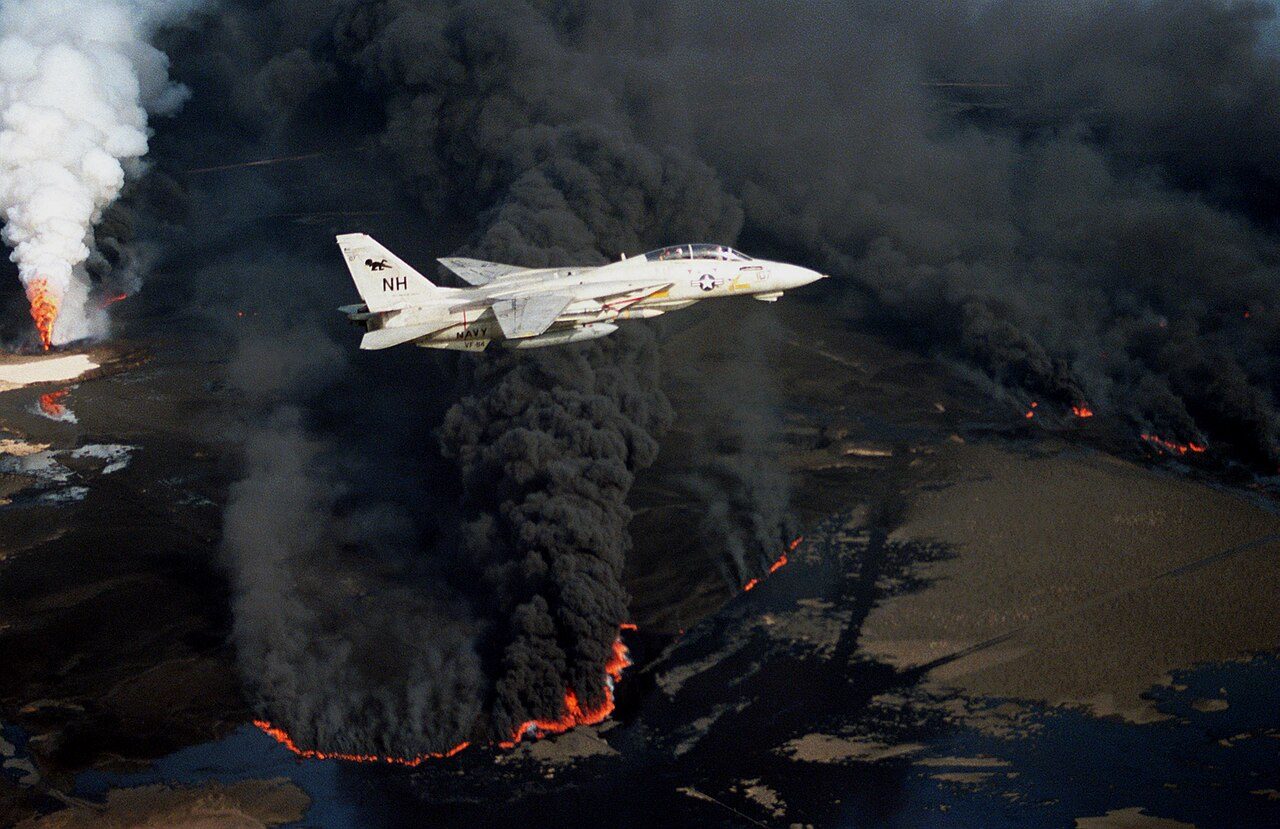
Saddam did not move. Coalition air operations opened on 17 January 1991, and after five weeks of bombing a ground offensive began on 24 February. The Iraqi military crumbled; Kuwait was liberated within the week, less than seven months after its annexation. In retreat, Iraqi forces set fire to Kuwait's oil wells — more than 600 of them — creating an environmental disaster that took most of a year to extinguish. The invasion had been meant to make Iraq the dominant power of the Gulf. Instead it produced the first great crisis of the post-Cold War world, and a template — a broad coalition acting under UN authority — that would not be repeated.
Why this date matters
August 2 is a date of signatures and seizures. On it in 1776 the American founders put their names to independence; on it in 1934 Hitler absorbed the German presidency into his own person; on it in 1990 a dictator simply took a neighbouring country off the map. It is also a day on which heads of state died at hinge moments — Harding in office in 1923, Hindenburg in 1934 — and on which Einstein's two-page letter quietly set the atomic age in motion. Few dates show so plainly how quickly a signature, or an army, can change what a country is.
Sources
- Encyclopaedia Britannica — On This Day: August 2
- HISTORY — What Happened on August 2
- Encyclopaedia Britannica — Persian Gulf War
- Wikimedia — On This Day feed: August 2
The facts on this page were checked against these sources on 19 November 2026. The History Trail's permanent pages are researched and written for this site; the live profiles elsewhere on The History Trail are assembled automatically from Wikipedia and Wikidata.
About the Author
Researched and written by the The History Trail Editorial Team — the accountable editorial function behind this site's permanent story pages. The team works from the published sources cited on each page; it does not invent historians, reviewers or credentials, and it corrects errors openly.
Fact Check
Every load-bearing fact on this page traces to one of the sources listed above, and significant claims link to their source in the text. Our checking method is described on the methodology page; errors can be reported via the corrections page.
Sources & Citations
Cite this page as: The History Trail Editorial Team, The History Trail — this article's title, publication and update dates are shown beneath its headline. The full source list appears under Sources above; the site's source standards are on the sources page.