
On This Day
December 1 in History
On 1 December 1955, in Montgomery, Alabama, a 42-year-old seamstress named Rosa Parks refused to surrender her seat on a segregated city bus to a white passenger and was arrested. That quiet refusal set off the 381-day Montgomery bus boycott, made a young pastor named Martin Luther King, Jr. a national figure, and became one of the founding moments of the modern civil rights movement. December 1 is also the day Ford's first moving assembly line started, the Antarctic Treaty was signed and the two ends of the Channel Tunnel met.
Choose another date: open the On This Day calendar to browse events, births and deaths for any day of the year.
At a Glance
- The act
- 1 December 1955 — Rosa Parks refuses to move to the back of a Montgomery city bus and is arrested under the city's segregation code
- Who she was
- A 42-year-old seamstress at the Montgomery Fair department store and a veteran NAACP activist, not a stranger to the movement
- The response
- Montgomery's Black community boycotts the city buses from 5 December 1955, led by the 26-year-old Martin Luther King, Jr.
- The length
- 381 days — the boycott holds until December 1956, when a federal court order reaches the city
- The legal end
- Browder v. Gayle (1956) rules bus segregation unconstitutional; the Supreme Court affirms, and the buses are desegregated
- The record
- Her police report and fingerprint card survive in the National Archives, filed as evidence in Browder v. Gayle
Events on this day
- 1825Tsar Alexander I of Russia dies at Taganrog, aged 47; his death, with no clear succession settled, triggers the Decembrist revolt of army officers later that month.
- 1862President Abraham Lincoln sends Congress his annual message — in effect a State of the Union address — defending his war policy and his preliminary Emancipation Proclamation, issued ten weeks earlier.
- 1913Henry Ford switches on the first moving assembly line for the mass production of a whole automobile at Highland Park, Michigan, cutting the time to build a Model T chassis from over twelve hours to about an hour and a half.
- 1925The Locarno Treaties, negotiated in October to settle Germany's western borders and ease post-war tensions, are formally signed in London.
- 1955Rosa Parks refuses to give up her seat on a segregated Montgomery bus and is arrested — the featured story above.
- 1958Fire sweeps the Our Lady of the Angels school in Chicago, killing 87 children and three nuns, with five more children dying later of their injuries — 95 deaths in all, and a turning point in American school fire-safety law.
- 1959Twelve nations, including the United States and the Soviet Union, sign the Antarctic Treaty in Washington, banning military activity on the continent — the first arms-control agreement of the Cold War.
- 1988The first World AIDS Day is observed, making 1 December the annual focus of the global campaign against HIV and AIDS.
- 1990The two halves of the Channel Tunnel meet beneath the English Channel as British and French tunnellers break through, joining Britain to the European mainland by land for the first time since the Ice Age.
- 2000Vicente Fox is inaugurated as president of Mexico, ending 71 years of rule by the Institutional Revolutionary Party.
Born on this day
- 1761Marie Tussaud — Strasbourg-born wax modeller who survived the French Revolution and founded the famous London wax museum that bears her name.
- 1884Karl Schmidt-Rottluff — German painter and printmaker, a cofounder of Die Brücke and a pioneer of Expressionism.
- 1945Bette Midler — American singer and actress, born in Honolulu, who rose from New York cabaret to Broadway and film stardom.
- 1970Sarah Silverman — American comedian and actress known for her taboo-breaking stand-up and The Sarah Silverman Program.
Died on this day
- 1825Alexander I — emperor of Russia from 1801, victor over Napoleon in 1812, dead at 47 in circumstances romantic legend refused to leave alone.
- 1934Sergei Kirov — Leningrad party chief and Politburo member, shot dead in his office; Stalin used his murder as the pretext for the Great Terror that followed.
- 1973David Ben-Gurion — the founding prime minister of Israel, who had proclaimed the state's independence in 1948, dead at 87.
The featured story: Rosa Parks refuses to give up her seat, 1 December 1955
Rosa Parks was riding home from work. She had spent the day sewing at the Montgomery Fair department store, and on the evening of Thursday 1 December 1955 she boarded a Cleveland Avenue bus and took a seat in the first row of the section reserved for Black passengers, just behind the whites-only rows at the front. As the bus filled, the driver, James F. Blake, ordered the four Black passengers in her row to stand so that a white man could sit. Three of them moved. Parks, as the National Archives account puts it, quietly set off a social revolution: she refused. Blake called the police, and she was arrested, booked, fingerprinted and charged with violating the city code that enforced racial segregation on Montgomery's buses.
It is tempting to picture the refusal as a tired woman's impulse, and Parks herself spent years correcting the story. She was 42, the secretary of the local NAACP chapter, and had trained in nonviolent resistance; she had also had a run-in with the same driver twelve years earlier. Her arrest was not the first on Montgomery's buses — Claudette Colvin, a fifteen-year-old, had been arrested for the same refusal that March — but Parks, a respected seamstress of, in the Archives' phrase, unchallenged character, was the figure around whom a movement could be built. Within days, Montgomery's Black churches and civic groups had organised the Montgomery Improvement Association and called a boycott of the buses.
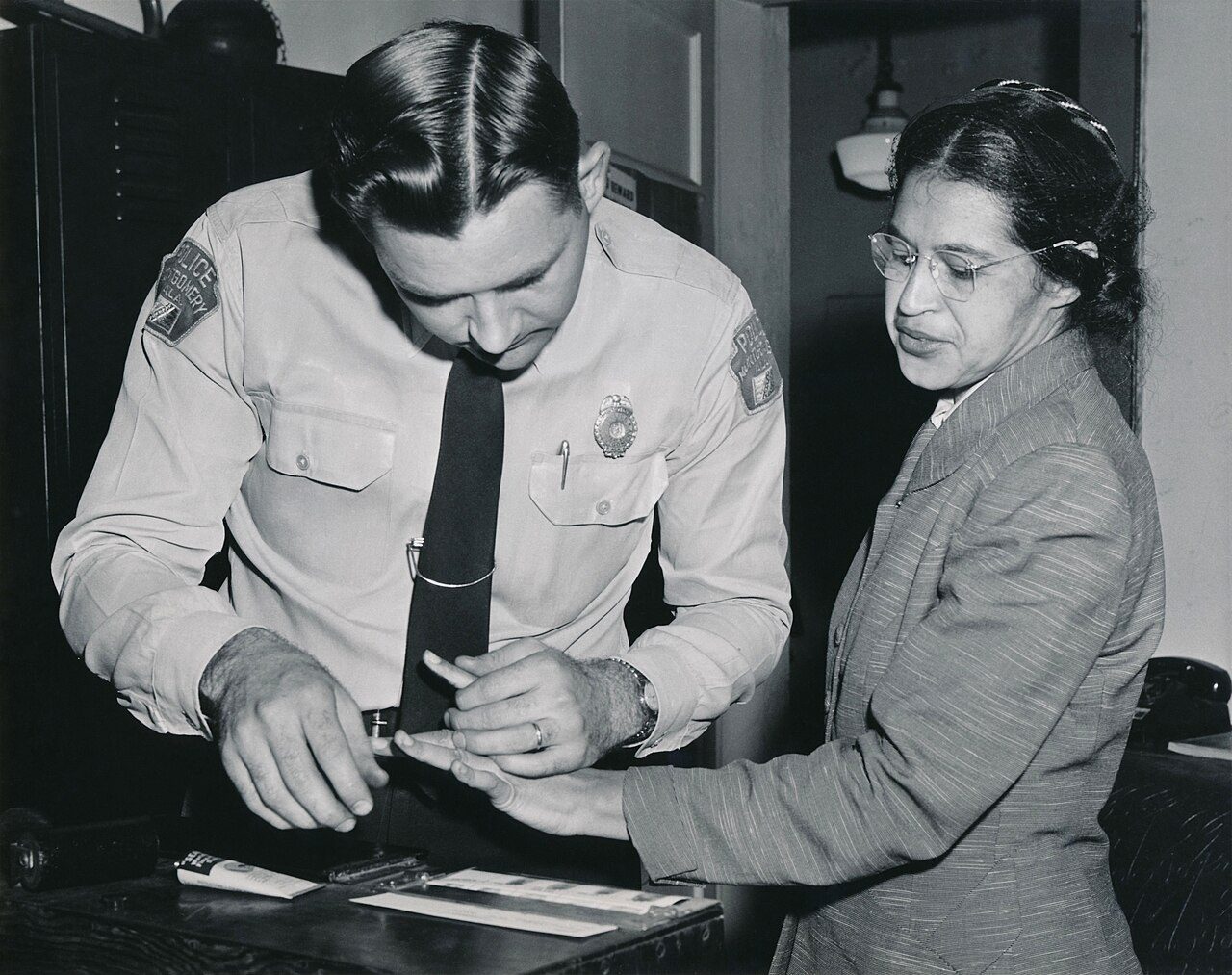
The boycott began on Monday 5 December, the day Parks was convicted and fined, and it was meant at first to last a day. Instead it lasted 381 days. Tens of thousands of Black riders — the great majority of the bus company's customers — walked, cycled, shared cars and rode in an improvised fleet of station wagons and taxis rather than submit to segregated seating. The movement's spokesman was a 26-year-old pastor, Martin Luther King, Jr., of the Dexter Avenue Baptist Church, whose house was bombed in the boycott's second month and who emerged from the campaign as the voice of a new kind of American protest. Parks herself was indicted in February 1956, along with more than a hundred others, for organising an illegal boycott; the fingerprinting photograph that illustrates this page dates from that second arrest.
The end came through the courts rather than the streets. In Browder v. Gayle — a case deliberately brought in the names of other Montgomery women, so that Parks's own criminal appeal could not be used to delay it — a federal court ruled in June 1956 that segregation on the buses was unconstitutional, and the Supreme Court affirmed the ruling that November. When the written order reached Montgomery on 20 December 1956, the boycott ended, and the next morning King, Parks and their colleagues boarded integrated buses. A seat kept for a few minutes on 1 December 1955 had become the Supreme Court's word on a city's buses, and the template — disciplined, nonviolent, mass economic pressure — for the movement that would transform the United States over the following decade.
Why this date matters
December 1 is a day on which small mechanisms move large things. A single occupied seat, held for a few minutes, brings down a city's segregation code; a moving belt in a Detroit suburb cuts the price of a car until ordinary families can buy one; a treaty signed in Washington takes a whole continent out of the Cold War's firing line; and two tunnel boring crews, meeting under the Channel, quietly end Britain's island geography. Again and again the date's history turns on someone refusing — or managing — to stay exactly where they were.
Sources
- Encyclopaedia Britannica — On This Day: December 1
- HISTORY — What Happened on December 1
- National Archives — An Act of Courage: The Arrest Records of Rosa Parks
- Smithsonian Magazine — Document Deep Dive: Rosa Parks' Arrest Records
The facts on this page were checked against these sources on 19 November 2026. The History Trail's permanent pages are researched and written for this site; the live profiles elsewhere on The History Trail are assembled automatically from Wikipedia and Wikidata.
About the Author
Researched and written by the The History Trail Editorial Team — the accountable editorial function behind this site's permanent story pages. The team works from the published sources cited on each page; it does not invent historians, reviewers or credentials, and it corrects errors openly.
Fact Check
Every load-bearing fact on this page traces to one of the sources listed above, and significant claims link to their source in the text. Our checking method is described on the methodology page; errors can be reported via the corrections page.
Sources & Citations
Cite this page as: The History Trail Editorial Team, The History Trail — this article's title, publication and update dates are shown beneath its headline. The full source list appears under Sources above; the site's source standards are on the sources page.