
On This Day
October 16 in History
On 16 October 1793 Marie Antoinette, the last queen of France before the Revolution abolished the monarchy, was guillotined at the Place de la Révolution in Paris, nine months after her husband Louis XVI suffered the same fate. October 16 is also the day ether anaesthesia was first publicly demonstrated, the Walt Disney Company was founded, and Oscar Wilde was born.
Choose another date: open the On This Day calendar to browse events, births and deaths for any day of the year.
At a Glance
- Born
- 2 November 1755 in Vienna, an Austrian archduchess, youngest daughter of Empress Maria Theresa
- Married
- 1770, aged 14, to the future Louis XVI — a marriage sealing the Franco-Austrian alliance
- Queen
- From 1774; blamed, fairly and unfairly, for court extravagance as France slid toward bankruptcy and revolution
- The trial
- 14–15 October 1793 before the Revolutionary Tribunal, on charges of treason and conspiracy with foreign powers
- Executed
- 16 October 1793, aged 37, at the Place de la Révolution, now the Place de la Concorde
- The famous words she never said
- 'Let them eat cake' appears in Rousseau, written when she was a child in Austria; there is no evidence she ever said it
Events on this day
- 1793Marie Antoinette is guillotined at the Place de la Révolution in Paris, nine months after Louis XVI — the featured story above.
- 1813The Battle of Leipzig begins; over three days the combined armies of Austria, Prussia, Russia and Sweden inflict Napoleon's first decisive defeat in Germany.
- 1834Fire destroys the Palace of Westminster in London; the blaze, started by the burning of old Exchequer tally sticks, leaves only Westminster Hall and the Jewel Tower standing.
- 1846At Massachusetts General Hospital, dentist William Morton publicly demonstrates ether as a surgical anaesthetic — 'Ether Day', the birthday of painless surgery.
- 1854In his Peoria speech, Abraham Lincoln sets out his case against the Kansas-Nebraska Act and the spread of slavery.
- 1859Abolitionist John Brown seizes the federal arsenal at Harpers Ferry, Virginia, hoping to ignite a slave rebellion; U.S. Marines storm the engine house two days later.
- 1869The Cardiff Giant, a supposed petrified man, is 'discovered' in New York state; it is soon exposed as a carved gypsum hoax — and a profitable one.
- 1916Margaret Sanger opens the first birth-control clinic in the United States, in Brooklyn, New York; police close it within days.
- 1923Walt and Roy Disney found the Disney Brothers Cartoon Studio in Hollywood — the seed of the Walt Disney Company.
- 1934Communist forces in Jiangxi begin the Long March, the year-long retreat across China that carries Mao Zedong to leadership of the party.
- 1946Ten Nazi leaders convicted at Nuremberg, among them Joachim von Ribbentrop and Wilhelm Keitel, are hanged in the prison gymnasium.
- 1964China detonates its first atomic bomb at Lop Nur, becoming the world's fifth nuclear power.
- 1968At the Mexico City Olympics, American sprinters Tommie Smith and John Carlos raise gloved fists on the medal podium in protest at racial injustice.
- 1978Cardinal Karol Wojtyła of Kraków is elected pope as John Paul II, the first non-Italian pope in 455 years.
- 1995Hundreds of thousands gather in Washington, D.C. for the Million Man March, a demonstration of African American men organised by Louis Farrakhan.
Born on this day
- 1758Noah Webster — American lexicographer whose dictionary and 'blue-backed speller' standardised American English.
- 1854Oscar Wilde — Irish playwright and wit, author of The Importance of Being Earnest and The Picture of Dorian Gray.
- 1886David Ben-Gurion — Polish-born leader who proclaimed the State of Israel and became its first prime minister.
- 1888Eugene O'Neill — American playwright, Nobel laureate, author of Long Day's Journey into Night.
- 1927Günter Grass — German novelist, Nobel laureate, whose The Tin Drum confronted his country's Nazi past.
- 1958Tim Robbins — American actor and director, star of The Shawshank Redemption.
Died on this day
- 1959George C. Marshall — American general and statesman, architect of the Marshall Plan for Europe's recovery and a Nobel Peace laureate.
- 1981Moshe Dayan — Israeli general and politician, the eye-patched defence minister of the Six-Day War.
- 1989Cornel Wilde — Hungarian-American actor and director, a swashbuckling star of the 1940s.
- 2007Deborah Kerr — Scottish actress of From Here to Eternity and The King and I.
The featured story: Marie Antoinette is executed, 16 October 1793
Marie Antoinette arrived in France in 1770 as a 14-year-old Austrian archduchess, married to the heir to the throne to cement an alliance between two hereditary enemies. As queen from 1774 she became the focus of everything France resented about its court: its spending, its Austrian connection, its remoteness. Some of the charges were earned — her early extravagance was real — and many were manufactured by a pamphlet industry that made 'Madame Déficit' the villain of the coming revolution. The phrase that defines her in popular memory, 'let them eat cake', was never hers: Rousseau had written it down when she was still a child in Vienna.
The Revolution stripped the story of any nuance. After the monarchy's fall in 1792 and Louis XVI's execution in January 1793, the widowed queen — 'the Widow Capet' to her jailers — was held in the Conciergerie while France fought for survival against most of Europe, Austria included. Her trial before the Revolutionary Tribunal opened on 14 October 1793. The charges mixed the plausible with the obscene: treasonous correspondence with Austria and the squandering of the treasury, alongside an accusation, promoted by the radical Jacques Hébert, of abusing her own son — at which she appealed, famously, 'to all mothers present'. The verdict was never in doubt; after a hearing of some 15 hours she was condemned unanimously.
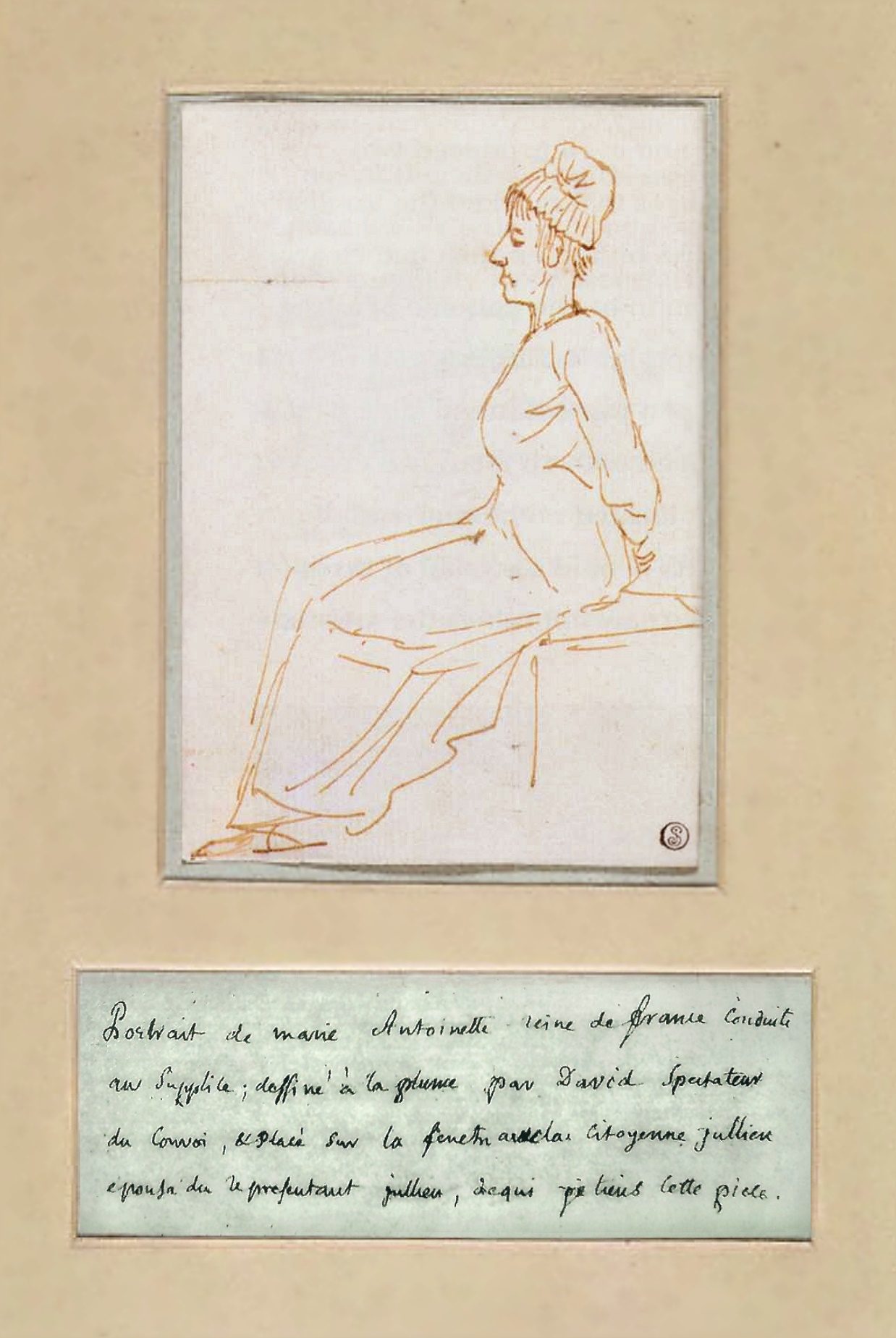
On the morning of 16 October she wrote a last letter to her sister-in-law, Madame Élisabeth, which was confiscated and never delivered. Denied the closed carriage granted to her husband, she was taken through Paris in an open cart, hands bound, her hair cut short, wearing a plain white dress — and, by every account including the sketch Jacques-Louis David made as she passed, entirely composed. At the scaffold on the Place de la Révolution she accidentally trod on the executioner Charles-Henri Sanson's foot and apologised: 'Pardon me, sir, I did not do it on purpose.' She was guillotined at about a quarter past twelve, aged 37.
Her death solved nothing for the Revolution — the Terror intensified for another nine months — but it fixed her image for two centuries: frivolous queen to her enemies, martyred mother to royalists, and to modern historians something harder, a politically inexperienced woman made to answer for the collapse of a system she had not created. Her remains, exhumed in 1815, rest with her husband's in the Basilica of Saint-Denis.
Why this date matters
October 16 holds the Revolution's most famous execution and, threaded around it, a surprising number of beginnings. On this date painless surgery begins in a Boston operating theatre, a birth-control clinic opens in Brooklyn, two brothers sign the papers for a cartoon studio in Hollywood, a Polish cardinal becomes pope, and a million men march on Washington. The date's pattern is stark: the old order ends on a scaffold in the morning of history, and the rest of the day is spent inventing what replaces it — in medicine, in media, in the church and in the streets.
Sources
- Encyclopaedia Britannica — On This Day: October 16
- HISTORY — What Happened on October 16
- Encyclopaedia Britannica — Marie-Antoinette, queen of France
- Wikimedia — On This Day feed: October 16
The facts on this page were checked against these sources on 19 November 2026. The History Trail's permanent pages are researched and written for this site; the live profiles elsewhere on The History Trail are assembled automatically from Wikipedia and Wikidata.
About the Author
Researched and written by the The History Trail Editorial Team — the accountable editorial function behind this site's permanent story pages. The team works from the published sources cited on each page; it does not invent historians, reviewers or credentials, and it corrects errors openly.
Fact Check
Every load-bearing fact on this page traces to one of the sources listed above, and significant claims link to their source in the text. Our checking method is described on the methodology page; errors can be reported via the corrections page.
Sources & Citations
Cite this page as: The History Trail Editorial Team, The History Trail — this article's title, publication and update dates are shown beneath its headline. The full source list appears under Sources above; the site's source standards are on the sources page.