
On This Day
July 22 in History
On 22 July 1942 the SS began the systematic deportation of Jews from the Warsaw Ghetto to the Treblinka killing centre — the start of the Grossaktion, in which about 265,000 people were sent to their deaths in two months. July 22 is also the day Lincoln first read his Emancipation Proclamation draft to his cabinet, Wiley Post completed his solo flight around the world, and terror attacks struck Norway in 2011.
Choose another date: open the On This Day calendar to browse events, births and deaths for any day of the year.
At a Glance
- The order
- 22 July 1942 — the SS orders the 'resettlement to the East' of Warsaw's Jews, with the Jewish Council forced to issue the decree
- The destination
- The Treblinka killing centre, newly built about 80 km north-east of Warsaw; deportees were murdered on arrival
- The assembly point
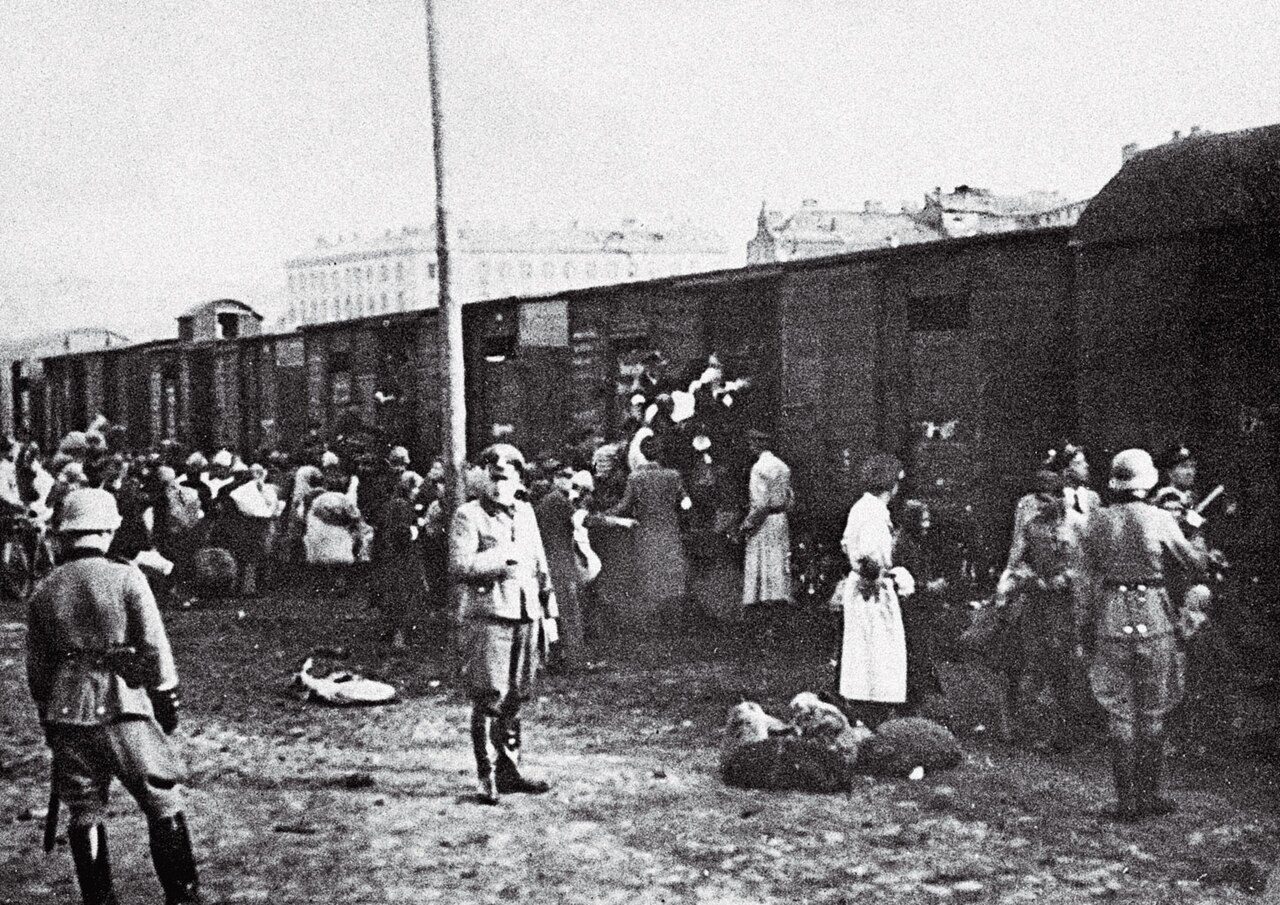
- The Umschlagplatz, a loading square by the railway siding at the ghetto's edge, where thousands waited overnight for trains
- The scale
- About 265,000 Jews deported from the ghetto to Treblinka between July and September 1942 (USHMM figure)
- The daily quota
- The Jewish Council was ordered to deliver thousands a day; its chairman, Adam Czerniaków, took his own life on 23 July
- The operation
- The Grossaktion Warsaw, part of Operation Reinhard, ran until 21 September 1942
- The consequence
- A residual ghetto of some 60,000 remained — the community that rose in the Warsaw Ghetto Uprising of April 1943
Events on this day
- 1298Edward I of England defeats William Wallace's Scots at the Battle of Falkirk, his longbowmen breaking the Scottish schiltron formations.
- 1793Scottish explorer Alexander Mackenzie reaches the Pacific coast at Bella Coola, completing the first recorded crossing of North America north of Mexico.
- 1862President Abraham Lincoln reads his cabinet a first draft of the Emancipation Proclamation, but agrees to wait for a Union military victory before issuing it.
- 1864Confederate forces under John Bell Hood attack Sherman's Union army outside Atlanta; the one-day Battle of Atlanta ends in a costly Confederate failure.
- 1894The first automobile race is held, from Paris to Rouen in France — a reliability trial that becomes the founding contest of motor sport.
- 1916A suitcase bomb explodes during San Francisco's Preparedness Day parade, killing 10 people and injuring 40 in an attack never conclusively solved.
- 1933Aviator Wiley Post lands in New York after flying solo around the world in 7 days, 18 hours and 49 minutes, the first solo circumnavigation by air.
- 1934Bank robber John Dillinger, America's first 'Public Enemy No. 1', is shot dead by FBI agents outside the Biograph Theater in Chicago.
- 1942The systematic deportation of Jews from the Warsaw Ghetto to the Treblinka killing centre begins — the featured story above.
- 1946The Irgun bombs the King David Hotel in Jerusalem, headquarters of the British administration in Palestine, killing 91 people.
- 1992Colombian drug lord Pablo Escobar escapes from La Catedral, the luxurious prison he had built for himself under a surrender deal.
- 2011Far-right terrorist Anders Behring Breivik kills 77 people in a bomb attack in Oslo and a mass shooting at a youth camp on the island of Utøya.
Born on this day
- 1784Friedrich Wilhelm Bessel — German astronomer who made the first successful measurement of the distance to a star other than the Sun.
- 1822Gregor Mendel — Austrian monk whose experiments with pea plants founded the science of genetics.
- 1849Emma Lazarus — American poet whose sonnet 'The New Colossus' is inscribed on the Statue of Liberty.
- 1882Edward Hopper — American painter of Nighthawks and other stark scenes of modern loneliness.
- 1888Raymond Chandler — American crime writer who created Philip Marlowe in The Big Sleep and Farewell, My Lovely.
- 1923Bob Dole — American senator from Kansas and the Republican presidential candidate of 1996.
- 1992Selena Gomez — American singer and actress who rose from Disney Channel child star to pop headliner.
Died on this day
- 1461Charles VII — king of France whose reign, aided by Joan of Arc, drove the English from most of France.
- 1826Giuseppe Piazzi — Italian astronomer who discovered Ceres, the first known asteroid.
- 1869John A. Roebling — German-American engineer who designed the Brooklyn Bridge and died of tetanus after an accident at its site.
- 1950William Lyon Mackenzie King — Canada's longest-serving prime minister, who led the country through the Second World War.
- 1967Carl Sandburg — American poet and Lincoln biographer who won three Pulitzer Prizes.
The featured story: the Warsaw Ghetto deportations begin, 22 July 1942
On 22 July 1942, German SS officers came to the Jewish Council in Warsaw with an order written in the Nazis' bureaucratic euphemism: all Jews in the Warsaw Ghetto, with listed exceptions, were to be 'resettled to the East'. The resettlement began that day. In reality, as the United States Holocaust Memorial Museum records, the trains that left the ghetto's Umschlagplatz — the loading square beside the railway siding — were bound for the newly built killing centre at Treblinka, some 80 kilometres away, where the deportees were murdered in gas chambers on arrival.
The ghetto they emptied was already a place of engineered misery. Since late 1940 the Germans had sealed roughly 400,000 Jews — about a third of Warsaw's population — into a walled district of a few streets, where starvation rations, disease and overcrowding killed thousands every month. The deportation order demanded thousands of people a day. The Jewish Council was ordered to deliver them; its chairman, Adam Czerniaków, refused to sign lists that included children and took his own life the following day, 23 July, as the scale of the deception became clear to him.
The operation, codenamed the Grossaktion, ran for two months, until 21 September 1942. Day after day, SS and police units with auxiliaries sealed streets, drove residents to the Umschlagplatz and loaded freight cars far beyond capacity, often after people had waited overnight without water in the summer heat. The USHMM puts the number deported from the ghetto to Treblinka between July and September 1942 at about 265,000; the POLIN Museum's account gives no fewer than 254,000. Nearly all were murdered. It was the largest single destruction of a Jewish community in the Holocaust's deadliest phase, Operation Reinhard.
What remained in Warsaw was a shrunken 'residual ghetto' of perhaps 60,000 people, many of them young workers who now understood exactly what deportation meant. From that knowledge came organisation: the fighters who, in April 1943, rose in the Warsaw Ghetto Uprising rather than board the trains. The deportations of July 1942 are therefore remembered twice over — as one of the Holocaust's greatest crimes, and as the event that taught its intended victims that survival would have to be seized, not granted.
Why this date matters
July 22 is a day on which journeys end badly for the powerful and worse for the powerless. A Scottish army's defiance ends at Falkirk; a bank robber's run ends outside a Chicago cinema; a drug lord walks out of his own prison; and in Norway in 2011 a terrorist turns on his own country's children. Against those endings stand two quieter crossings — Mackenzie reaching the Pacific, Wiley Post circling the globe alone — and one document read aloud in a cabinet room, Lincoln's draft proclamation, which promised that a different kind of journey, out of slavery, would soon be law. But the day's centre of gravity is Warsaw in 1942, where 'resettlement' trains began the journey from which almost no one returned.
Sources
- Encyclopaedia Britannica — On This Day: July 22
- HISTORY — What Happened on July 22
- United States Holocaust Memorial Museum — Deportations to and from the Warsaw Ghetto
- POLIN Museum of the History of Polish Jews — The Anniversary of the Great Liquidation Action at the Warsaw Ghetto
- Wikimedia Commons — Umschlagplatz loading.jpg

The facts on this page were checked against these sources on 19 November 2026. The History Trail's permanent pages are researched and written for this site; the live profiles elsewhere on The History Trail are assembled automatically from Wikipedia and Wikidata.
About the Author
Researched and written by the The History Trail Editorial Team — the accountable editorial function behind this site's permanent story pages. The team works from the published sources cited on each page; it does not invent historians, reviewers or credentials, and it corrects errors openly.
Fact Check
Every load-bearing fact on this page traces to one of the sources listed above, and significant claims link to their source in the text. Our checking method is described on the methodology page; errors can be reported via the corrections page.
Sources & Citations
Cite this page as: The History Trail Editorial Team, The History Trail — this article's title, publication and update dates are shown beneath its headline. The full source list appears under Sources above; the site's source standards are on the sources page.