
Years
1914 in History
1914 is the year a Balkan murder became a world war. On 28 June a 19-year-old student shot the heir to the Austro-Hungarian throne at Sarajevo; five weeks of ultimatums, mobilisations and alliance promises later, Europe's great powers were at war. By Christmas the armies were locked in trenches — and, for one famous day, climbed out of them to meet in no-man's-land.
At a Glance
- Defining event
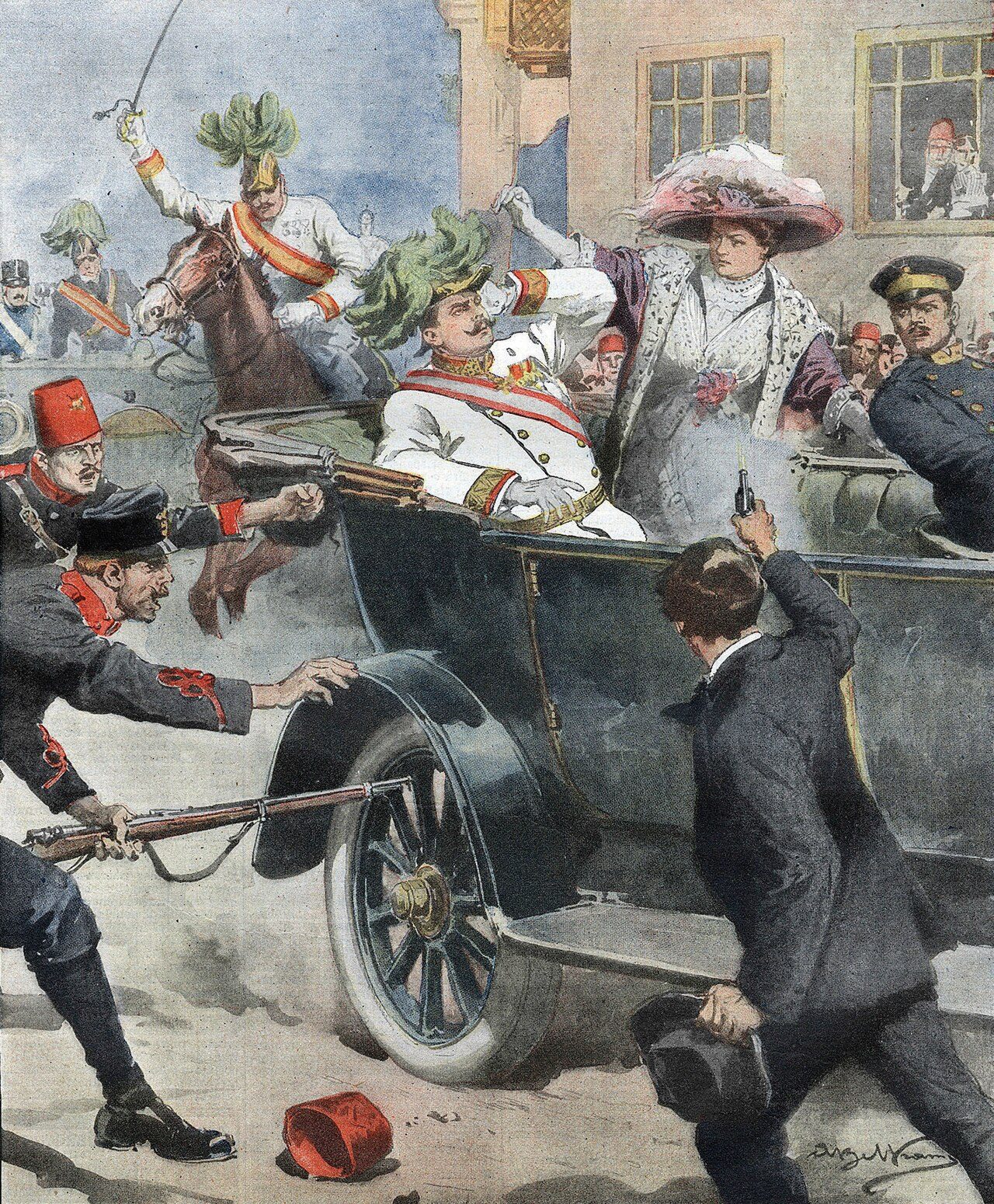
- Archduke Franz Ferdinand and his wife Sophie are assassinated at Sarajevo on 28 June
- The ultimatum
- Austria-Hungary gives Serbia 48 hours to accept ten demands on 23 July; Serbia accepts all but one point
- War begins
- Austria-Hungary declares war on Serbia on 28 July; Germany declares war on Russia (1 August) and France (3 August); Britain declares war on Germany on 4 August
- The trenches set
- The First Battle of the Marne (from 6 September) and First Ypres (from 19 October) end the war of movement in the west
- Also this year
- The Panama Canal opens to traffic on 15 August, linking the Atlantic and Pacific oceans
- Remembered for
- The Christmas Truce of 25 December, when soldiers on both sides met in no-man's-land
The defining story: from Sarajevo to the trenches
On the morning of Sunday, 28 June 1914, Archduke Franz Ferdinand, heir to the throne of Austria-Hungary, and his wife Sophie rode in an open car through Sarajevo, the capital of Bosnia, which the empire had annexed six years before. By about 10:45 both were dead, shot at point-blank range by Gavrilo Princip, a 19-year-old Bosnian Serb student. Princip was one of a group of young assassins — six were positioned along the motorcade route — supplied with pistols, bombs and cyanide through the Black Hand, a secret organisation of Serbian officers. The visit was itself a provocation in their eyes: 28 June was Vidovdan, the anniversary of the Battle of Kosovo in 1389 and the holiest date in the Serbian national calendar.
What killed the archduke was an error. After a reception at the city hall, where he protested bitterly at being received with bombs, Franz Ferdinand insisted on visiting the wounded in hospital. The route was changed, but the drivers were not told. Turning wrongly into Franz Joseph Street, the lead cars stopped and began to reverse — directly in front of a café where Princip, who had given up, was standing. He stepped forward and fired twice. Nearly a month of deceptive calm followed while Vienna, assured of German support by the Kaiser's 'blank cheque', prepared its response.
At six o'clock on the evening of 23 July, Austria-Hungary handed Serbia an ultimatum: 48 hours to accept ten demands drafted to be refused — including the notorious sixth point, allowing Austro-Hungarian delegates to take part in the judicial inquiry on Serbian territory itself. Serbia's reply, delivered minutes before the deadline on 25 July, accepted almost everything and rejected only the sixth point, offering to refer the dispute to the tribunal at The Hague. It was more submission than anyone had expected. Vienna was unmoved: on 28 July Austria-Hungary declared war on Serbia. Germany declared war on Russia on 1 August and on France on 3 August, setting the Schlieffen Plan in motion; on 4 August Britain declared war on Germany, and the United States proclaimed its neutrality.
The war of movement burned itself out by winter. German troops occupied Brussels and fought the British at Mons; the Battle of Tannenberg destroyed a Russian army in East Prussia; and on 6 September the First Battle of the Marne began as the French attacked the German flank north-east of Paris. The First Battle of Ypres, from 19 October, closed the last mobile phase in the west before the trenches set hard. Meanwhile the war widened — Britain and France declared war on the Ottoman Empire in November — and on 15 August the Panama Canal had opened to traffic, a peacetime triumph overtaken within days by war. On Christmas Day, along parts of the Western Front, German troops sang carols after midnight, and at dawn soldiers from both sides met in no-man's-land: the Christmas Truce.
Timeline of 1914
- 7 February
Charlie Chaplin's Little Tramp appears on screen for the first time, in the short film Kid Auto Races at Venice.
- 29 May
The liner Empress of Ireland sinks in the St. Lawrence River after a collision, killing 1,012 people.
- 28 June
Archduke Franz Ferdinand and his wife Sophie are assassinated at Sarajevo by Gavrilo Princip.
- 23 July
Austria-Hungary delivers its ultimatum to Serbia, giving Belgrade 48 hours to accept demands designed to be refused.
- 1 August
Germany declares war on Russia and France orders mobilisation, as the First World War begins.
- 3 August
Germany declares war on France and sets the Schlieffen Plan in motion.
- 4 August
Britain declares war on Germany, bringing the British Empire into the war; the United States proclaims neutrality.
- 15 August
The Panama Canal opens to traffic with the passage of the SS Ancon, linking the Atlantic and Pacific oceans.
- 26 August
The Battle of Tannenberg begins in East Prussia, ending in a catastrophic Russian defeat.
- 6 September
The First Battle of the Marne begins, as the French Sixth Army attacks the German First Army's flank north-east of Paris.
- 19 October
The First Battle of Ypres begins in Flanders, opening the last mobile phase of the war in the west.
- 5 November
Britain and France formally declare war on the Ottoman Empire, widening the war into the Middle East.
- 16 December
German warships bombard the English coastal towns of Hartlepool and Scarborough, killing more than a hundred civilians.
- 25 December
The Christmas Truce begins along parts of the Western Front: soldiers from both sides meet in no-man's-land.
Why 1914 still matters
1914 still matters because it is the hinge on which the modern world turned. In five weeks the alliance system converted a Balkan murder into a general European war, and the war that followed destroyed the world that had made it: the trenches that set hard after the Marne and Ypres defined the Western Front for four years, and the conflict spread from Flanders to the Middle East and the Indian coast within months. Almost everything in the century that followed — revolution in Russia, the settlement of 1919, the second war a generation later — runs back through the decisions of July and August 1914.
The year also left a counter-image. The Christmas Truce — carols after midnight, enemies meeting at dawn in no-man's-land — has become the war's most retold story precisely because it contradicts the machinery around it. It happened once, spontaneously, in the war's first winter, before the trenches and the hatred hardened; this site tells its full story as a permanent page. Between Sarajevo's wrong turn and that Christmas morning, 1914 contains both the century's catastrophe and its most famous refusal of it.
Two of the year's footnotes deserve their place in its meaning. The Panama Canal, opened on 15 August with the passage of the SS Ancon, was the era's greatest engineering triumph — and it opened in the very days Europe mobilised, a monument to the connected world the war was about to tear apart. And in May, before the shots at Sarajevo, the liner Empress of Ireland had sunk in the St. Lawrence River after a collision, killing 1,012 people — a disaster on Titanic's scale that the coming war almost erased from memory. The year was already teaching the century how quickly one catastrophe could be overtaken by a greater one.
1914 on The History Trail
The History Trail tells 1914 from the shots at Sarajevo to the Christmas Truce.
- June 28 in History — the assassination of Archduke Franz Ferdinand at Sarajevo.
- July 23 in History — Austria-Hungary delivers its ultimatum to Serbia.
- The Christmas Truce of 1914 — the full story of the soldiers who met in no-man's-land.
- Christmas — the festival at the heart of the truce story.
Sources
- National Geographic — How Franz Ferdinand's assassination changed the course of history
- Encyclopaedia Britannica — On This Day: June 28
- HISTORY — What Happened on July 23
- The Open University — The July Crisis: Ultimatum and the Outbreak of War
- Encyclopaedia Britannica — On This Day: August 15
- HISTORY — What Happened on August 4
The facts on this page were checked against these sources on 19 November 2026. The History Trail's permanent pages are researched and written for this site; the live profiles elsewhere on The History Trail are assembled automatically from Wikipedia and Wikidata.
About the Author
Researched and written by the The History Trail Editorial Team — the accountable editorial function behind this site's permanent story pages. The team works from the published sources cited on each page; it does not invent historians, reviewers or credentials, and it corrects errors openly.
Fact Check
Every load-bearing fact on this page traces to one of the sources listed above, and significant claims link to their source in the text. Our checking method is described on the methodology page; errors can be reported via the corrections page.
Sources & Citations
Cite this page as: The History Trail Editorial Team, The History Trail — this article's title, publication and update dates are shown beneath its headline. The full source list appears under Sources above; the site's source standards are on the sources page.