
Years
1915 in History
1915 is remembered for the afternoon of 7 May, when the German submarine U-20 torpedoed the Cunard liner Lusitania off Ireland: she sank in eighteen minutes with 1,198 people, among them 128 Americans, and United States opinion turned against Germany. The year also brought the Gallipoli landings on 25 April, the first major poison gas attack of the First World War at Ypres, and the completion of Einstein's general theory of relativity.
At a Glance
- Defining event
- Sinking of the Lusitania, 7 May — 1,198 dead, including 128 Americans
- Gallipoli
- Allied troops land on the Gallipoli Peninsula, 25 April; the campaign lasts eight months
- New weapon
- Germany releases chlorine gas at Ypres, 22 April — the first major poison gas attack of the war
- War at sea
- Germany declares the waters around the British Isles a war zone, 4 February
- Physics remade
- Einstein completes general relativity, rebuilding gravity as curved space-time
- Closed the year
- Nurse Edith Cavell executed in Brussels, 12 October, for helping Allied soldiers escape
The defining story: the Lusitania goes down
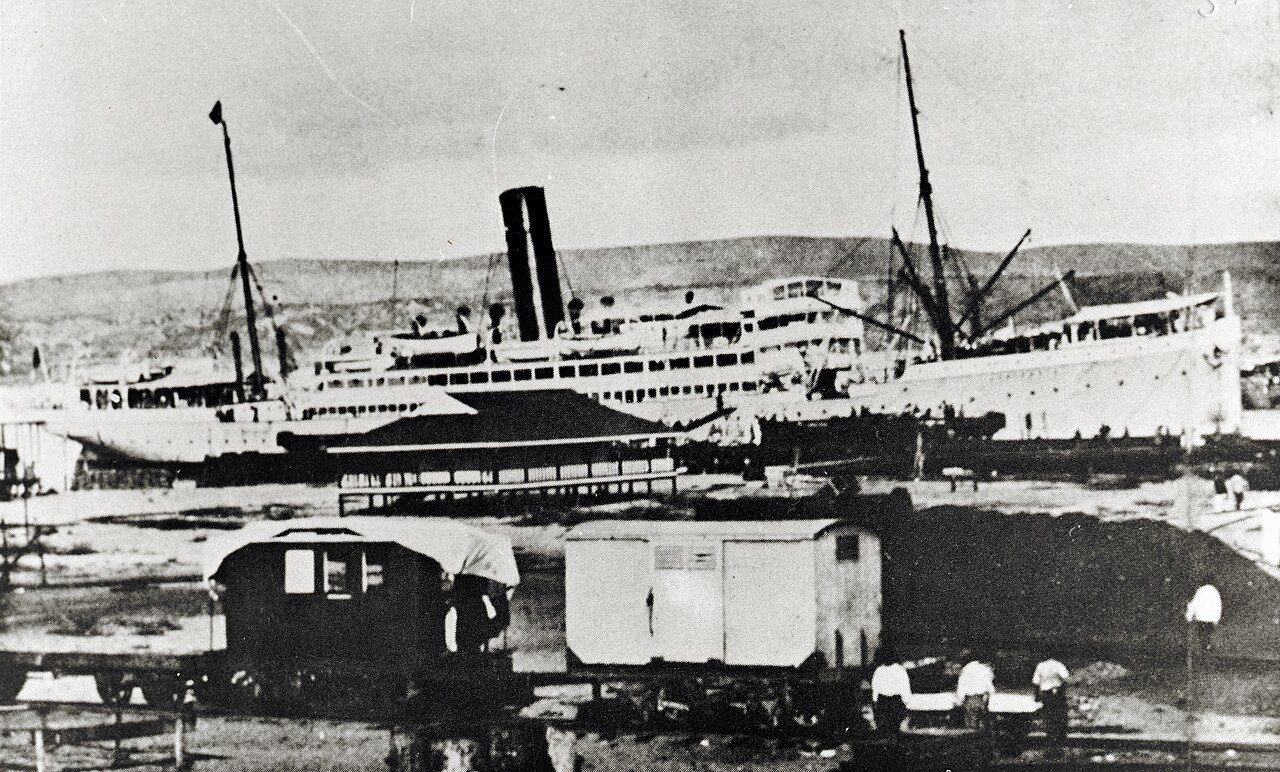
Lusitania was a greyhound of the Atlantic: launched in 1906, holder of the Blue Riband for speed, and one of the most famous ships in the world. When war came in 1914 she stayed in passenger service. In February 1915 Germany declared the waters around the British Isles a war zone, in which Allied shipping could be sunk without the customary warning and search, and the German embassy in Washington published newspaper advertisements warning travellers that ships flying the British flag were liable to destruction. The war at sea had already come home: on 19 January German zeppelins raided Great Yarmouth and King's Lynn, the first air raid on Britain.
The Allies, meanwhile, tried to break the deadlock of the trenches at the Dardanelles. British and French warships opened the naval attack on 19 February, and on 18 March the great naval assault failed with three battleships sunk to mines. The task passed to the army, and before dawn on 25 April Australian and New Zealand troops — the ANZACs — stormed ashore at the cove that took their name, beginning an eight-month campaign of attrition on the Gallipoli Peninsula. Three days earlier, on 22 April, Germany had released more than 150 tons of chlorine gas against Allied lines at Ypres in Belgium, opening the Second Battle of Ypres — the first major poison gas attack of the First World War.
On 1 May Lusitania sailed from New York with 1,960 people aboard and a cargo that included millions of rifle cartridges. On the last afternoon of the crossing, 7 May, steaming at reduced speed off the south coast of Ireland, she was sighted by Kapitänleutnant Walther Schwieger of U-20, who fired one torpedo. It struck under the bridge; seconds later came a second, larger explosion, whose cause — coal dust, a boiler, or the ammunition cargo — has been argued over for a century. Lusitania listed so steeply that most of her lifeboats could not be launched, and in eighteen minutes the great liner was gone, taking 1,198 people with her, including 128 Americans and 94 children.
Britain denounced a crime against civilisation; Germany answered that the ship was a legitimate target — listed as an armed merchant cruiser and carrying munitions, warned in advance. President Woodrow Wilson, determined to keep the United States out of the war, protested, and on 9 June his secretary of state, William Jennings Bryan, resigned in protest at Wilson's handling of the crisis. Italy had entered the war on the Allied side on 23 May. America did not — not yet — but the slow turn that would bring it into the war in 1917 began in those eighteen minutes off the Old Head of Kinsale.
Timeline of 1915
- 19 January
German zeppelins raid Great Yarmouth and King's Lynn — the first air raid on Britain.
- 4 February
Germany declares the waters around the British Isles a war zone; merchant ships may be sunk without warning.
- 19 February
British and French warships open the naval attack on the Dardanelles, first stage of the Gallipoli campaign.
- 18 March
The Allied naval attack on the Dardanelles fails; three battleships are sunk and the fleet withdraws.
- 22 April
Germany releases chlorine gas at Ypres — the first major poison gas attack of the First World War.
- 25 April
Allied troops land on the Gallipoli Peninsula; the ANZACs come ashore at Anzac Cove.
- 7 May
The liner Lusitania is torpedoed by U-20 off Ireland; 1,198 people die, among them 128 Americans.
- 23 May
Italy declares war on Austria-Hungary and enters the First World War on the Allied side.
- 9 June
William Jennings Bryan resigns as US secretary of state over Wilson's handling of the Lusitania crisis.
- 24 July
The excursion steamer Eastland capsizes at its dock in Chicago, killing 844 people.
- 8 September
A German Zeppelin bombs Aldersgate in central London, killing 22 people.
- 12 October
British nurse Edith Cavell is executed by a German firing squad in Brussels.
Why 1915 still matters
The Lusitania's sinking matters because it redrew the rules civilians lived by. A passenger liner, advertised and warned in the newspapers, was sunk without warning in eighteen minutes, and neither side's argument has ever quite gone away: Germany's claim of a legitimate military target against Britain's charge of a crime against civilisation. The diplomatic crisis it caused — Bryan's resignation, Wilson's protests, Germany's eventual curbs on submarine warfare — was the first act of the drama that ended with American troops in France. The second explosion's cause is still disputed, a reminder that even the century's most examined shipwreck keeps secrets.
Gallipoli failed in every aim — the straits stayed closed, the Ottoman Empire stayed in the war — yet 25 April became Anzac Day, the central day of remembrance for Australia and New Zealand, and the campaign made the reputation of Mustafa Kemal, the Turkish commander who would found modern Turkey. Its most successful operation was its ending: the December evacuation, tens of thousands of men lifted over successive nights behind self-firing rifles rigged to water-drip triggers, completed without a single life lost. The gas at Ypres, by contrast, succeeded as a weapon and thereby normalised one: poison gas, first used in a major attack in 1915, haunted every battlefield plan for the rest of the century.
Away from the war, 1915 quietly rebuilt the universe. Einstein completed general relativity, the theory that describes gravity as the curvature of space-time; four years later an eclipse would test it and make him world-famous. The year's American culture split along the country's oldest line: D. W. Griffith's The Birth of a Nation, premiered in February, was a landmark of film technique and a poisonous work of racist propaganda that helped revive the Ku Klux Klan. Technique and conscience, in 1915, did not advance together.
1915 on The History Trail
This year's featured days are the Gallipoli landings and the Lusitania, with the relativity story told in full.
- April 25 in History — Australian and New Zealand troops land at Anzac Cove on the Gallipoli Peninsula.
- May 7 in History — The Lusitania is torpedoed off Ireland; 1,198 people die.
- Theory of relativity — Einstein rebuilds space and time — special relativity in 1905, general relativity in 1915.
- April 22 in History — Germany releases chlorine gas at Ypres, the first major poison gas attack of the war.
- July 24 in History — The steamer Eastland capsizes in Chicago, killing 844 people.
- October 12 in History — Nurse Edith Cavell is executed by a German firing squad in Brussels.
Sources
- HISTORY — What Happened on April 25
- Encyclopaedia Britannica — On This Day: May 7
- Encyclopaedia Britannica — On This Day: April 22
- Encyclopaedia Britannica — On This Day: February 4
- Encyclopaedia Britannica — On This Day: October 12
- Encyclopaedia Britannica — On This Day: July 24
The facts on this page were checked against these sources on 19 November 2026. The History Trail's permanent pages are researched and written for this site; the live profiles elsewhere on The History Trail are assembled automatically from Wikipedia and Wikidata.
About the Author
Researched and written by the The History Trail Editorial Team — the accountable editorial function behind this site's permanent story pages. The team works from the published sources cited on each page; it does not invent historians, reviewers or credentials, and it corrects errors openly.
Fact Check
Every load-bearing fact on this page traces to one of the sources listed above, and significant claims link to their source in the text. Our checking method is described on the methodology page; errors can be reported via the corrections page.
Sources & Citations
Cite this page as: The History Trail Editorial Team, The History Trail — this article's title, publication and update dates are shown beneath its headline. The full source list appears under Sources above; the site's source standards are on the sources page.