
On This Day
July 23 in History
On 23 July 1914 Austria-Hungary delivered an ultimatum to Serbia — ten demands, a 48-hour deadline, and terms drafted to be rejected. Serbia's near-total acceptance changed nothing: war was declared on 28 July and Europe's alliances did the rest. July 23 is also the day NASA announced the Earth-like planet Kepler-452b and the day the Chinese Communist Party was founded.
Choose another date: open the On This Day calendar to browse events, births and deaths for any day of the year.
At a Glance
- The delivery
- 6 p.m., 23 July 1914 — Baron Giesl hands the ultimatum to the Serbian foreign ministry in Belgrade
- The deadline
- 48 hours — Serbia must accept all demands in full by the evening of 25 July
- The trigger
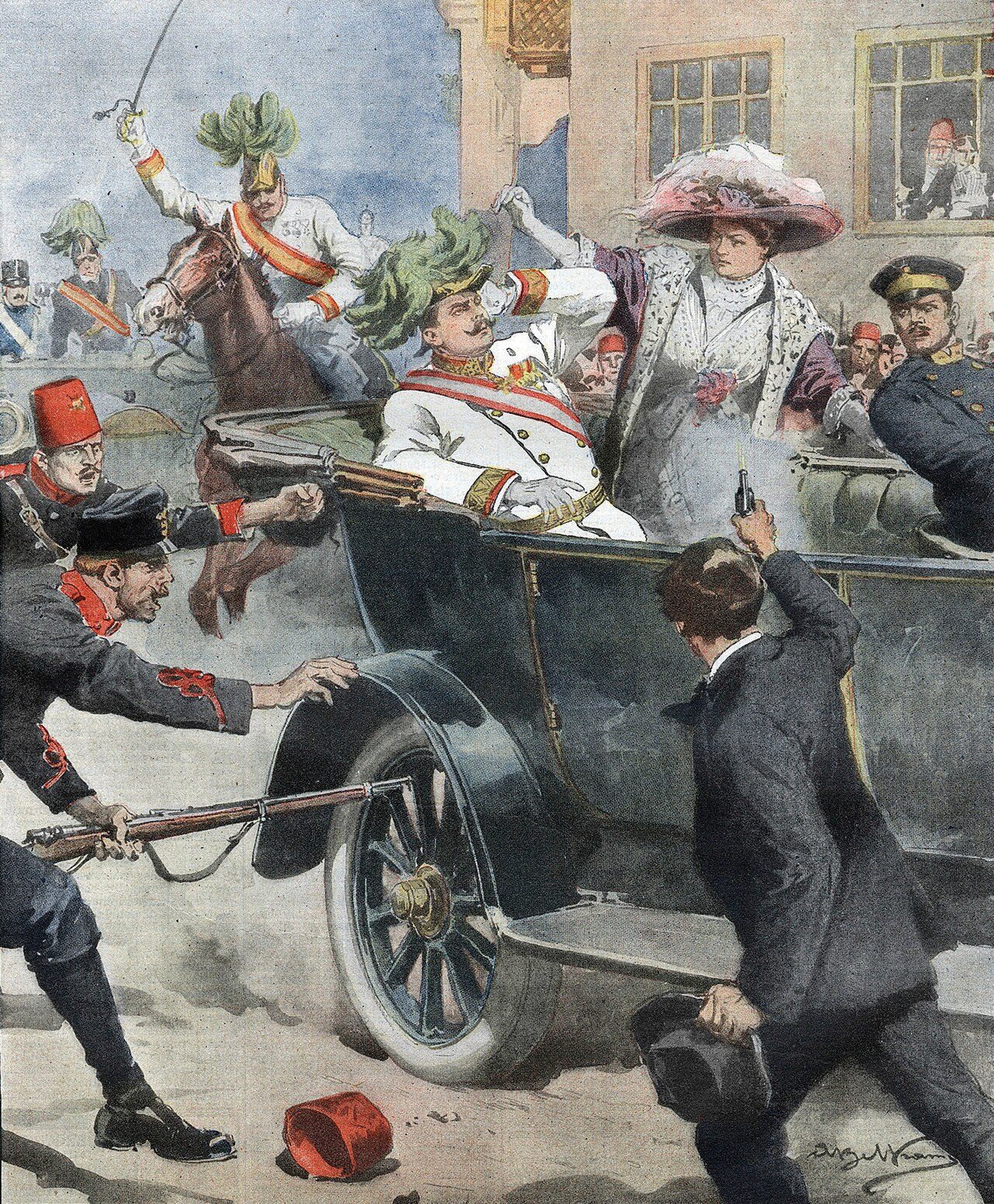
- The assassination of Archduke Franz Ferdinand and his wife Sophie at Sarajevo on 28 June 1914
- The hardest demand
- Point 6: Austro-Hungarian delegates to join the judicial inquiry on Serbian soil — the one demand Serbia refused
- Serbia's answer
- Acceptance of almost every demand, with The Hague offered for the disputed point
- The result
- Austria-Hungary breaks relations at once and declares war on Serbia on 28 July 1914
Events on this day
- 1829William Austin Burt patents the typographer, a working prototype of the typewriter, in the United States.
- 1840Britain's Act of Union receives assent, uniting Upper and Lower Canada into a single Province of Canada.
- 1903The Ford Motor Company sells its first car, a Model A, to a Chicago dentist — the start of the Ford production story.
- 1914Austria-Hungary delivers its ultimatum to Serbia, giving Belgrade 48 hours to accept demands designed to be refused — the featured story above.
- 1921The First Congress of the Chinese Communist Party opens in Shanghai, the founding meeting of the party that would rule China from 1949.
- 1952Egypt's Free Officers seize power in a coup led by Muhammad Naguib and Gamal Abdel Nasser, forcing King Farouk to abdicate within days.
- 1962Fourteen nations sign the International Agreement on the Neutrality of Laos in Geneva, pledging to respect Lao neutrality — a pledge the Vietnam War would shred.
- 1967A police raid on an unlicensed bar in Detroit sparks five days of rioting in which 43 people die and some 1,400 buildings are burned.
- 1972NASA launches Landsat 1, the first satellite in the programme that has photographed Earth's changing surface ever since.
- 1999Eileen Collins becomes the first woman to command a space shuttle, leading Columbia on mission STS-93, which deploys the Chandra X-ray Observatory.
- 2015NASA announces Kepler-452b, an exoplanet in its star's habitable zone, described as Earth's 'bigger, older cousin'.
Born on this day
- 1856Bal Gangadhar Tilak — Indian nationalist leader whose call for swaraj made him the first mass leader of India's independence movement.
- 1884Emil Jannings — German actor, the first winner of the Academy Award for Best Actor.
- 1892Haile Selassie — emperor of Ethiopia from 1930 to 1974, moderniser at home and a founding figure of African unity.
- 1906Chandra Shekhar Azad — Indian revolutionary who vowed never to be taken alive by the British, and kept the vow.
- 1961Woody Harrelson — American actor of Cheers, Natural Born Killers and True Detective.
- 1989Daniel Radcliffe — English actor who grew up on screen as Harry Potter.
Died on this day
- 1885Ulysses S. Grant — Union general who won the American Civil War and 18th president of the United States, dead of throat cancer at 63 days after finishing his memoirs.
- 1948D. W. Griffith — pioneering American film director of The Birth of a Nation and Intolerance.
- 2011Amy Winehouse — English singer-songwriter whose album Back to Black made her a global star, dead at 27.
- 2012Sally Ride — physicist and the first American woman in space, dead at 61.
The featured story: Austria-Hungary's ultimatum to Serbia, 23 July 1914
At six o'clock on the evening of 23 July 1914, the Austro-Hungarian minister in Belgrade, Baron Giesl von Gieslingen, handed the Serbian government an ultimatum. Serbia had 48 hours to accept it. Nearly a month had passed since a Bosnian Serb student, Gavrilo Princip, had shot Archduke Franz Ferdinand, the heir to the Habsburg throne, and his wife Sophie in Sarajevo — and Vienna, assured of German support by the Kaiser's 'blank cheque', had spent those weeks preparing a response meant not to settle the quarrel but to crush Serbia.
The document's ten demands were drafted to humiliate. Serbia was to publish a formal condemnation of anti-Austrian propaganda on the front page of its official journal, suppress publications and school teaching hostile to the Monarchy, dissolve nationalist organisations, dismiss officials and officers named by Vienna, arrest two named Serbian officials implicated in the plot — and, in the notorious sixth point, allow Austro-Hungarian delegates to take part in the judicial inquiry on Serbian territory itself. As the Open University's account of the July Crisis notes, Giesl's instructions were explicit: whatever Serbia answered, he was to break off relations; it must come to war.
Serbia's reply, delivered minutes before the deadline on 25 July, was a masterpiece of concession with one refusal. Belgrade accepted almost everything, hedged on details, and rejected only the sixth point — foreign officials operating inside Serbia — offering instead to refer the dispute to the tribunal at The Hague. It was more submission than anyone had expected, and even the Kaiser briefly thought it removed the reason for war. Vienna was unmoved. Giesl had already left Belgrade; on 28 July Austria-Hungary declared war on Serbia.
What followed was the alliance machine doing its work. Russia mobilised for Serbia; Germany declared war on Russia and France and invaded Belgium; Britain declared war on Germany. Within six weeks of the ultimatum's delivery, Europe's great powers were locked in the First World War — a conflict that would kill some twenty million people and destroy four empires, including the one that had written the ultimatum. Few single documents have ever carried a heavier charge than the note Giesl carried across Belgrade that evening.
Why this date matters
July 23 keeps producing papers that change the world: a patent for the machine that would mechanise writing, an act of union redrawing Canada, a neutrality agreement for Laos that nobody kept, and above all an ultimatum with a 48-hour fuse that lit the First World War. It is also a day of foundings and firsts in the heavens — Landsat beginning its long watch over Earth, Eileen Collins taking command of a shuttle, Kepler-452b raising the question of another Earth — and of cities under strain, from the Free Officers' Cairo to a Detroit that burned. Ultimatums and launches: the day specialises in points of no return.
Sources
- Encyclopaedia Britannica — On This Day: July 23
- HISTORY — What Happened on July 23
- The Open University — The July Crisis: Ultimatum and the Outbreak of War
- Wikimedia Commons — Domenica del Corriere cover, the Sarajevo assassination (Achille Beltrame)

The facts on this page were checked against these sources on 19 November 2026. The History Trail's permanent pages are researched and written for this site; the live profiles elsewhere on The History Trail are assembled automatically from Wikipedia and Wikidata.
About the Author
Researched and written by the The History Trail Editorial Team — the accountable editorial function behind this site's permanent story pages. The team works from the published sources cited on each page; it does not invent historians, reviewers or credentials, and it corrects errors openly.
Fact Check
Every load-bearing fact on this page traces to one of the sources listed above, and significant claims link to their source in the text. Our checking method is described on the methodology page; errors can be reported via the corrections page.
Sources & Citations
Cite this page as: The History Trail Editorial Team, The History Trail — this article's title, publication and update dates are shown beneath its headline. The full source list appears under Sources above; the site's source standards are on the sources page.