
Things
The Christmas Truce of 1914
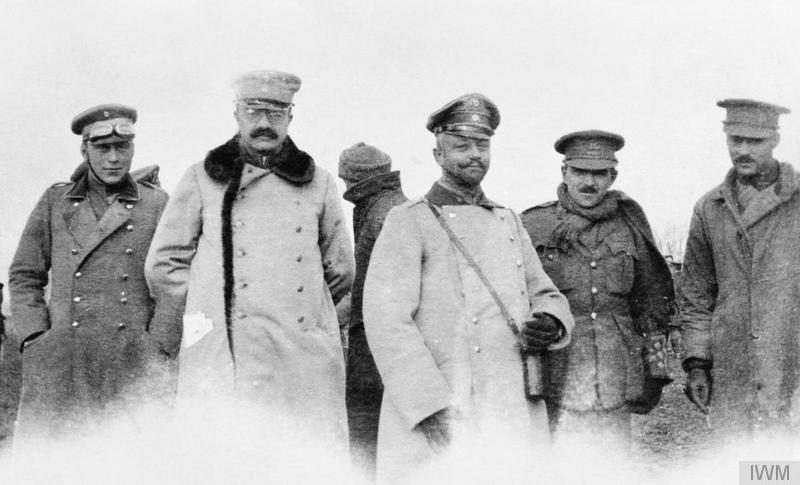
The Christmas Truce was a series of unofficial ceasefires along parts of the Western Front on 24 and 25 December 1914, five months into the First World War, when British and German soldiers sang carols across no man's land, met between the trenches, exchanged food and gifts, buried their dead — and, in places, kicked footballs about.
At a Glance
- When
- 24–25 December 1914, with some local ceasefires lasting until after New Year's Day
- Where
- Parts of the British–German front in France and Belgium; fighting continued elsewhere
- Scale
- Often estimated at around 100,000 British and German troops, though nobody counted at the time
- The carol
- 'Stille Nacht' ('Silent Night'), sung from the German trenches and answered in English
- Football
- Kickabouts are attested in letters and diaries; an organised match with a 3–2 score is not proven
- Aftermath
- High commands on both sides forbade any repeat; attempts at Christmas 1915 were suppressed
Introduction
In December 1914 the First World War was five months old, and the short war of movement had frozen into trenches. Along the British-held sector of the Western Front, the opposing lines sometimes ran within fifty yards of each other — close enough for soldiers to hear the men opposite singing. On Christmas Eve, in place after place, that singing turned into conversation, and conversation into something neither army had planned or authorised: a truce.
The Christmas Truce was never one event. It was a patchwork of local, unofficial ceasefires, strong along much of the British–German line and almost absent where French troops faced the occupiers of their own country. Men who had been trying to kill each other stood in the open, shook hands, swapped food and souvenirs, buried the dead lying between the trenches, and in some places kicked a football around. Then, within days, the war resumed — and the high commands made sure it never happened on that scale again.
Background: The War That Was Supposed to Be Over by Christmas
The war that began in August 1914 was expected to be short; soldiers on both sides were told it would be over by Christmas. Instead, the German advance was stopped at the Marne, the armies raced each other to the sea, and the First Battle of Ypres in the autumn bled both sides white. By December a continuous line of trenches ran from the Channel to Switzerland, and the men in them were enduring cold, mud, flooding and sniping in a war that had visibly settled in for the winter.
An appeal for a Christmas pause had already been made and refused. On 7 December 1914 Pope Benedict XV asked the warring governments to agree that the guns might fall silent at least on the night the angels sang; the leaders rejected it. Kaiser Wilhelm II, meanwhile, sent Christmas trees — Tannenbäume — to German front-line units. What happened next owed nothing to any of them: it began with the soldiers themselves.
Christmas Eve and Christmas Day 1914
On 23 and 24 December, German troops in many sectors set the little fir trees on their parapets and lit candles and lanterns along the trenches. Carols drifted across no man's land — above all 'Stille Nacht', 'Silent Night', a song both armies knew — and the British answered with carols of their own, including 'The First Noel'. Shouted greetings and jokes followed. In one Scots Guards account, a German message promised that if the British did not fire, the Germans would not fire either.
On Christmas morning men climbed out, unarmed, and met in the middle. They exchanged gifts — whisky, cigars, tinned food, plum puddings, and buttons and badges cut from uniforms as souvenirs — and posed for photographs. Joint burial services were among the commonest activities of the day: the dead who had lain between the lines since the autumn were finally collected and buried, sometimes with chaplains of both sides reading over the same graves, and trenches and dugouts were repaired in the open. Rifleman William Eve's diary for 25 December records a day of standing on the parapet, conversation, souvenir-swapping and football, with not a shot fired all day or night.
An often-quoted estimate suggests around 100,000 British and German troops took part in the informal cessations of hostility, though nobody counted and the truce was never universal. Along roughly two-thirds of the British Expeditionary Force's front the guns fell silent; elsewhere the war went on, and men were killed on Christmas Day in sectors where no truce took hold. After Boxing Day the meetings dwindled, though in some quiet places the ceasefire lingered until after New Year's Day.
Timeline
- August 1914
The First World War begins; soldiers on both sides expect to be home by Christmas.
- September–November 1914
The advance stalls at the Marne and at First Ypres; the Western Front hardens into trenches.
- 7 December 1914
Pope Benedict XV appeals for a Christmas truce; the warring governments refuse.
- 23–24 December 1914
German troops place Christmas trees and lanterns on their parapets and sing 'Stille Nacht'; British troops answer with carols.
- 25 December 1914
Along much of the British–German line, soldiers meet in no man's land, exchange gifts, bury the dead and, in places, play impromptu football.
- 26 December 1914
Boxing Day: the meetings begin to dwindle as units rotate and officers reassert control, though some local truces continue.
- Early January 1915
The last lingering local ceasefires end; in quiet sectors an informal 'live and let live' understanding survives.
- December 1915
High commands on both sides order that there be no repeat; attempts to revive the truce are quashed, in places with artillery fire on Christmas Eve.
- 11 November 1918
The Armistice silences the Western Front — the first general ceasefire since the truce of 1914.
Significance
The truce matters because it was made from below. No government ordered it and no general planned it; it grew out of shared carols, shared misery and the professional soldier's respect for the men opposite. Many of the troops of 1914 were regulars who respected rather than hated their opponents, and mass conscription, propaganda and atrocity stories had not yet done their work. For one day, the men doing the fighting briefly declined to fight, and the machinery of war could not immediately make them start again.
It also exposed the fragility of the system the armies were building. Some officers on the spot welcomed a quiet day, but the high commands saw fraternisation as a threat to fighting spirit, and after 1914 they took strong steps — orders, troop rotations and artillery fire timed for Christmas — to prevent any repetition. The truce's suppression is part of its meaning: it showed both what soldiers might choose and what their armies could not allow.
Myths and disputes
Did they play football? Yes — but not the way the legend tells it. Letters home and diaries, including Rifleman Eve's, mention football during the truce, and historians at the Imperial War Museum and the Smithsonian agree that impromptu kickabouts happened. The famous organised match is another matter. A letter in The Times of 1 January 1915, from a Rifle Brigade doctor, reported a match between the armies — but his own brigade's official history denied it. A Saxon officer, Johannes Niemann, later recalled a game against Scots that his regimental history scored 3–2 to the Germans, with caps for goalposts and no referee; yet the same 3–2 scoreline appears in Robert Graves's 1962 fictional reconstruction of a truce match. Ernie Williams, who took part in a kickabout, remembered it plainly in 1983: a ball was produced and men chased it, but there was no referee and no score, no tally at all. The honest verdict: kickabouts, attested; an organised international match ending 3–2, not proven.
Two softer myths also need correcting. The truce did not cover the whole front: it was weakest in the French sectors, where the enemy was occupying French soil, and there was no truce on the Eastern Front, where Orthodox Christmas fell in January. And the men of 1914 were not punished for it — Britannica notes there were no courts-martial for the fraternisation of that Christmas. The punishment was preventive, and it was aimed at 1915.
Legacy
The Christmas Truce has become the First World War's most retold story, retold in books, films and songs, and taught as the war's great parable of common humanity. The National Army Museum calls it a powerful tale of hope and humanity despite taking place during one of history's darkest times — and that is how it survives: not as a turning point, for it changed nothing about the war's course, but as evidence of what the men in the trenches, left to themselves for a day, chose to do.
Sources
- Imperial War Museums — The Real Story Of The Christmas Truce Of 1914
- Encyclopaedia Britannica — Christmas Truce
- Smithsonian Magazine — The Story of the WWI Christmas Truce
- National Army Museum — The Christmas Truce
The facts on this page were checked against these sources on 19 November 2026. The History Trail's permanent pages are researched and written for this site; the live profiles elsewhere on The History Trail are assembled automatically from Wikipedia and Wikidata.
About the Author
Researched and written by the The History Trail Editorial Team — the accountable editorial function behind this site's permanent story pages. The team works from the published sources cited on each page; it does not invent historians, reviewers or credentials, and it corrects errors openly.
Fact Check
Every load-bearing fact on this page traces to one of the sources listed above, and significant claims link to their source in the text. Our checking method is described on the methodology page; errors can be reported via the corrections page.
Sources & Citations
Cite this page as: The History Trail Editorial Team, The History Trail — this article's title, publication and update dates are shown beneath its headline. The full source list appears under Sources above; the site's source standards are on the sources page.