
On This Day
June 28 in History
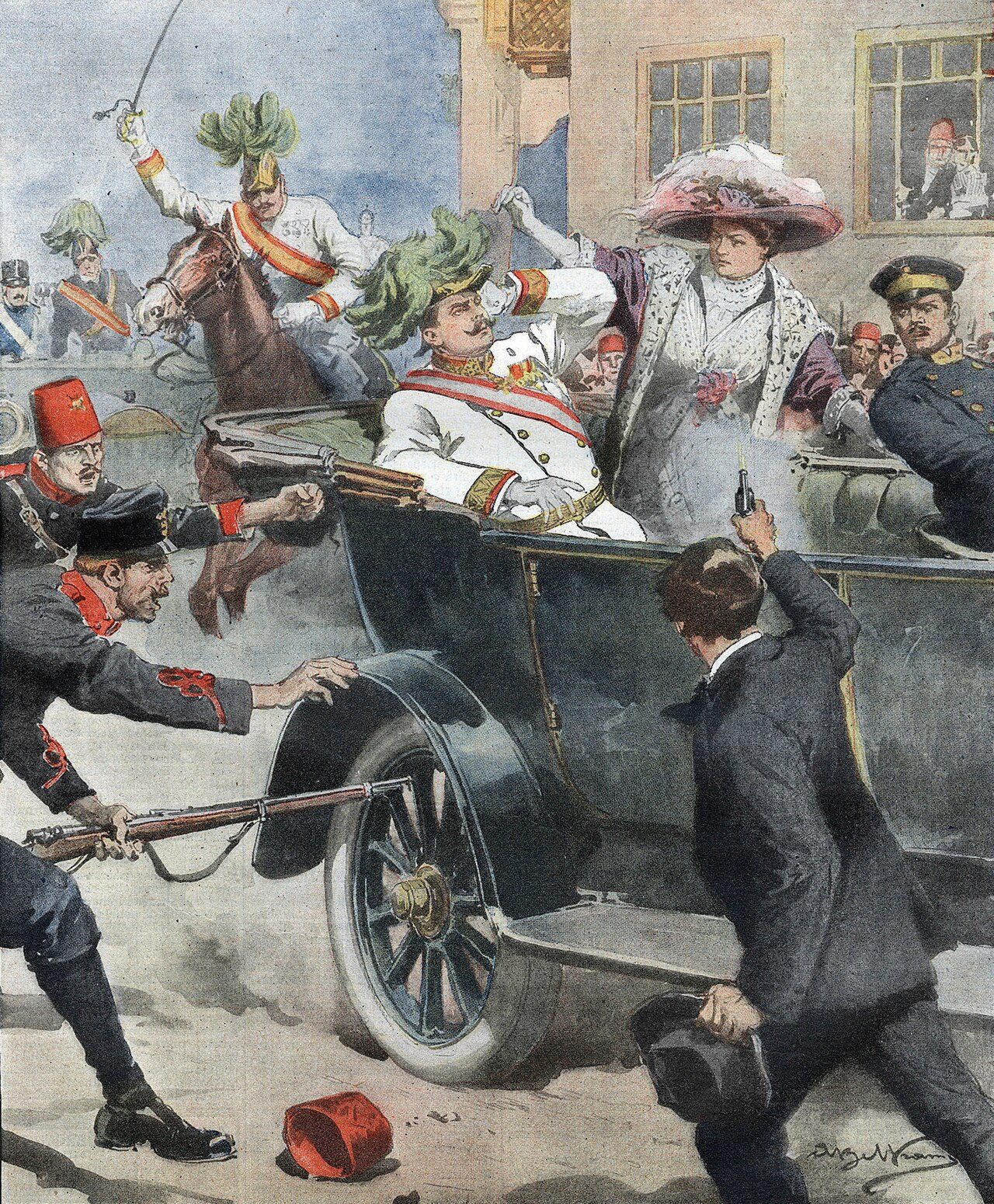
On 28 June 1914, in Sarajevo, a 19-year-old student named Gavrilo Princip shot dead Archduke Franz Ferdinand, heir to the Austro-Hungarian throne, and his wife Sophie. Five weeks later Europe was at war. June 28 is also the day the Treaty of Versailles was signed, the Stonewall uprising began, and Henry VIII and Elon Musk were born.
Choose another date: open the On This Day calendar to browse events, births and deaths for any day of the year.
At a Glance
- The victims
- Archduke Franz Ferdinand, heir to the Austro-Hungarian throne, and Sophie, Duchess of Hohenberg
- The assassin
- Gavrilo Princip, 19, a Bosnian Serb student armed through the Black Hand network
- The place
- Beside the Latin Bridge in Sarajevo, at about 10:45 on the morning of 28 June 1914
- The chance
- After an earlier bomb attack failed, the archduke's car took a wrong turn and stopped in front of Princip
- The consequence
- The July Crisis: Austria-Hungary declared war on Serbia on 28 July 1914, and the alliance system produced a general European war
- The assassin's fate
- Too young to hang, Princip received twenty years and died of tuberculosis in prison in 1918
Events on this day
- 1519Charles of Spain is elected Holy Roman emperor as Charles V, inheriting an empire on which, it was said, the sun never set.
- 1846Adolphe Sax receives a French patent for the saxophone, the instrument he designed to bridge brass and woodwind.
- 1914Archduke Franz Ferdinand and his wife Sophie are assassinated at Sarajevo — the featured story above.
- 1919Germany and the Allies sign the Treaty of Versailles, formally ending the state of war begun five years earlier.
- 1969Patrons of the Stonewall Inn in New York fight back against a police raid, the uprising that ignites the modern gay rights movement.
- 1997Mike Tyson bites Evander Holyfield's ear during their heavyweight title rematch in Las Vegas and is disqualified.
- 2000Elian Gonzalez, the Cuban boy at the centre of an international custody dispute, flies home to Cuba with his father.
- 2009Honduras's president, Manuel Zelaya, is seized by soldiers and flown out of the country in a coup.
- 2016Gunmen and suicide bombers attack Istanbul's Ataturk Airport, killing more than forty people.
Born on this day
- 1491Henry VIII — king of England whose break with Rome reshaped the English church and state.
- 1577Peter Paul Rubens — Flemish painter and diplomat, the most influential artist of the Baroque in northern Europe.
- 1712Jean-Jacques Rousseau — Genevan philosopher of The Social Contract and Emile, prophet of the Romantic age.
- 1867Luigi Pirandello — Italian dramatist and novelist of Six Characters in Search of an Author, Nobel laureate in Literature.
- 1926Mel Brooks — American comedian and film-maker, creator of The Producers and Blazing Saddles.
- 1971Elon Musk — South African-born entrepreneur of Tesla and SpaceX.
Died on this day
- 1836James Madison — fourth president of the United States and the Constitution's principal architect, dead at Montpelier at 85.
- 1914Franz Ferdinand — archduke of Austria and heir to the Habsburg throne, assassinated at Sarajevo; see the featured story above.
- 1914Sophie, Duchess of Hohenberg — wife of Franz Ferdinand, killed beside him at Sarajevo.
- 1975Rod Serling — American screenwriter and creator of The Twilight Zone, dead at 50.
The featured story: the assassination at Sarajevo, 28 June 1914
On the morning of Sunday, 28 June 1914, Archduke Franz Ferdinand, heir to the throne of Austria-Hungary, and his wife Sophie rode in an open car through Sarajevo, the capital of Bosnia, which the empire had annexed six years before. By about 10:45 both were dead, shot at point-blank range by Gavrilo Princip, a 19-year-old Bosnian Serb student. The assassination, as the standard accounts agree, was the most immediate cause of the First World War: within five weeks the alliance system had converted a Balkan murder into a general European war that killed a generation and destroyed four empires, including the one Franz Ferdinand was to have inherited.
The plot was a conspiracy of schoolboys armed by a state within a state. Princip was one of a group of young Bosnian assassins — six were positioned along the motorcade route that morning — organised by Danilo Ilic and supplied with pistols, bombs and cyanide through the Black Hand, a secret organisation of Serbian officers dedicated to uniting all Serbs in one state. The archduke's visit was itself a provocation in their eyes: 28 June was Vidovdan, St Vitus's Day, the anniversary of the Battle of Kosovo in 1389 and the holiest date in the Serbian national calendar, and Franz Ferdinand had come to inspect army manoeuvres. The first attempt of the day failed when Nedeljko Cabrinovic threw a bomb that bounced off the archduke's car and exploded under the following vehicle, wounding officers and bystanders; Cabrinovic swallowed his cyanide, which only made him vomit, and was arrested.
What killed the archduke was an error. After a reception at the city hall, where he protested bitterly at being received with bombs, Franz Ferdinand insisted on visiting the wounded in hospital. The route was changed, but the drivers were not told. Turning wrongly into Franz Joseph Street, the lead cars stopped and began to reverse — directly in front of a cafe where Princip, who had given up and gone for a sandwich by the usual account, was standing. He stepped forward and fired twice. One bullet struck Sophie in the abdomen; the other severed the archduke's jugular vein. Sophie died almost at once. Franz Ferdinand, bleeding from the mouth, was heard to plead with her — 'Sopherl, don't die, stay alive for the children' — and died within the hour.
The July Crisis that followed was not inevitable in its outcome, but every government chose the step that made war likelier. Austria-Hungary, assured of German support by the famous 'blank cheque', sent Serbia an ultimatum designed to be rejected, and declared war on 28 July. Russia mobilised for Serbia; Germany declared war on Russia and France and invaded Belgium; Britain declared war on Germany on 4 August. Princip, too young for the death penalty under Austrian law, was sentenced to twenty years and died of tuberculosis in prison in 1918, months before the empire he had struck ceased to exist. The car, the uniform and the pistol are still displayed in Vienna's Museum of Military History — relics of the twenty minutes that set the twentieth century alight.
Why this date matters
June 28 is the date the twentieth century began, whatever the calendar says. Two pistol shots in a provincial capital set off the war that destroyed the old European order, and the peace that closed that war was signed on the same date five years later, at Versailles — an anniversary Germany noted and resented. The day's other entries rhyme with its centre: a police raid in 1969 that turned a persecuted minority into a movement, an emperor elected in 1519 whose inheritance made Europe's first world empire. It is a date about how small rooms and short moments — a cafe corner, a bar, a railway of wrong turns — acquire the power to move millions.
Sources
- Encyclopaedia Britannica — On This Day: June 28
- HISTORY — What Happened on June 28
- National Geographic — How Franz Ferdinand's assassination changed the course of history
- Brigham Young University — Sarajevo, June 28, 1914 (World War I Document Archive)
The facts on this page were checked against these sources on 19 November 2026. The History Trail's permanent pages are researched and written for this site; the live profiles elsewhere on The History Trail are assembled automatically from Wikipedia and Wikidata.
About the Author
Researched and written by the The History Trail Editorial Team — the accountable editorial function behind this site's permanent story pages. The team works from the published sources cited on each page; it does not invent historians, reviewers or credentials, and it corrects errors openly.
Fact Check
Every load-bearing fact on this page traces to one of the sources listed above, and significant claims link to their source in the text. Our checking method is described on the methodology page; errors can be reported via the corrections page.
Sources & Citations
Cite this page as: The History Trail Editorial Team, The History Trail — this article's title, publication and update dates are shown beneath its headline. The full source list appears under Sources above; the site's source standards are on the sources page.