
Years
1917 in History
1917 is the year the old world came apart. In Russia, two revolutions in eight months ended three centuries of Romanov rule and brought Lenin's Bolsheviks to power. The United States entered the First World War, Britain issued the Balfour Declaration on Palestine, and Finland declared its independence — a single year that set the terms of the century to come.
At a Glance
- Defining event
- The Bolsheviks seize power in Petrograd in the October Revolution, 7 November
- First revolution
- The February Revolution begins on 8 March; within a week Nicholas II abdicates, ending the Romanov dynasty
- America enters
- The United States declares war on Germany on 6 April; the first American troops land in France on 26 June
- The declaration
- Britain issues the Balfour Declaration on 2 November, supporting a national home for the Jewish people in Palestine
- New nation
- Finland's Parliament adopts the declaration of independence from Russia on 6 December
- Trigger at sea
- Germany resumes unrestricted submarine warfare on 1 February, helping bring the United States into the war
The defining story: two revolutions and a world remade
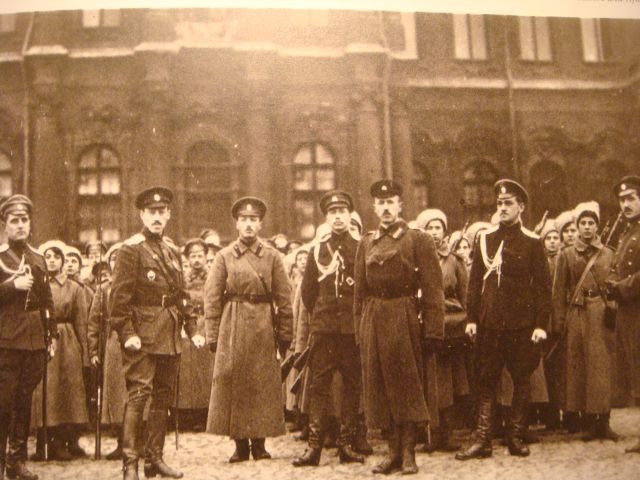
Petrograd was cold, hungry and tired of war. By the winter of 1916–17 the First World War had killed millions of Russian soldiers, the railways were failing, and the capital's bakeries could not keep bread in the shops. On 8 March 1917 — International Women's Day, and 23 February by the Julian calendar Russia still used — the women of the city's textile mills made the queue into a movement: thousands struck and marched, calling for bread and an end to the war. What made the February Revolution unstoppable was the soldiers. The Petrograd garrison was ordered to clear the streets; some units fired on the crowds, and then the regiments began to mutiny and join the demonstrations instead. On 15 March, in a railway carriage at Pskov, Nicholas II abdicated. The Romanov dynasty, which had ruled Russia for 304 years, ended a week after the textile workers walked out.
The Provisional Government that replaced the tsar promised elections and continued the war, sharing power uneasily with the soviets — councils of workers and soldiers. That unstable 'dual power' ran through a year in which the wider war also transformed. Germany had resumed unrestricted submarine warfare on 1 February, sinking neutral shipping without warning; the intercepted Zimmermann Telegram, proposing a German-Mexican alliance against the United States, reached the American ambassador in February and was published in American newspapers in March. On 6 April the United States formally declared war on Germany, and on 16 April Lenin returned to Petrograd from exile in a sealed train to take charge of the revolution.
In the autumn the second revolution came. The seizure of 7 November was organised by the Petrograd Soviet's Military Revolutionary Committee, directed in practice by Leon Trotsky, and timed to present the Congress of Soviets, meeting that day, with a finished fact. In the night of 6–7 November, Red Guards, soldiers and sailors occupied Petrograd's bridges, railway stations, telegraph office, telephone exchange and State Bank, mostly without firing a shot. The cruiser Aurora fired a blank round as a signal; after light shelling the Winter Palace was entered, and the Provisional Government's ministers were arrested at about two in the morning. The Congress proclaimed the transfer of power and adopted Lenin's Decrees on Peace and on Land.
Five days earlier, on 2 November, Britain had issued the Balfour Declaration: a letter from Foreign Secretary Arthur Balfour to Lord Rothschild declaring British support for 'the establishment in Palestine of a national home for the Jewish people' — a document of a few dozen words, approved as wartime statecraft while Britain fought the Ottoman Empire that ruled Palestine. In December the map moved again: Finland's Parliament adopted its declaration of independence on 6 December, ending 108 years as a Russian Grand Duchy, and Soviet Russia recognised Finnish independence on 31 December. On 15 December revolutionary Russia signed an armistice with the Central Powers, taking itself out of the war.
Timeline of 1917
- 1 February
Germany resumes unrestricted submarine warfare, sinking neutral shipping without warning.
- 24 February
The intercepted Zimmermann Telegram, proposing a German alliance with Mexico against the United States, is given to the American ambassador in London.
- 8 March
Women textile workers strike in Petrograd on International Women's Day, beginning the February Revolution.
- 31 March
The United States takes possession of the Danish West Indies, bought from Denmark for $25 million and renamed the US Virgin Islands.
- 6 April
The United States formally declares war on Germany and enters the First World War.
- 16 April
Vladimir Lenin returns to Petrograd from exile in a sealed train, to take charge of the Russian Revolution.
- 24 May
Britain introduces the convoy system to protect merchant shipping from German submarines.
- 26 June
The first American troops of the First World War land in France, at Saint-Nazaire.
- 17 July
George V renames the British royal house Windsor, shedding the German Saxe-Coburg-Gotha.
- 2 November
Britain issues the Balfour Declaration, supporting a national home for the Jewish people in Palestine.
- 6 November
Canadian troops capture the village of Passchendaele, ending the Third Battle of Ypres.
- 7 November
The Bolsheviks seize power in Petrograd in the October Revolution.
- 20 November
The Battle of Cambrai opens with a massed tank attack that breaks the Hindenburg Line before stalling.
- 6 December
Finland's Parliament adopts the declaration of independence from Russia; the same morning, the Halifax Explosion kills some 2,000 people in Nova Scotia.
Why 1917 still matters
1917 still matters because it invented the century's central contest. The Bolshevik seizure of power created the first communist state, and the government of People's Commissars elected that November night began an experiment whose consequences — civil war, the Soviet Union, the Cold War — ran for the rest of the century. The United States' entry into the war in April, and the arrival of its troops in France from June, marked the moment American power became decisive in Europe's affairs, a role it has never since entirely left. Between the sealed train and the troopships, the balance of the old world shifted for good.
The year's shortest document may have had its longest fuse. The Balfour Declaration never used the word 'state', and it described Palestine's Arab majority — then roughly nine-tenths of the population — only as 'existing non-Jewish communities'. In 1922 the League of Nations wrote the declaration into the Mandate for Palestine, giving the promise international standing, and Britain spent three decades administering obligations that proved impossible to reconcile. Finland, by contrast, settled its question: recognised by Soviet Russia within the month, it kept the independence declared on 6 December 1917.
The year's margins held their own firsts. The National Hockey League was founded in Montreal in November, with five charter teams, and played its first games in December — a league whose history continues today. The United States took possession of the Danish West Indies, bought from Denmark for $25 million and renamed the US Virgin Islands. Britain's convoy system, introduced in May, protected the merchant shipping the U-boats had been sinking. And the year took a generation's artists with it: Scott Joplin, L. L. Zamenhof, Émile Durkheim and Auguste Rodin all died in 1917, as the world they had adorned disappeared.
1917 on The History Trail
The History Trail tells 1917 through its revolutions, its declaration and its new nations.
- March 8 in History — the February Revolution begins in Petrograd.
- November 2 in History — the Balfour Declaration is issued.
- November 7 in History — the Bolsheviks seize power in the October Revolution.
- December 6 in History — Finland declares independence from Russia.
- Russian Revolution — the full story of the upheavals of 1917.
- Communism — the idea that came to power in Petrograd.
Sources
- Encyclopaedia Britannica — On This Day: March 8
- HISTORY — This Day in History: March 8
- Encyclopaedia Britannica — On This Day: April 6
- HISTORY — What Happened on April 6
- Encyclopaedia Britannica — On This Day: February 1
The facts on this page were checked against these sources on 19 November 2026. The History Trail's permanent pages are researched and written for this site; the live profiles elsewhere on The History Trail are assembled automatically from Wikipedia and Wikidata.
About the Author
Researched and written by the The History Trail Editorial Team — the accountable editorial function behind this site's permanent story pages. The team works from the published sources cited on each page; it does not invent historians, reviewers or credentials, and it corrects errors openly.
Fact Check
Every load-bearing fact on this page traces to one of the sources listed above, and significant claims link to their source in the text. Our checking method is described on the methodology page; errors can be reported via the corrections page.
Sources & Citations
Cite this page as: The History Trail Editorial Team, The History Trail — this article's title, publication and update dates are shown beneath its headline. The full source list appears under Sources above; the site's source standards are on the sources page.