
Years
1885 in History
1885 turned on gambles and partitions. On 6 July Louis Pasteur's rabies vaccine was used on a human for the first time — nine-year-old Joseph Meister, who survived. In January Khartoum had fallen to the Mahdi's forces and General Gordon was killed; in February the Berlin Conference concluded, agreeing the rules by which Europe would carve up Africa. The year closed with the first session of the Indian National Congress in Bombay.
At a Glance
- Defining event
- Pasteur's rabies vaccine first used on a human, 6 July 1885 — Joseph Meister survives
- Khartoum falls
- The city falls to the Mahdi's forces, 26 January; General Charles Gordon is killed
- Africa divided
- Berlin Conference concludes, 26 February, setting the rules for colonial claims in Africa
- Liberty arrives
- The Statue of Liberty reaches New York Harbor in 350 pieces in 214 crates, 17 June
- Canada joined
- Last spike of Canada's first transcontinental railway driven, 7 November
- Congress founded
- Indian National Congress holds its first session in Bombay, 28 December
The defining story: a vaccine tested on a child
The year opened with a siege's end. On 26 January Khartoum fell to the forces of the Mahdi after a siege of nearly a year, and General Charles Gordon was killed in the city's defence — the imperial martyr of the age. A month later the powers dividing his continent formalised their method: on 26 February the Berlin Conference concluded, as the European powers agreed the rules by which they would carve up colonial claims in Africa. In Canada, Louis Riel's Métis forces clashed with police at Duck Lake on 26 March, the first fight of the North-West Rebellion; Riel was hanged for treason on 16 November.
America received its statue in pieces. On 17 June the Statue of Liberty arrived in New York Harbor in 350 pieces packed in 214 crates aboard the French ship Isère — the gift whose dedication would fill the following year. In February the Washington Monument had been dedicated, and Mark Twain's Adventures of Huckleberry Finn was published in the United States, the novel that became the centrepiece of American literature. Victor Hugo died in Paris on 22 May, aged 83, and Ulysses S. Grant, the general who won the Civil War, died of throat cancer on 23 July, days after finishing his memoirs.
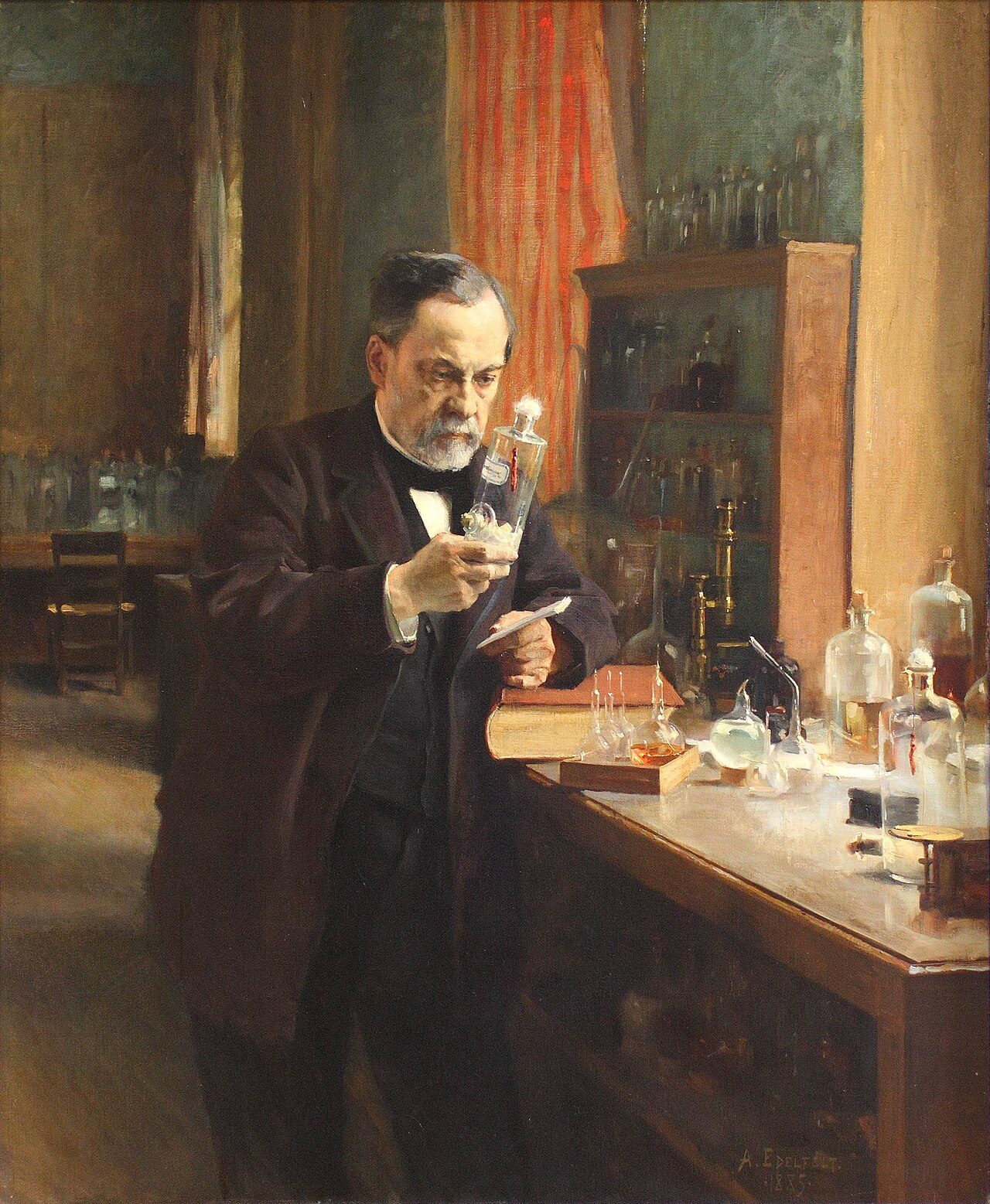
The year's defining act was quiet and clinical. On 6 July, in Paris, nine-year-old Joseph Meister, badly bitten by a rabid dog two days earlier, was brought to Louis Pasteur's laboratory. Rabies was then an almost invariably fatal disease and no treatment existed. Pasteur's team began a course of injections made from the spinal cords of infected rabbits, dried for varying lengths to weaken the virus — a vaccine now used on a human being for the first time. The gamble was considerable: Pasteur was a chemist, not a physician, and the treatment had been tested only on dogs. Over the following days Meister received a series of injections, each stronger than the last, ending with virulent material. The boy did not develop rabies. He recovered and went home.
News spread, and bite victims began arriving in Paris from across Europe and beyond; hundreds were saved in the following years. An international subscription built Pasteur a permanent institute, inaugurated in 1888. The year closed with two foundations of a different kind: on 7 November the last spike of Canada's first transcontinental railway was driven at Craigellachie, British Columbia, and on 28 December the Indian National Congress — the movement that would lead India to independence — held its first session in Bombay.
Timeline of 1885
- 26 January
Khartoum falls to the forces of the Mahdi; General Charles Gordon is killed in the city's defence.
- 7 February
Sinclair Lewis, the first American to win the Nobel Prize in Literature, is born.
- 18 February
Mark Twain's Adventures of Huckleberry Finn is published in the United States.
- 21 February
The Washington Monument is dedicated in Washington, D.C.
- 26 February
The Berlin Conference concludes, setting the rules for European colonial claims in Africa.
- 26 March
Louis Riel's Métis forces clash with Canadian police at Duck Lake, the first fight of the North-West Rebellion.
- 22 May
Victor Hugo, French author of Les Misérables, dies in Paris aged 83.
- 17 June
The Statue of Liberty arrives in New York Harbor, in 350 pieces packed in 214 crates.
- 6 July
Louis Pasteur's rabies vaccine is used on a human patient, Joseph Meister, for the first time.
- 23 July
Ulysses S. Grant dies of throat cancer at 63, days after finishing his memoirs.
- 29 August
Gottlieb Daimler patents the first motorcycle, the petroleum-driven Reitwagen.
- 7 November
The last spike of Canada's first transcontinental railway is driven at Craigellachie, British Columbia.
- 16 November
Louis Riel, Canadian Métis leader, is hanged for treason after the North-West Rebellion.
- 28 December
The Indian National Congress holds its first session in Bombay.
Why 1885 still matters
Meister's vaccination is remembered as a founding moment of modern medicine: one of the first demonstrations that a laboratory-made vaccine could defeat a lethal virus. It completed Pasteur's public reputation — the scientist of fermentation, pasteurisation and the anthrax vaccine had now defeated the most feared of infections — and the institute founded in his name in 1888 became one of the world's great research centres, the place where, a century later, the virus that causes AIDS was identified. It also raised questions that have followed medicine ever since, about experimenting on a patient who cannot consent with a treatment untested in humans.
The Berlin Conference's rules shaped Africa's map — and its conflicts — for generations: claims agreed in a European capital, with no African voice in the room. Khartoum's fall became the era's emblem of imperial overreach and martyrdom, while the Indian National Congress's modest first session in Bombay began the organised movement that would end British rule in India in 1947.
Canada's last spike bound a dominion coast to coast, and Daimler's Reitwagen patent of 29 August put an engine on two wheels a year before Benz's car patent filled the following January. 1885 divided a continent on paper, joined another by rail, and in a Paris laboratory showed that a virus could be beaten by design.
1885 on The History Trail
A vaccine, a fallen city and a divided continent lead this year on The History Trail.
- July 6 in History — Pasteur's rabies vaccine is used on a human for the first time.
- January 26 in History — Khartoum falls and General Gordon is killed.
- February 26 in History — The Berlin Conference concludes its division of African claims.
- June 17 in History — The Statue of Liberty arrives in New York Harbor in crates.
- December 28 in History — The Indian National Congress holds its first session in Bombay.
- The bicycle — freedom on two wheels — The two-wheeled world into which Daimler's motorised Reitwagen arrived in 1885.
Sources
- Encyclopaedia Britannica — On This Day: July 6
- Encyclopaedia Britannica — Louis Pasteur: Vaccine development
- Encyclopaedia Britannica — On This Day: January 26
- Encyclopaedia Britannica — On This Day: February 26
- Encyclopaedia Britannica — On This Day: June 17
- Encyclopaedia Britannica — On This Day: December 28
The facts on this page were checked against these sources on 19 November 2026. The History Trail's permanent pages are researched and written for this site; the live profiles elsewhere on The History Trail are assembled automatically from Wikipedia and Wikidata.
About the Author
Researched and written by the The History Trail Editorial Team — the accountable editorial function behind this site's permanent story pages. The team works from the published sources cited on each page; it does not invent historians, reviewers or credentials, and it corrects errors openly.
Fact Check
Every load-bearing fact on this page traces to one of the sources listed above, and significant claims link to their source in the text. Our checking method is described on the methodology page; errors can be reported via the corrections page.
Sources & Citations
Cite this page as: The History Trail Editorial Team, The History Trail — this article's title, publication and update dates are shown beneath its headline. The full source list appears under Sources above; the site's source standards are on the sources page.