
On This Day
June 17 in History
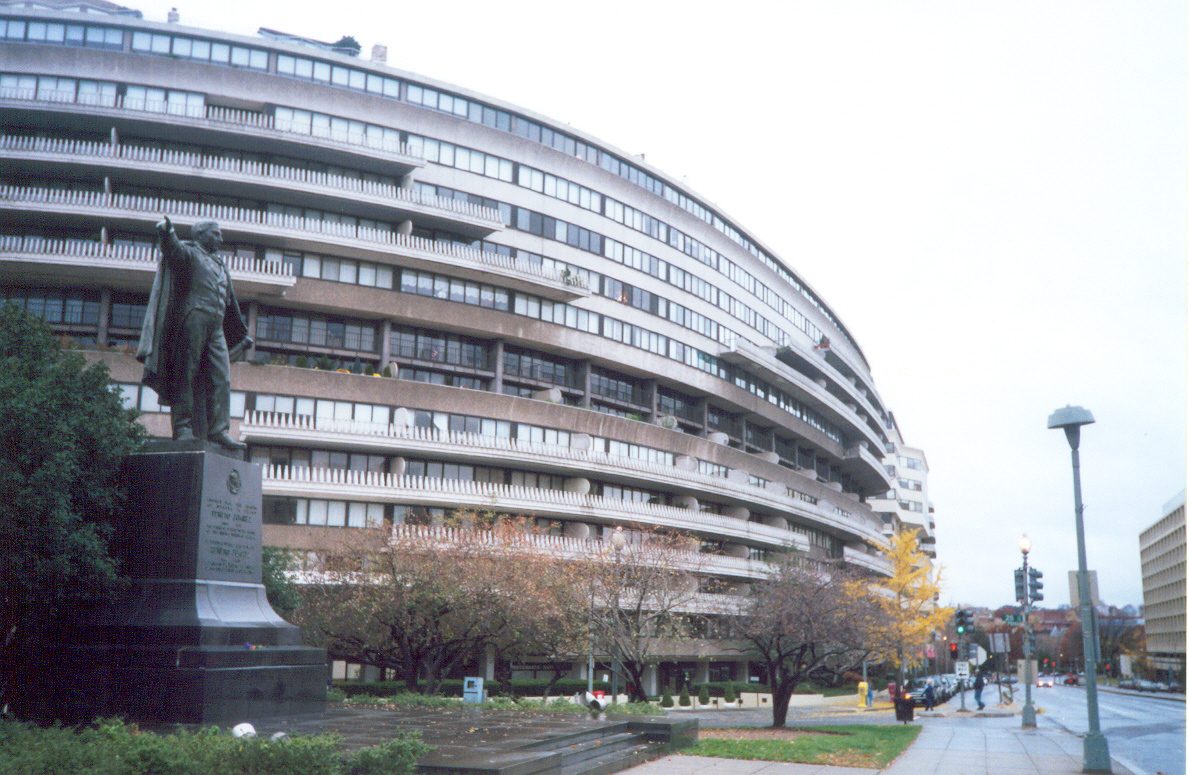
In the early hours of 17 June 1972, five men in suits and surgical gloves were arrested inside the Democratic headquarters at Washington's Watergate complex — a 'third-rate burglary' that, two years later, forced Richard Nixon to resign the presidency. June 17 is also the day of Bunker Hill, the Statue of Liberty's arrival, and Iceland's founding as a republic.
Choose another date: open the On This Day calendar to browse events, births and deaths for any day of the year.
At a Glance
- The arrest
- About 2 a.m., 17 June 1972: five men arrested inside Democratic National Committee headquarters at the Watergate complex
- The watchman
- Frank Wills, who twice found a door latch taped open and called the police
- The link
- One burglar, James McCord, was security chief of Nixon's re-election committee; the cash they carried traced to campaign funds
- The reporting
- Woodward and Bernstein of The Washington Post, guided by 'Deep Throat' — later revealed as FBI deputy director Mark Felt
- The proof
- The 'smoking gun' tape of 23 June 1972 showed Nixon approving obstruction of the FBI investigation
- The end
- Nixon resigned on 9 August 1974, the only US president to do so; Ford pardoned him a month later
Events on this day
- 1579Sir Francis Drake lands on the coast of California and claims 'Nova Albion' for Elizabeth I.
- 1631Mumtaz Mahal dies in childbirth in Burhanpur; her husband Shah Jahan will spend two decades building her tomb, the Taj Mahal.
- 1775The Battle of Bunker Hill is fought outside Boston — a British victory so costly it emboldens the American rebellion.
- 1885The Statue of Liberty arrives in New York Harbor, in 350 pieces packed in 214 crates aboard the French ship Isere.
- 1928Amelia Earhart takes off from Newfoundland as a passenger on the first transatlantic flight by a woman.
- 1930President Herbert Hoover signs the Smoot-Hawley Tariff, raising American duties to record levels and deepening the world Depression.
- 1944Iceland proclaims itself a republic at Thingvellir, ending its union with Denmark.
- 1967China successfully tests its first hydrogen bomb, four years after its first atomic test.
- 1972Five men are arrested inside the Democratic headquarters at the Watergate — the featured story above.
- 1994After a televised slow-speed freeway chase watched by millions, O. J. Simpson is arrested for the murders of Nicole Brown Simpson and Ronald Goldman.
- 2015Nine Black worshippers are murdered at a Bible study at Emanuel AME Church in Charleston, South Carolina, by a white supremacist gunman.
Born on this day
- 1871James Weldon Johnson — American writer and NAACP leader who wrote the words of 'Lift Every Voice and Sing'.
- 1882Igor Stravinsky — Russian composer whose Rite of Spring detonated musical modernism.
- 1898M. C. Escher — Dutch graphic artist of impossible staircases and interlocking tessellations.
- 1943Barry Manilow — American singer-songwriter of elaborately orchestrated romantic ballads.
- 1980Venus Williams — American tennis champion who won seven Grand Slam singles titles and changed the women's game.
- 1987Kendrick Lamar — American rapper, the first popular musician to win the Pulitzer Prize for Music.
Died on this day
- 1631Mumtaz Mahal — Mughal empress whose death in childbirth at about 38 set the Taj Mahal in motion.
- 1719Joseph Addison — English essayist whose Spectator papers defined polite journalism, dead at 47.
- 1996Thomas Kuhn — American philosopher of science who gave the world the phrase 'paradigm shift'.
- 2019Mohamed Morsi — Egypt's first democratically elected president, deposed by the army, dead in a Cairo courtroom at 67.
- 2019Gloria Vanderbilt — American heiress, artist and jeans designer, dead at 95.
The featured story: the Watergate break-in, 17 June 1972
In the early hours of Saturday 17 June 1972, a night watchman named Frank Wills, making his rounds of the Watergate office complex in Washington, found a door latch taped open between the car park and the offices. He removed the tape; finding the door taped again an hour later, he called the police. Plain-clothes officers crept up the stairs and, shortly after 2 a.m., arrested five men inside the headquarters of the Democratic National Committee. They were wearing business suits and surgical gloves, and carrying cameras, film, lock picks, tear-gas pens and a small fortune in sequentially numbered hundred-dollar bills.
It looked, at first, like a curious burglary. The men included a former CIA officer, James McCord, who was the security co-ordinator of President Richard Nixon's re-election committee, and the money in their pockets could be traced to campaign funds. Two Washington Post reporters, Bob Woodward and Carl Bernstein, were put on the story and refused to let it go. Over the following months, guided in part by a source inside the government later revealed as FBI deputy director Mark Felt — 'Deep Throat' — they connected the break-in to a campaign of political espionage and sabotage run from within the White House itself.
The cover-up unraveled in stages through 1973: televised Senate hearings, the resignation of Nixon's closest aides, the revelation that the president had secretly taped his own conversations, and a Supreme Court fight over those tapes. The 'smoking gun' tape of 23 June 1972, released in August 1974, proved Nixon had approved obstructing the FBI's investigation days after the arrests. With impeachment certain and conviction likely, Nixon resigned on 9 August 1974 — the only American president ever to do so — and was pardoned a month later by his successor, Gerald Ford.
The break-in itself was, as Nixon's press secretary first called it, a third-rate burglary. Its consequences were first-rate: a presidency destroyed, a suffix — '-gate' — permanently attached to scandal, campaign-finance and ethics laws rewritten, and a generation's trust in government permanently lowered. It also completed a circuit begun exactly a year and four days earlier, when the same White House, panicked by the Pentagon Papers leak, had formed the 'Plumbers' unit whose members were among those arrested in the Watergate that night.
Why this date matters
June 17 is a day of thresholds crossed quietly and loudly. A statue arrived in crates; a republic was proclaimed on a Viking assembly plain; a tariff was signed that helped sink the world economy; and in the small hours of 1972 five men in surgical gloves crossed a threshold in an office building and set off the slow collapse of a presidency. Twice the date has also been a stage for racial violence and its opposite — Bunker Hill's costly defiance in 1775, Charleston's church massacre in 2015. It rewards attention precisely because its biggest event looked, on the morning it happened, like almost nothing.
Sources
- Encyclopaedia Britannica — On This Day: June 17
- HISTORY — What Happened on June 17
- HISTORY — Battle of Bunker Hill begins
- Wikimedia Commons — Watergate-DC

The facts on this page were checked against these sources on 19 November 2026. The History Trail's permanent pages are researched and written for this site; the live profiles elsewhere on The History Trail are assembled automatically from Wikipedia and Wikidata.
About the Author
Researched and written by the The History Trail Editorial Team — the accountable editorial function behind this site's permanent story pages. The team works from the published sources cited on each page; it does not invent historians, reviewers or credentials, and it corrects errors openly.
Fact Check
Every load-bearing fact on this page traces to one of the sources listed above, and significant claims link to their source in the text. Our checking method is described on the methodology page; errors can be reported via the corrections page.
Sources & Citations
Cite this page as: The History Trail Editorial Team, The History Trail — this article's title, publication and update dates are shown beneath its headline. The full source list appears under Sources above; the site's source standards are on the sources page.