
On This Day
January 26 in History
On 26 January 1950 the Constitution of India came into force, Rajendra Prasad became its first president, and the Dominion of India became the Republic of India — the world's most populous democracy, governed by the longest written constitution ever adopted. January 26 is also the day the Cullinan diamond was found, Sydney was founded, Khartoum fell, and John Logie Baird first demonstrated television.
Choose another date: open the On This Day calendar to browse events, births and deaths for any day of the year.
At a Glance
- Independence
- 15 August 1947 — India becomes independent as a dominion, with the British monarch still head of state
- Constitution adopted
- 26 November 1949 by the Constituent Assembly, after nearly three years of debate
- Republic Day
- 26 January 1950 — the Constitution takes effect; India becomes a sovereign democratic republic
- First president
- Rajendra Prasad, sworn in on 26 January 1950; Jawaharlal Nehru continues as prime minister
- Chief drafter
- B. R. Ambedkar chaired the drafting committee; at 395 articles the Constitution was the world's longest
- Why 26 January
- Chosen for the 20th anniversary of the Purna Swaraj (complete independence) declaration of 26 January 1930
Events on this day
- 1500Spanish navigator Vicente Yáñez Pinzón reaches the coast of Brazil, the first recorded European arrival there.
- 1788Captain Arthur Phillip raises the British flag at Sydney Cove, founding the first permanent European settlement in Australia.
- 1885Khartoum falls to the forces of the Mahdi after a siege of nearly a year; General Charles Gordon is killed in the city's defence.
- 1905The Cullinan diamond, the largest gem-quality rough diamond ever found, is unearthed at the Premier Mine in South Africa; it weighs 3,106 carats.
- 1926Scottish inventor John Logie Baird gives the first public demonstration of a true television system, in London.
- 1930The Indian National Congress's declaration of Purna Swaraj — complete independence — is celebrated as Independence Day across India for the first time.
- 1939Barcelona falls to General Franco's Nationalist forces in the Spanish Civil War; the Republic's collapse follows within weeks.
- 1950The Constitution of India takes effect and the Republic of India is born — the featured story above.
- 1988Andrew Lloyd Webber's The Phantom of the Opera opens on Broadway in New York, beginning a run of 35 years.
- 2001An earthquake of magnitude 7.7 strikes Gujarat, India, devastating the city of Bhuj and killing an estimated 20,000 people.
- 2005Condoleezza Rice is sworn in as U.S. secretary of state, the first Black woman to hold the office.
Born on this day
- 1880Douglas MacArthur — American general who commanded Allied forces in the Southwest Pacific and accepted Japan's surrender in 1945.
- 1925Paul Newman — American actor, director and racing driver, star of Cool Hand Luke and Butch Cassidy and the Sundance Kid.
- 1944Angela Davis — American scholar and activist, a defining voice of the civil rights and prison-abolition movements.
- 1955Eddie Van Halen — Dutch-born American guitarist whose technique remade rock guitar.
- 1958Ellen DeGeneres — American comedian and talk-show host who reshaped daytime television.
- 1961Wayne Gretzky — Canadian ice hockey player, 'the Great One', holder of the NHL's scoring records.
Died on this day
- 1885Charles Gordon — British general, killed at Khartoum as the city fell to the Mahdi's forces.
- 1962Lucky Luciano — Sicilian-born crime boss who built the modern American Mafia, dead of a heart attack at Naples airport at 64.
- 1973Edward G. Robinson — American actor of Little Caesar and Double Indemnity, dead at 79.
- 2016Abe Vigoda — American character actor beloved as Fish in Barney Miller, dead at 94.
- 2020Kobe Bryant — American basketball star of the Los Angeles Lakers, killed with his daughter Gianna and seven others in a helicopter crash at 41.
The featured story: the Republic of India is born, 26 January 1950
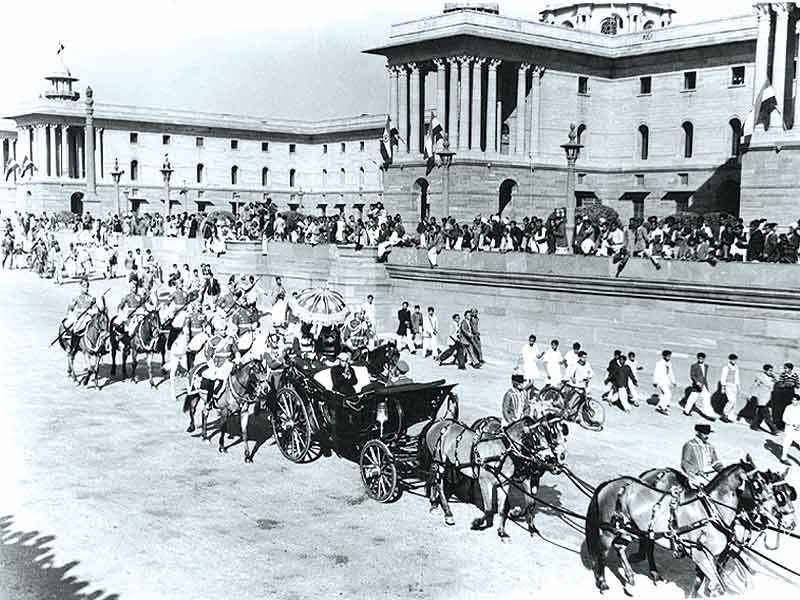
At 10:18 on the morning of 26 January 1950, in the Durbar Hall of Government House in New Delhi, the last Governor-General of India, C. Rajagopalachari, proclaimed the establishment of the Republic of India. Minutes later Rajendra Prasad was sworn in as the country's first President, a 21-gun salute was fired, and the Constitution of India came into force. India had been independent since 15 August 1947, but for two and a half years it had remained a dominion, with the British king as its head of state. On this morning it became, in the Constitution's own words, a sovereign democratic republic — and the most populous democracy on Earth.
The Constitution that took effect that day was the work of a Constituent Assembly that had sat for almost three years, debating nearly every clause in public. Its drafting committee was chaired by B. R. Ambedkar, the jurist and campaigner against caste discrimination who became independent India's first law minister. The document they produced was the longest written constitution in the world — 395 articles at adoption — guaranteeing universal adult suffrage at a stroke, in a largely poor and illiterate country where most Western democracies had extended the vote only gradually. Every Indian adult, man or woman, rich or poor, literate or not, became a voter on 26 January 1950.
The date was not chosen for convenience. Twenty years earlier, on 26 January 1930, the Indian National Congress had proclaimed Purna Swaraj — complete independence — and Indians had marked the day as Independence Day through the 1930s and 1940s, hoisting flags in defiance of the Raj. When the time came to bring the Constitution into force, the Assembly deliberately reached back to that anniversary, binding the legal birth of the republic to the moral declaration that had preceded it by a generation. Jawaharlal Nehru, who had moved the Purna Swaraj resolution in 1929, continued as prime minister under the new order.
That afternoon Prasad rode in a state carriage to the Irwin Amphitheatre, where some 15,000 people watched the first Republic Day parade and the new president took the salute from the armed forces; Indonesia's President Sukarno was the first chief guest. Republic Day is still India's great civic festival, marked each 26 January by the parade in New Delhi. What began that morning has held: the Constitution of 1950, amended often but never replaced, remains the framework of the world's largest democracy — the date on which India stopped merely being free of Britain and started governing itself by its own written rules.
Why this date matters
January 26 is a day of foundings and falls. A flag goes up at Sydney Cove in 1788 and an empire's outpost falls at Khartoum in 1885; Barcelona's fall in 1939 closes one republic's story just as, eleven years later, India opens its own. The date also keeps delivering first views of the future: television flickers into life in a London attic in 1926, the largest diamond ever found comes out of African earth in 1905, and a musical about a masked ghost begins a 35-year reign in 1988. And for two nations — India by design, Australia by the accident of a fleet's arrival — it is simply the national day, the date on the calendar around which identity is organised.
Sources
- Encyclopaedia Britannica — On This Day: January 26
- HISTORY — What Happened on January 26
- HISTORY — Republic of India Born
The facts on this page were checked against these sources on 19 November 2026. The History Trail's permanent pages are researched and written for this site; the live profiles elsewhere on The History Trail are assembled automatically from Wikipedia and Wikidata.
About the Author
Researched and written by the The History Trail Editorial Team — the accountable editorial function behind this site's permanent story pages. The team works from the published sources cited on each page; it does not invent historians, reviewers or credentials, and it corrects errors openly.
Fact Check
Every load-bearing fact on this page traces to one of the sources listed above, and significant claims link to their source in the text. Our checking method is described on the methodology page; errors can be reported via the corrections page.
Sources & Citations
Cite this page as: The History Trail Editorial Team, The History Trail — this article's title, publication and update dates are shown beneath its headline. The full source list appears under Sources above; the site's source standards are on the sources page.