
Years
1883 in History
1883 is the year of Krakatoa. On 27 August the Indonesian volcano destroyed itself in a series of explosions heard 3,000 miles away, generating tsunamis that killed an estimated 36,000 people and veiling the Earth in a haze that cooled the climate for years. The same year opened the Brooklyn Bridge in New York, sent the Orient Express on its first run, and persuaded American and Canadian railroads to adopt standard time zones.
At a Glance
- Defining event
- Eruption of Krakatoa, 27 August 1883 — an estimated 36,000 people killed, mostly by tsunamis
- The bridge
- Brooklyn Bridge opens, 24 May, the world's first steel-wire suspension bridge
- Standard time
- American and Canadian railroads adopt standard continental time zones, 18 November
- The train
- Orient Express makes its first run from Paris, 4 October
- Two thinkers die
- Karl Marx dies in London, 14 March; Richard Wagner in Venice, 13 February
- Born this year
- John Maynard Keynes, Franz Kafka and Coco Chanel
The defining story: the island that destroyed itself
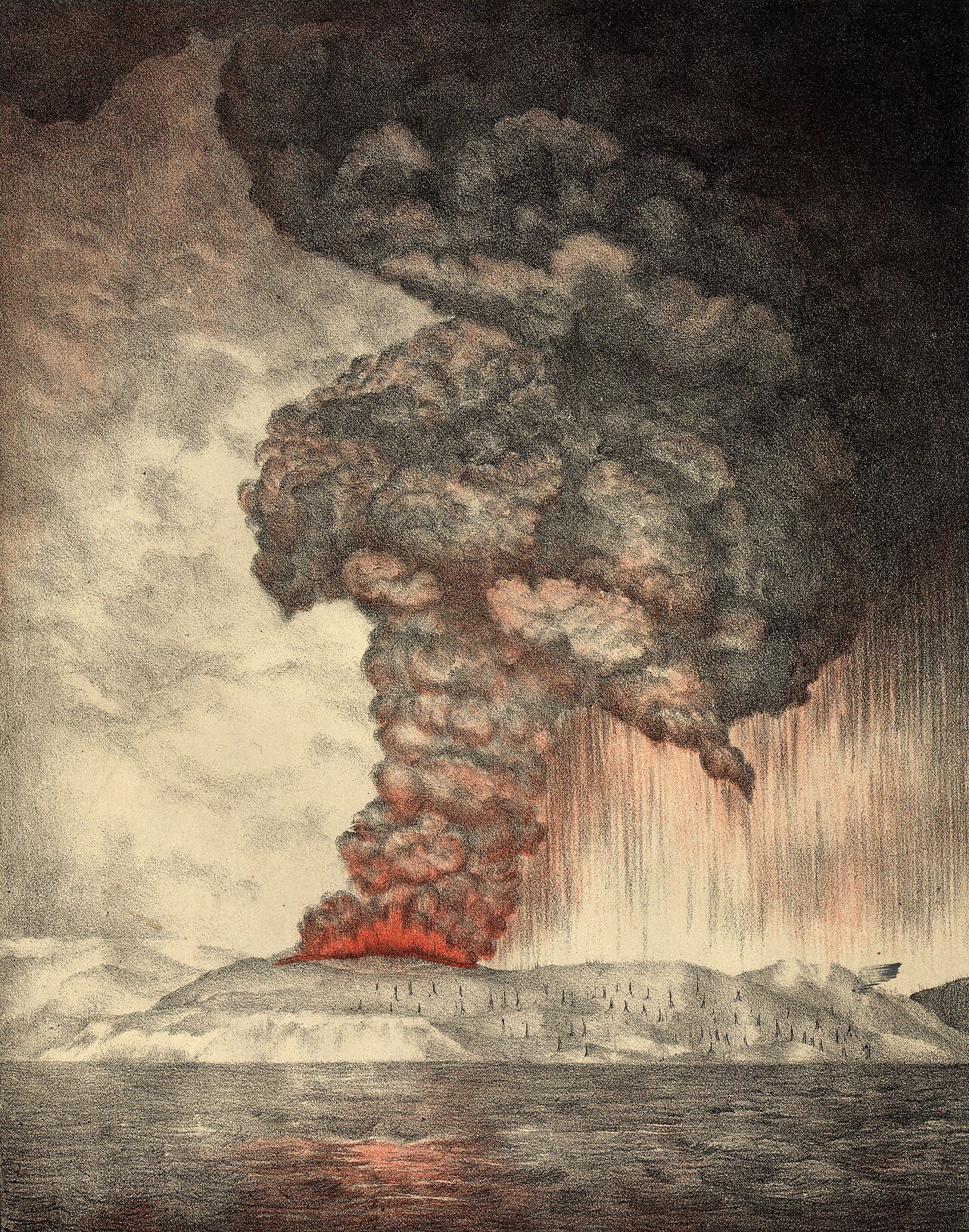
Krakatoa had been grumbling since May 1883, entertaining tourists who sailed out to watch its smoking cone. On Sunday 26 August the eruption turned violent — the final stage, as the record for that day puts it — and by the next morning the island in the Sunda Strait was tearing itself apart. Four colossal explosions punctuated the morning of 27 August, the greatest at about ten o'clock, heard as distant cannon fire in Perth, Western Australia, and on Rodrigues Island in the Indian Ocean, nearly 5,000 kilometres away. Its pressure wave was registered on barographs around the world, circling the Earth three and a half times.
The sound killed no one; the sea did. As the volcano's emptying magma chamber collapsed, two-thirds of the island fell into the ocean, displacing the water into tsunamis. Waves reported at up to 35 metres struck the coasts of Java and Sumatra without warning, destroying more than 160 villages. An estimated 36,000 people died, most of them in minutes. A Dutch warship was carried two miles inland and left stranded in the jungle.
Then the sky changed. Krakatoa had thrown an estimated 20 cubic kilometres of rock and ash into the stratosphere. For years afterwards the world watched blood-red sunsets, blue moons and a halo around the sun named Bishop's Ring; global average temperatures fell by about 1.2 degrees Celsius and weather patterns stayed disturbed for half a decade. The Royal Society's investigation, published in 1888, became a model of global scientific reporting, assembled from hundreds of eyewitnesses, tide gauges and barographs — the report in which this page's 1888 lithograph appeared.
The year's other works were feats of connection. On 24 May the Brooklyn Bridge opened between New York and Brooklyn after 14 years of construction, becoming the world's first steel-wire suspension bridge and its longest span; Emily Roebling, who had effectively supervised the work for her bedridden husband, was given the first ride across, carrying a rooster as a symbol of victory. On 4 October the Orient Express made its first run from Paris towards Constantinople. And on 18 November American and Canadian railroads adopted standard continental time zones, ending the chaos of thousands of local times.
Timeline of 1883
- 3 January
Clement Attlee, the British prime minister whose government created the National Health Service, is born.
- 16 January
The Pendleton Act becomes law, beginning merit-based civil service reform in the United States.
- 5 February
The Southern Pacific Railroad completes its Sunset Route from New Orleans to California.
- 13 February
Richard Wagner, German composer of the Ring cycle, dies in Venice at 69.
- 14 March
Karl Marx, co-author of The Communist Manifesto and author of Das Kapital, dies in exile in London.
- 30 April
Édouard Manet, the French painter who opened the road to modern art, dies at 51.
- 24 May
The Brooklyn Bridge opens between New York and Brooklyn after 14 years of construction.
- 5 June
John Maynard Keynes, the English economist who reshaped governments' management of economies, is born.
- 3 July
Franz Kafka, Prague novelist of The Trial and The Metamorphosis, is born.
- 19 August
Coco Chanel, French fashion designer and creator of Chanel No. 5, is born.
- 26 August
Krakatoa's eruption enters its final stage, a day before the island destroys itself.
- 27 August
Krakatoa destroys itself in a cataclysmic eruption; tsunamis kill an estimated 36,000 people.
- 4 October
The Orient Express makes its first run, from Paris towards Constantinople.
- 18 November
American and Canadian railroads adopt standard continental time zones.
Why 1883 still matters
Krakatoa was the nineteenth century's clearest lesson that a single volcano can edit the climate of a planet: a sulphate veil, years of lurid sunsets sketched hundreds of times by artists such as William Ascroft in London, and a measurable fall in global temperature. The Royal Society's 1888 report — hundreds of eyewitnesses, tide gauges and barographs assembled worldwide — became a model of how global science reports a global event. The caldera stayed quiet until 1927, when a new cone breached the surface at the same spot: Anak Krakatau, the child of Krakatoa.
The bridge and the timetable were the year's constructive mirror image. The Brooklyn Bridge — the first steel-wire suspension bridge, built at the cost of 27 lives including its designer John A. Roebling — bound Brooklyn to New York until the two merged in 1898, and an estimated 250,000 people walked across within its first 24 hours. Standard time, adopted by the railroads that November, quietly abolished thousands of local noons and made the modern, synchronised continent possible.
The deaths of Wagner and Marx within five weeks closed two of the century's most consequential careers, while the births of Keynes, Kafka, Chanel and Attlee stocked the next one. 1883 is remembered for destruction on a planetary scale — but it also built the bridge, the train and the clock by which the modern world still runs.
1883 on The History Trail
A volcano, a bridge and a new clock lead this year on The History Trail.
- August 27 in History — Krakatoa destroys itself, in the loudest sound in recorded history.
- May 24 in History — The Brooklyn Bridge opens after 14 years of construction.
- August 26 in History — Krakatoa's eruption enters its final stage.
- November 18 in History — The railroads adopt standard continental time zones.
- October 4 in History — The Orient Express makes its first run from Paris.
- March 14 in History — Karl Marx dies in exile in London.
Sources
- Encyclopaedia Britannica — On This Day: August 27
- Encyclopaedia Britannica — On This Day: May 24
- Encyclopaedia Britannica — On This Day: August 26
- Wikimedia — On This Day feed: November 18
- Encyclopaedia Britannica — On This Day: October 4
- HISTORY — What Happened on March 14
The facts on this page were checked against these sources on 19 November 2026. The History Trail's permanent pages are researched and written for this site; the live profiles elsewhere on The History Trail are assembled automatically from Wikipedia and Wikidata.
About the Author
Researched and written by the The History Trail Editorial Team — the accountable editorial function behind this site's permanent story pages. The team works from the published sources cited on each page; it does not invent historians, reviewers or credentials, and it corrects errors openly.
Fact Check
Every load-bearing fact on this page traces to one of the sources listed above, and significant claims link to their source in the text. Our checking method is described on the methodology page; errors can be reported via the corrections page.
Sources & Citations
Cite this page as: The History Trail Editorial Team, The History Trail — this article's title, publication and update dates are shown beneath its headline. The full source list appears under Sources above; the site's source standards are on the sources page.