
On This Day
December 28 in History
On the evening of 28 December 1895, in the Salon Indien, a basement room of the Grand Café in Paris, Auguste and Louis Lumière presented ten short films to a small paying audience with their Cinématographe — the first commercial public screening in cinema history, and the night the movies became a business. December 28 is also the day Westminster Abbey was consecrated, Röntgen submitted his X-ray paper, and the Endangered Species Act was signed.
Choose another date: open the On This Day calendar to browse events, births and deaths for any day of the year.
At a Glance
- The venue
- The Salon Indien, the basement of the Grand Café, 14 Boulevard des Capucines, Paris
- The machine
- The Cinématographe — camera, printer and projector in one hand-cranked box, patented by the brothers on 13 February 1895
- The programme
- Ten short films, each under a minute, opening with Workers Leaving the Lumière Factory
- The audience
- Fewer than forty people on the first night — accounts differ between about thirty paying customers and a slightly larger party including invited guests; admission was one franc
- The response
- Within days, queues stretched down the boulevard, with more than 2,000 spectators a day reported in the first days of January 1896
- The same day
- In Würzburg, Wilhelm Röntgen submitted his paper announcing the discovery of X-rays — 28 December 1895 launched both the cinema and radiography
Events on this day
- 1065Westminster Abbey is consecrated in London; its builder, Edward the Confessor, is too ill to attend and dies within days.
- 1612Galileo Galilei observes the planet Neptune and records it in his notebook, mistaking it for a fixed star — the first known sighting of the planet.
- 1832John C. Calhoun resigns as vice president of the United States, the first to do so, amid the Nullification Crisis with his own president.
- 1846Iowa is admitted to the Union as the 29th state.
- 1879The Tay Bridge in Scotland collapses in a storm as a train crosses, killing everyone aboard — some 75 people, by the usual estimate.
- 1885The Indian National Congress, the movement that will lead India to independence, holds its first session in Bombay.
- 1895The Lumière brothers give the first paid public screening of projected films, at the Grand Café in Paris — the featured story above.
- 1895Wilhelm Röntgen submits his preliminary report 'On a New Kind of Rays' in Würzburg, announcing the discovery of X-rays to the world.
- 1908An earthquake devastates Messina in Sicily and Reggio across the strait; about 80,000 people are killed, by the estimates of the time — Europe's deadliest recorded earthquake.
- 1918Constance Markievicz becomes the first woman elected to the British Parliament, winning in Dublin while imprisoned in Holloway; she does not take her seat.
- 1973President Richard Nixon signs the Endangered Species Act, the strongest wildlife-protection law in American history.
- 1981Elizabeth Jordan Carr, the first American baby conceived by in-vitro fertilisation, is born in Norfolk, Virginia.
Born on this day
- 1856Woodrow Wilson — 28th president of the United States, who led the country through the First World War.
- 1903John von Neumann — Hungarian-American mathematician whose work underlies computing, game theory and the atomic age.
- 1922Stan Lee — American comic-book writer, co-creator of Spider-Man, the X-Men and the Marvel universe.
- 1934Maggie Smith — English actress of stage and screen, from The Prime of Miss Jean Brodie to Downton Abbey.
- 1978John Legend — American singer and songwriter, the first African American man to achieve EGOT status.
Died on this day
- 1694Mary II — queen of England, Scotland and Ireland, dead of smallpox at 32; her husband William III reigns alone thereafter.
- 1734Rob Roy MacGregor — Scottish outlaw and folk hero of the Jacobite age, dead at Balquhidder.
- 1938Florence Lawrence — Canadian-American silent-film star, often called the first movie star, dead in Beverly Hills.
- 1945Theodore Dreiser — American novelist of Sister Carrie and An American Tragedy.
The featured story: the Lumière brothers' first public screening, 28 December 1895
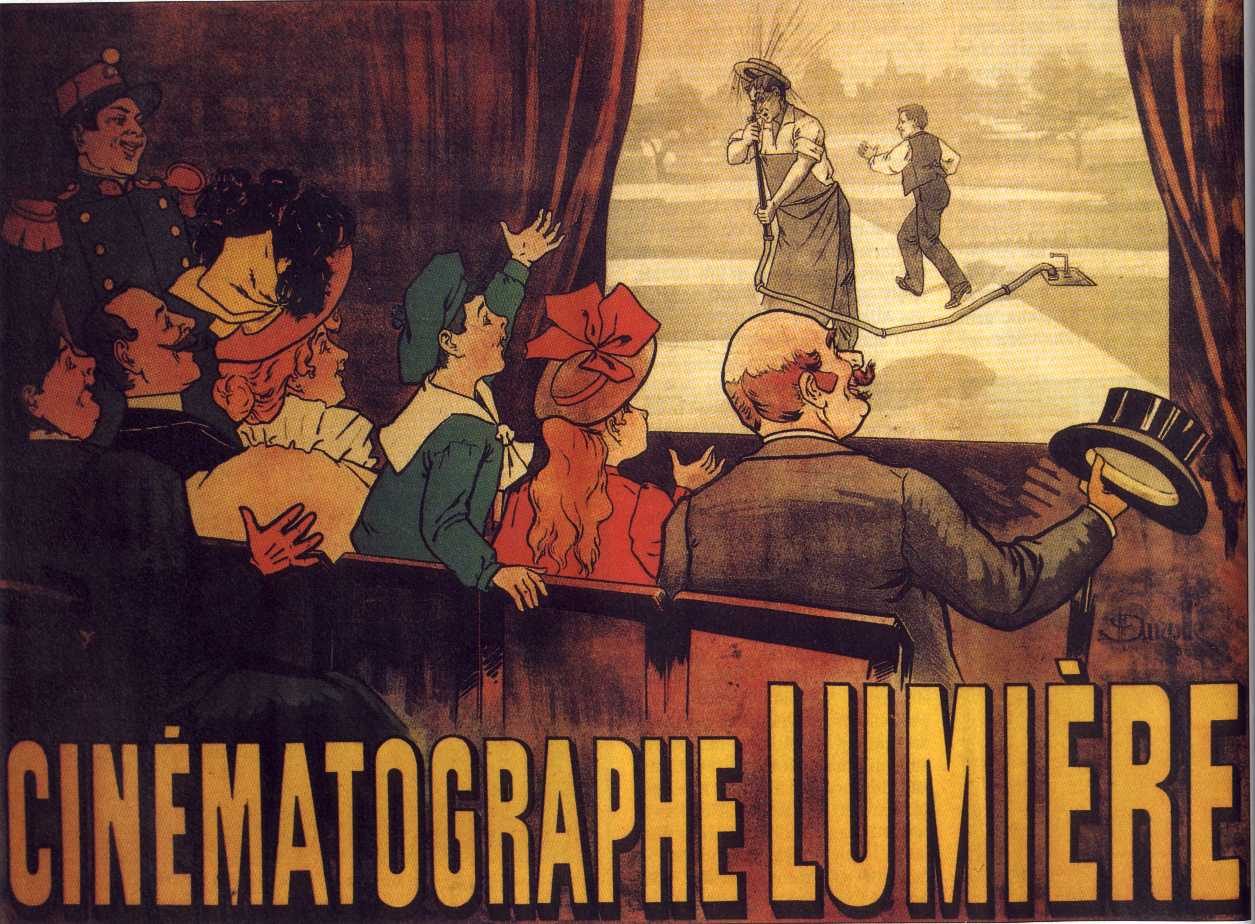
The machine came first. Auguste and Louis Lumière ran their father's photographic factory in Lyon, and in early 1895 Louis perfected the Cinématographe: a wooden box weighing about five kilograms that could record film, print it and project it, its claw mechanism — inspired, family tradition says, by the needle action of a sewing machine — pulling perforated 35mm film through at sixteen frames a second. The brothers patented it on 13 February 1895 and spent the year shooting one-minute scenes of ordinary life: workers leaving their own factory, a train arriving, a baby's breakfast, a gardener tricked by his own hose.
Private showings to scientific societies through 1895 convinced their father, Antoine, that the device was ready to earn money. He rented the Salon Indien, the basement billiard room of the Grand Café on the Boulevard des Capucines, hung a white screen, and set the projector on a stepladder. On 28 December 1895 the doors opened to the paying public at one franc a head. The first night's audience was tiny — accounts put it between about thirty paying customers and forty people including invited guests — and neither brother was even there; three staff ran the show. Ten films, each less than a minute, made up the programme.
Word of mouth did what advertising had not. Within days the queues reached down the boulevard; by the first days of January 1896 more than 2,000 people a day were paying their franc, and two posters — Marcellin Auzolle's image of a laughing audience, and Henri Brispot's of the crowd surging at the door — were pasted across Paris. Among the invited guests of the first days was the stage illusionist Georges Méliès, who immediately tried to buy a Cinématographe. The brothers refused to sell. Within a year their operators were filming on every continent, and cinema had become an industry.
The irony is that the inventors walked away. The brothers judged film a novelty and had withdrawn from the business by 1905, returning to still photography and their Autochrome colour process. But the form they launched that December night — strangers sitting together in the dark, paying to watch projected life — became the defining popular art of the twentieth century. Every cinema ticket since descends from the franc coins collected in a Paris basement on 28 December 1895.
Why this date matters
December 28 is modernity's birthday twice over. On this date in 1895, in a Paris basement, projected film became a public, paying spectacle; on the same date, in a Würzburg laboratory, Röntgen's report on an invisible ray that photographed bones began its journey around the world. Around those twin launches the day gathers its older and newer selves: an abbey consecrated for a dying king, a planet glimpsed and mistaken for a star, a bridge falling in a gale, a woman elected to a parliament she cannot enter, and a law signed to keep species from vanishing. Few dates hold so much of what the world was about to become.
Sources
- Encyclopaedia Britannica — On This Day: December 28
- HISTORY — What Happened on December 28
- Smithsonian Magazine — Poster From One of the Earliest Public Movie Screenings Is Heading to Auction
- National Science and Media Museum — The Lumière brothers: pioneers of cinema and photography
The facts on this page were checked against these sources on 19 November 2026. The History Trail's permanent pages are researched and written for this site; the live profiles elsewhere on The History Trail are assembled automatically from Wikipedia and Wikidata.
About the Author
Researched and written by the The History Trail Editorial Team — the accountable editorial function behind this site's permanent story pages. The team works from the published sources cited on each page; it does not invent historians, reviewers or credentials, and it corrects errors openly.
Fact Check
Every load-bearing fact on this page traces to one of the sources listed above, and significant claims link to their source in the text. Our checking method is described on the methodology page; errors can be reported via the corrections page.
Sources & Citations
Cite this page as: The History Trail Editorial Team, The History Trail — this article's title, publication and update dates are shown beneath its headline. The full source list appears under Sources above; the site's source standards are on the sources page.