
Years
1886 in History
1886 gave the world the car and unveiled its most famous statue. On 29 January Karl Benz applied for patent 37435 on his Patent-Motorwagen, the first purpose-built, commercially sold automobile, and in July he demonstrated it on a public road in Mannheim. On 28 October the Statue of Liberty was dedicated in New York Harbor. Between them came Coca-Cola's first serving in Atlanta and the Haymarket bomb in Chicago.
At a Glance
- Defining event
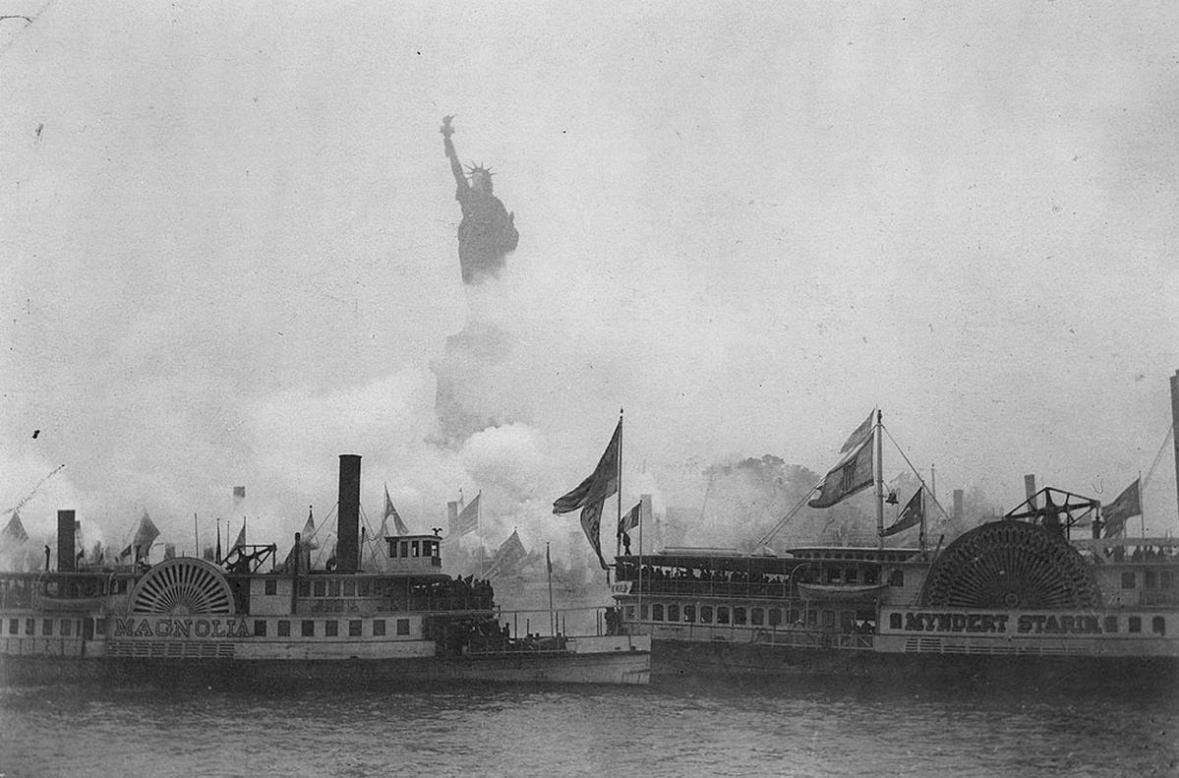
- Statue of Liberty dedicated in New York Harbor, 28 October 1886
- The car patented
- Karl Benz applies for patent 37435 on the Patent-Motorwagen, 29 January
- The car shown
- Benz demonstrates the Motorwagen publicly in Mannheim, 3 July
- A drink begins
- Coca-Cola first served at Jacobs' Pharmacy in Atlanta, 8 May
- Labour's wound
- Haymarket bomb in Chicago, 4 May — as many as 15 die, including seven police officers
- Closed the year
- Ty Cobb, baseball's fiercest competitor, is born, 18 December
The defining story: an engine patented, a statue unveiled
On 29 January 1886, in Mannheim, Karl Benz filed the document the Mercedes-Benz Group still calls the birth certificate of the automobile: patent 37435, for a vehicle powered by a gas engine. The Patent-Motorwagen had been built the year before and was unlike anything else on the road because it was not a carriage with an engine added — Benz designed the whole machine around a single-cylinder, four-stroke engine of his own design, with electric ignition, a water-cooled cylinder and a differential. It was frail by modern measure: about three-quarters of a horsepower, roughly 16 km/h, a tiller for steering and a bench seat over exposed machinery. But it worked, repeatedly and controllably.
On 3 July Benz gave the first public demonstration on Mannheim's Ringstrasse, with his son Eugen running alongside with a bottle of fuel. The patent was granted on 2 November, and Benz began selling the Motorwagen — the first automobile offered commercially. Gottlieb Daimler, working independently a few miles away, patented his own motorised carriage the same year, and the argument over who invented the car has run ever since; the legal priority belongs to Benz's three-wheeler.
America's year ran from a pharmacy to a harbour. In Atlanta, druggist John Pemberton brewed the first batch of his syrup on 29 March, and Coca-Cola was served for the first time at Jacobs' Pharmacy on 8 May. Labour's spring turned violent: rallies across the United States demanded the eight-hour day on 1 May, and on 4 May a bomb was thrown at police in Chicago's Haymarket Square during a labour rally, killing as many as 15 people, including seven police officers. On 2 June President Grover Cleveland married Frances Folsom in the White House, the only presidential wedding held there. On 4 September Geronimo surrendered in Arizona, ending the last major phase of the Indian Wars in the Southwest, and on 31 August an earthquake estimated at magnitude 7 devastated Charleston, killing an estimated 60 people.
The year closed with its statue. The Statue of Liberty — completed in France, shipped in some 350 pieces, and reassembled on Bedloe's Island after Joseph Pulitzer's campaign raised the pedestal money from more than a hundred thousand small donors — was dedicated on 28 October by President Cleveland in cold rain. As the dedication parade passed the financial district, office workers showered it with ticker tape, inventing New York's ticker-tape parade. France's gift, conceived in 1865 as a monument to republican liberty and Franco-American friendship, stood at the gate through which millions of immigrants would reach America.
Timeline of 1886
- 29 January
Karl Benz applies for the patent on his Motorwagen, the first practical automobile.
- 29 March
Atlanta druggist John Pemberton brews the first batch of the syrup that becomes Coca-Cola.
- 1 May
Rallies across the United States demand the eight-hour working day.
- 4 May
A bomb is thrown at police in Chicago's Haymarket Square; as many as 15 people die, including seven police officers.
- 8 May
Coca-Cola is served for the first time, at Jacobs' Pharmacy in Atlanta.
- 15 May
Emily Dickinson, the American poet almost unpublished in her lifetime, dies.
- 2 June
President Grover Cleveland marries Frances Folsom in the White House, the only presidential wedding held there.
- 13 June
Louis II of Bavaria, builder of Neuschwanstein, is found drowned in Lake Starnberg days after being deposed.
- 3 July
Karl Benz gives the first public demonstration of his Patent-Motorwagen in Mannheim.
- 31 August
A major earthquake, estimated at magnitude 7, devastates Charleston, South Carolina, killing an estimated 60 people.
- 4 September
Apache leader Geronimo surrenders to U.S. troops in Arizona.
- 28 October
The Statue of Liberty is dedicated in New York Harbor by President Grover Cleveland.
- 18 November
Chester A. Arthur, 21st president of the United States, dies.
- 18 December
Ty Cobb, American baseball's fiercest early competitor, is born.
Why 1886 still matters
From Benz's patent the motor industry descends in a straight line: Benz & Cie. became the world's largest automobile factory of its day, and in 1926 merged with Daimler to form the company that builds Mercedes-Benz cars. The car's great advertisement was still to come — Bertha Benz's 106-kilometre drive of August 1888 — but the legal and engineering foundation is the three-wheeler of January 1886. Every car on every road is its descendant.
Liberty's meaning shifted with the century: conceived as a monument to republican friendship, she stood beside Ellis Island, opened in 1892, and Emma Lazarus's 'New Colossus' gave her a second identity as the Mother of Exiles. Fifty years to the day after the dedication, Franklin D. Roosevelt rededicated her. The ticker-tape parade invented for her that afternoon later showered Lindbergh and the Apollo astronauts.
Haymarket cast the longest shadow over labour: the eight-hour movement from which International Workers' Day descends won its day, in time, but the bomb and its trials defined an era's fear of organised workers. Coca-Cola, served the same week, built a quieter empire. 1886 patented the machine age's defining object and unveiled its defining symbol in a single year.
1886 on The History Trail
A patent, a first serving and a dedication lead this year on The History Trail.
- January 29 in History — Karl Benz patents the first automobile.
- October 28 in History — The Statue of Liberty is dedicated in New York Harbor.
- July 3 in History — Benz demonstrates the Motorwagen on a public road.
- May 8 in History — Coca-Cola is served for the first time in Atlanta.
- May 4 in History — The Haymarket bomb is thrown in Chicago.
- Coca-Cola — The drink Pemberton brewed and first served in Atlanta in 1886.
Sources
- Encyclopaedia Britannica — On This Day: January 29
- Mercedes-Benz Group — Benz Patent Motor Car: The First Automobile (1885–1886)
- Encyclopaedia Britannica — On This Day: October 28
- Gilder Lehrman Institute — On This Day: The Statue of Liberty Is Dedicated, 1886
- Encyclopaedia Britannica — On This Day: May 8
- Encyclopaedia Britannica — On This Day: May 4
The facts on this page were checked against these sources on 19 November 2026. The History Trail's permanent pages are researched and written for this site; the live profiles elsewhere on The History Trail are assembled automatically from Wikipedia and Wikidata.
About the Author
Researched and written by the The History Trail Editorial Team — the accountable editorial function behind this site's permanent story pages. The team works from the published sources cited on each page; it does not invent historians, reviewers or credentials, and it corrects errors openly.
Fact Check
Every load-bearing fact on this page traces to one of the sources listed above, and significant claims link to their source in the text. Our checking method is described on the methodology page; errors can be reported via the corrections page.
Sources & Citations
Cite this page as: The History Trail Editorial Team, The History Trail — this article's title, publication and update dates are shown beneath its headline. The full source list appears under Sources above; the site's source standards are on the sources page.