
On This Day
July 6 in History
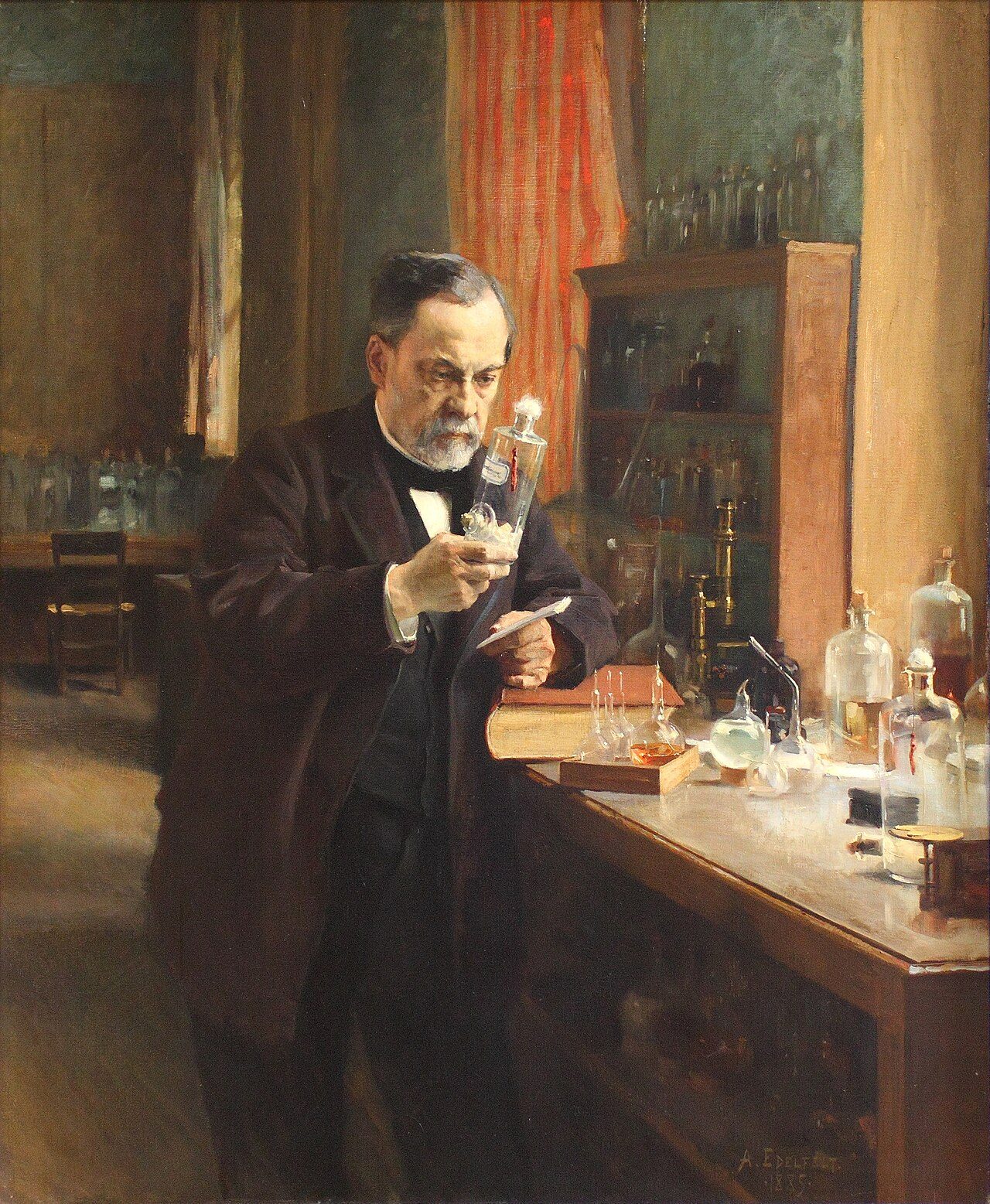
On 6 July 1885 Louis Pasteur's rabies treatment was used on a human being for the first time: nine-year-old Joseph Meister, bitten by a rabid dog, received the first of a course of injections — and lived. July 6 is also the day Anne Frank's family went into hiding in 1942, and the day John Lennon met Paul McCartney in 1957. It is a date unusually crowded with beginnings in science, money and music.
Choose another date: open the On This Day calendar to browse events, births and deaths for any day of the year.
At a Glance
- The patient
- Joseph Meister, a nine-year-old boy from Alsace, badly bitten by a rabid dog on 4 July 1885
- The treatment
- A series of injections of rabies-infected rabbit spinal cord, dried to weaken the virus, each dose stronger than the last
- The outcome
- Meister never developed rabies and recovered fully
- The risk
- The vaccine had been tested only on dogs; Pasteur, a chemist rather than a physician, had never used it on a human
- The response
- Bite victims travelled to Paris from across Europe; hundreds were treated successfully in the following years
- The legacy
- International fundraising built the Pasteur Institute in Paris, inaugurated on 14 November 1888
Events on this day
- 1775The Continental Congress issues its Declaration on the Causes and Necessity of Taking Up Arms, explaining to Britain and the world why the colonies are fighting.
- 1785The Continental Congress adopts the dollar as the official currency of the United States.
- 1885Louis Pasteur's rabies vaccine is used on a human patient, nine-year-old Joseph Meister, for the first time — the featured story above.
- 1933The first Major League Baseball All-Star Game is played at Comiskey Park in Chicago, won by the American League.
- 1942Anne Frank and her family go into hiding in the secret annexe above her father's business in Amsterdam, where she will write her diary.
- 1944Fire breaks out under the big top of the Ringling Brothers circus in Hartford, Connecticut, killing 167 people, most of them children.
- 1957Althea Gibson becomes the first Black player to win a Wimbledon singles title, defeating Darlene Hard in the women's final.
- 1957John Lennon, 16, meets Paul McCartney, 15, for the first time, at a church fete in Liverpool where Lennon's skiffle group the Quarrymen are playing.
- 1994Forrest Gump, starring Tom Hanks, opens in American cinemas; it goes on to win the Academy Award for Best Picture.
Born on this day
- 1747John Paul Jones — Scottish-born naval commander of the American Revolution, founder-figure of the United States Navy.
- 1907Frida Kahlo — Mexican painter whose self-portraits made her one of the most recognisable artists of the twentieth century.
- 1921Nancy Reagan — American actress and First Lady, wife of President Ronald Reagan.
- 1935Tenzin Gyatso — the fourteenth Dalai Lama, spiritual leader of Tibetan Buddhism and Nobel Peace Prize laureate.
- 1946George W. Bush — forty-third president of the United States.
- 1946Sylvester Stallone — American actor and filmmaker, creator and star of the Rocky and Rambo films.
Died on this day
- 1415Jan Hus — Czech church reformer, burned at the stake for heresy at Constance a century before Luther.
- 1535Thomas More — English statesman and author of Utopia, executed for refusing to accept Henry VIII as head of the Church.
- 1962William Faulkner — American novelist of The Sound and the Fury, Nobel laureate, dead in Mississippi at 64.
- 1992Marsha P. Johnson — American gay-rights activist and central figure of the Stonewall generation, found dead in the Hudson River.
The featured story: Pasteur's first rabies vaccination, 6 July 1885
On 6 July 1885, in Paris, a nine-year-old boy from Alsace named Joseph Meister, who had been badly bitten by a rabid dog two days earlier, was brought to the laboratory of Louis Pasteur. Rabies was then an almost invariably fatal disease once symptoms appeared, and no treatment existed. Pasteur's team began a course of injections of a preparation made from the spinal cords of rabbits infected with rabies, dried for varying lengths of time to weaken the virus — a vaccine that, as Britannica notes, Pasteur now used on a human being for the first time.
The gamble was considerable. Pasteur was a chemist, not a physician, and the treatment had been tested only on dogs. Over the following days Meister received a series of injections, each stronger than the last, ending with a dose of virulent material that would ordinarily have been expected to cause the disease. The boy did not develop rabies. He recovered, went home, and grew up — later working, by a much-told account, as a caretaker at the institute founded in Pasteur's name.
News of the success spread quickly, and bite victims began arriving in Paris from across Europe and beyond; Britannica records that hundreds were saved by the treatment in the following years. The triumph completed Pasteur's public reputation: the scientist who had shown that microbes caused fermentation and disease, devised pasteurisation, and produced vaccines against anthrax and fowl cholera had now defeated the most feared of infections. It also raised questions that have followed medicine ever since, about experimenting on a patient who cannot consent, with a treatment untested in humans.
An international subscription raised the funds to build Pasteur a permanent institute. The Pasteur Institute in Paris was inaugurated on 14 November 1888, and became one of the world's great centres of medical research — the institution where, a century later, the virus that causes AIDS was identified. Joseph Meister's vaccination on 6 July 1885 is remembered as the founding moment of that lineage, and one of the first demonstrations that a laboratory-made vaccine could defeat a lethal virus.
Why this date matters
July 6 pairs declarations with rescues. Congress explained its war in 1775 and chose its currency in 1785; two centuries later a boy was saved from a death sentence by a vaccine, and a family in Amsterdam began the hiding that produced the century's most read diary. The day also holds first meetings and firsts of other kinds — Lennon meeting McCartney, Gibson breaking Wimbledon's colour bar. Its thread is beginnings whose scale nobody present could have guessed: a church-fete introduction, a laboratory injection, a currency adopted by a country that had existed for nine years. A fifteen-year-old introduced to a sixteen-year-old at a Liverpool church fete became, within six years, half of the most famous songwriting partnership of the century.
Sources
- Encyclopaedia Britannica — On This Day: July 6
- HISTORY — This Day in History: July 6
- Encyclopaedia Britannica — Louis Pasteur: Vaccine development
- Encyclopaedia Britannica — On This Day podcast: July 6
The facts on this page were checked against these sources on 19 November 2026. The History Trail's permanent pages are researched and written for this site; the live profiles elsewhere on The History Trail are assembled automatically from Wikipedia and Wikidata.
About the Author
Researched and written by the The History Trail Editorial Team — the accountable editorial function behind this site's permanent story pages. The team works from the published sources cited on each page; it does not invent historians, reviewers or credentials, and it corrects errors openly.
Fact Check
Every load-bearing fact on this page traces to one of the sources listed above, and significant claims link to their source in the text. Our checking method is described on the methodology page; errors can be reported via the corrections page.
Sources & Citations
Cite this page as: The History Trail Editorial Team, The History Trail — this article's title, publication and update dates are shown beneath its headline. The full source list appears under Sources above; the site's source standards are on the sources page.