
Years
1993 in History
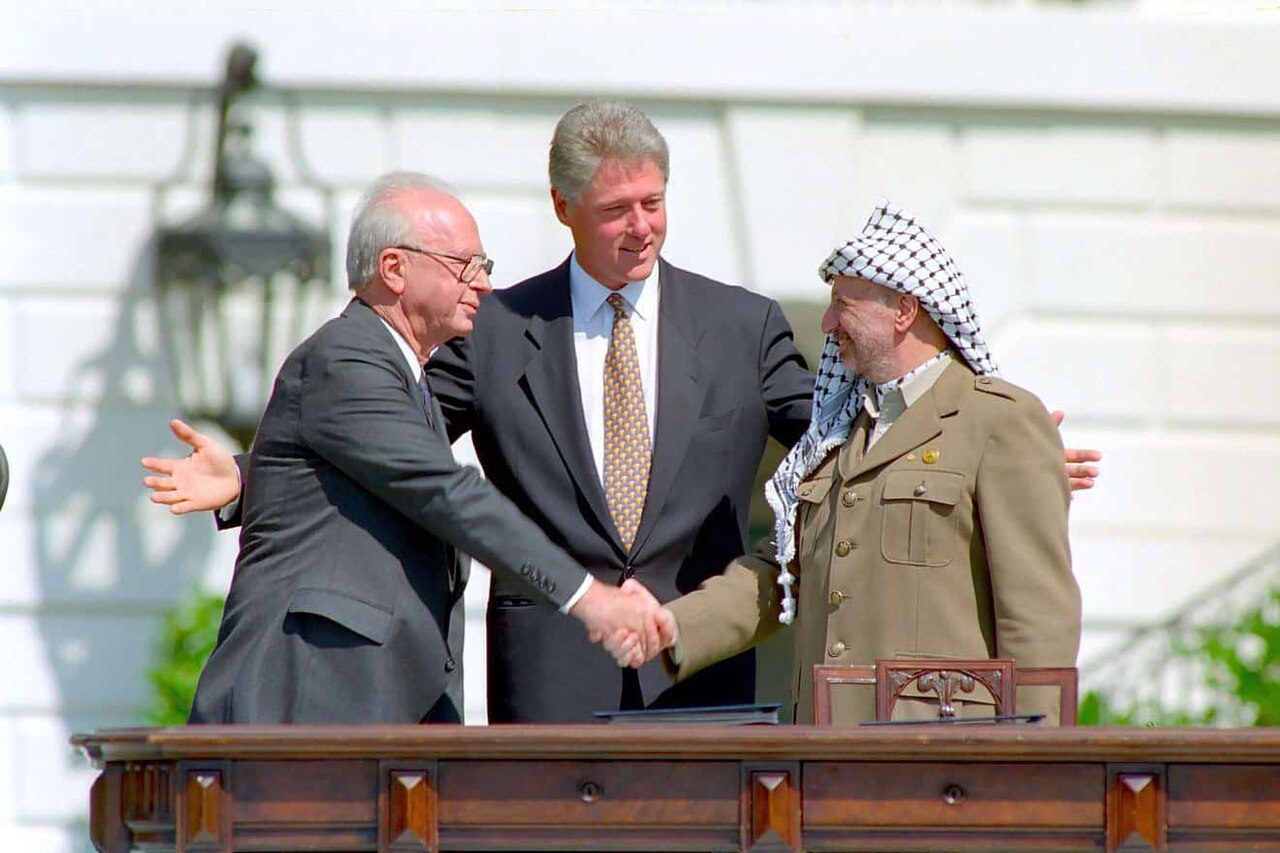
1993 is remembered for a handshake on the White House lawn: on 13 September Israel's Yitzhak Rabin and the PLO's Yasser Arafat sealed the Oslo Accord before President Bill Clinton, the first face-to-face agreement between Israel and the Palestine Liberation Organization. The same year CERN gave the World Wide Web to the world for free, and the Maastricht Treaty brought the European Union into being.
At a Glance
- Defining event
- The Oslo Accord — Israel and the PLO sign the Declaration of Principles at the White House, 13 September
- The handshake
- Prime minister Yitzhak Rabin and PLO chairman Yasser Arafat, with President Bill Clinton between them
- Given away free
- CERN announces on 30 April that the World Wide Web's protocols and code are free for anyone to use
- A union is born
- The Maastricht Treaty takes effect on 1 November, formally establishing the European Union
- Opened the year
- Production begins on Toy Story, Pixar's first feature, on 19 January
- Closed the year
- Schindler's List, Steven Spielberg's film of the Holocaust, opens in the United States on 15 December
The defining story: the handshake at the White House
The ceremony on the White House lawn on 13 September 1993 produced the most famous handshake of the decade. Israel's prime minister, Yitzhak Rabin, visibly reluctant, took the hand of Yasser Arafat, chairman of the Palestine Liberation Organization — two men whose organisations had been at war for a generation — while President Bill Clinton stood between them with his arms spread wide. What they were sealing was a Declaration of Principles on Interim Self-Government Arrangements: the first face-to-face agreement ever made between the government of Israel and the PLO, and the moment the conflict's two sides formally recognised each other.
The agreement had not been made in Washington. It was the product of months of secret talks in Norway, conducted away from the stalled public negotiations that had followed the 1991 Madrid Conference, and completed in August 1993. Days before the ceremony the two sides exchanged letters of mutual recognition: the PLO recognised Israel's right to exist and renounced terrorism, and Israel recognised the PLO as the representative of the Palestinian people. The documents themselves were signed at the ceremony by Mahmoud Abbas for the PLO and foreign minister Shimon Peres for Israel, with the American and Russian foreign ministers as witnesses.
The Declaration set out a five-year interim period. A Palestinian Authority would govern in the Gaza Strip and parts of the West Bank, Israeli forces would withdraw in stages, and negotiations on the hardest questions — Jerusalem, refugees, settlements, borders — were deferred to final-status talks due within the period. It was, by design, a framework rather than a settlement: a bet that governing together would build the trust a comprehensive peace required. In 1994 Rabin, Peres and Arafat received the Nobel Peace Prize for it.
The Oslo signing crowned a year in which the post-Cold War world was being rebuilt in several places at once. On 30 April CERN announced that the World Wide Web — its protocols and code — would be free for anyone to use, opening the internet to the world. On 1 November the Maastricht Treaty took effect, formally establishing the European Union. Cambodia's monarchy was restored in September, with Norodom Sihanouk again becoming king two decades after his overthrow. Against those beginnings stood the year's violence: a truck bomb beneath the World Trade Center in February killed six people and injured more than a thousand, and the 51-day siege at Waco, Texas, ended in fire in April with about 80 Branch Davidians dead.
Timeline of 1993
- 19 January
Production begins on Toy Story, Pixar's first feature and the first full-length computer-animated film.
- 24 January
Thurgood Marshall, the first Black justice of the U.S. Supreme Court, dies at 84.
- 26 February
A truck bomb explodes beneath the World Trade Center in New York, killing six people and injuring more than a thousand.
- 28 February
Federal agents raid the Branch Davidian compound near Waco, Texas, beginning a siege that ends in fire fifty-one days later.
- 12 March
Janet Reno is sworn in as U.S. attorney general, the first woman to hold the office.
- 19 April
The siege at Waco ends in fire; about 80 Branch Davidians, including their leader David Koresh, die.
- 30 April
CERN announces that the World Wide Web will be free for anyone to use, opening the internet to the world.
- 25 June
Kim Campbell is sworn in as Canada's first female prime minister.
- 10 August
Ruth Bader Ginsburg is sworn in as a justice of the United States Supreme Court.
- 13 September
Israel and the PLO sign the Declaration of Principles — the Oslo Accord — at the White House.
- 1 November
The Maastricht Treaty takes effect, formally establishing the European Union.
- 15 December
Schindler's List, Steven Spielberg's film of the Holocaust, opens in the United States.
Why 1993 still matters
The bet behind Oslo failed, and the record of the following years is written into the September 13 record itself: a second agreement, Oslo II, followed in 1995, but that November Rabin was assassinated by an Israeli extremist opposed to the accords. Suicide bombings, settlement expansion and collapsing trust stalled the process; the final-status deadline passed, and the permanent settlement the Declaration promised has never been reached. Yet the structures Oslo created — mutual recognition and the Palestinian Authority — still stand, which is why 1993 remains the year the conflict's end was first drafted, even though it never arrived.
The year's other gifts proved more durable. CERN's decision to give the web away free, rather than license it, is the reason a laboratory tool became the world's common medium within a few years; the announcement of 30 April is arguably the most consequential half-page of the decade. The European Union that took formal shape on 1 November became the framework inside which most of Europe still organises its trade, travel and law. And in a Hollywood studio, production began on Toy Story, the first full-length computer-animated film — the start of a takeover of animation that has never been reversed.
Even the year's scholarship reached backwards to close an old file: in July, DNA testing was reported to have identified the remains of Russia's last tsar, Nicholas II, and his family, executed in 1918. A year that identified the bones of an old order while drafting new ones — a European union, a free web, a framework for peace in the Middle East — earns its place as one of the hinge years of the 1990s.
1993 on The History Trail
The handshake dominates this year on The History Trail, but the web's birthday and the Union's founding are here too.
- September 13 in History — Israel and the PLO sign the Oslo Accord at the White House — the year's featured story.
- April 30 in History — CERN announces the World Wide Web will be free for anyone to use.
- November 1 in History — The Maastricht Treaty takes effect, formally establishing the European Union.
- February 26 in History — A truck bomb explodes beneath the World Trade Center in New York.
- December 15 in History — Schindler's List opens in the United States.
- Microsoft — The software company whose world the free web of 1993 was about to remake.
- NASA — The space agency in the background of the year's other great project, the coming space station era.
Sources
- Encyclopaedia Britannica — On This Day: September 13
- Encyclopaedia Britannica — On This Day: April 30
- Encyclopaedia Britannica — On This Day: November 1
- Encyclopaedia Britannica — On This Day: February 26
- Encyclopaedia Britannica — On This Day: December 15
- U.S. Department of State, Office of the Historian — The Oslo Accords and the Arab-Israeli Peace Process
The facts on this page were checked against these sources on 19 November 2026. The History Trail's permanent pages are researched and written for this site; the live profiles elsewhere on The History Trail are assembled automatically from Wikipedia and Wikidata.
About the Author
Researched and written by the The History Trail Editorial Team — the accountable editorial function behind this site's permanent story pages. The team works from the published sources cited on each page; it does not invent historians, reviewers or credentials, and it corrects errors openly.
Fact Check
Every load-bearing fact on this page traces to one of the sources listed above, and significant claims link to their source in the text. Our checking method is described on the methodology page; errors can be reported via the corrections page.
Sources & Citations
Cite this page as: The History Trail Editorial Team, The History Trail — this article's title, publication and update dates are shown beneath its headline. The full source list appears under Sources above; the site's source standards are on the sources page.