
On This Day
September 13 in History
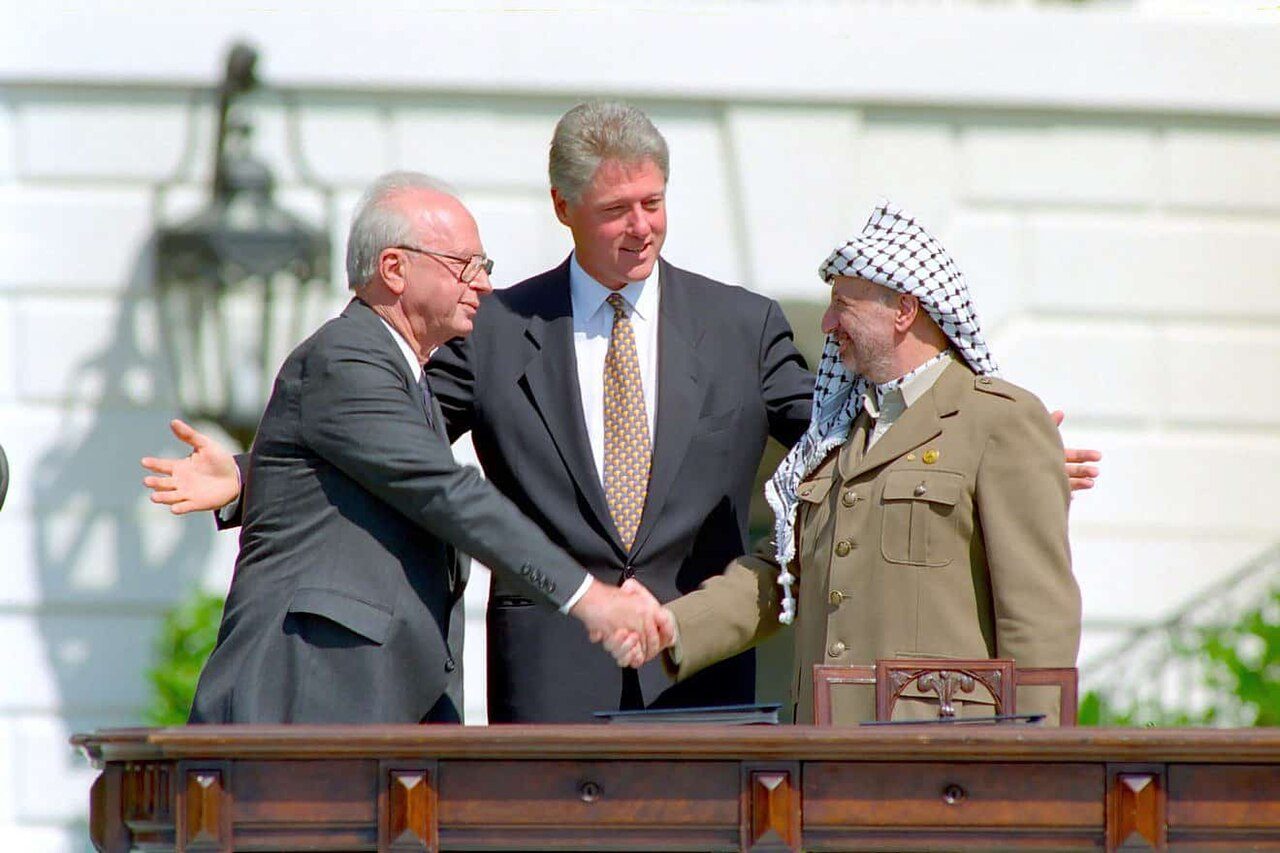
On 13 September 1993, on the South Lawn of the White House, Israel and the Palestine Liberation Organization signed a Declaration of Principles — the Oslo Accord — and Yitzhak Rabin and Yasser Arafat shook hands before President Bill Clinton. September 13 is also the day of the Battle of Quebec in 1759, the retaking of Attica prison in 1971 and the adoption of the UN Declaration on the Rights of Indigenous Peoples.
Choose another date: open the On This Day calendar to browse events, births and deaths for any day of the year.
At a Glance
- The document
- The Declaration of Principles on Interim Self-Government Arrangements, known as the Oslo I Accord
- The signers
- Mahmoud Abbas for the PLO and Shimon Peres for Israel, witnessed by the US and Russian foreign ministers
- The handshake
- Israeli prime minister Yitzhak Rabin and PLO chairman Yasser Arafat, in the presence of President Bill Clinton
- The bargain
- Mutual recognition between Israel and the PLO, and a Palestinian interim self-government in Gaza and the West Bank over a five-year transition
- The prelude
- Months of secret negotiations in Norway, hosted by the Fafo institute, after the public Madrid process stalled
- The sequel
- Rabin, Peres and Arafat shared the 1994 Nobel Peace Prize; Rabin was assassinated in 1995, and the promised final settlement was never reached
Events on this day
- 1759British forces under James Wolfe defeat the French under Montcalm on the Plains of Abraham outside Quebec; both generals are mortally wounded, and Canada passes toward British rule.
- 1848Railroad foreman Phineas Gage survives an iron rod being driven through his skull in Vermont, becoming a landmark case in the study of the brain and personality.
- 1862Union soldiers near Frederick, Maryland, find a lost copy of Robert E. Lee's campaign orders wrapped around cigars, revealing the Confederate plan before Antietam.
- 1940Italian forces cross from Libya into Egypt, opening the North African campaign of the Second World War.
- 1963Mary Kay Ash founds her cosmetics company in Dallas with her life savings, building it into a direct-selling empire.
- 1971State police storm Attica prison in New York, ending a four-day uprising; 39 people are killed in the assault, including 29 prisoners and 10 hostages.
- 1987Scavengers open a radioactive caesium-137 canister from an abandoned clinic in Goiânia, Brazil, beginning one of the world's worst radiation accidents.
- 1990Law & Order debuts on American television, beginning one of the longest-running drama franchises in TV history.
- 1993Israel and the PLO sign the Declaration of Principles — the Oslo Accord — at the White House — the featured story above.
- 2007The UN General Assembly adopts the Declaration on the Rights of Indigenous Peoples, recognising their rights to land, culture and self-determination.
Born on this day
- 1851Walter Reed — American army physician who led the commission that proved yellow fever is carried by mosquitoes.
- 1857Milton Hershey — American chocolatier who built the Hershey chocolate company and the model town named for it.
- 1885Alain Locke — American philosopher and writer, a central figure and interpreter of the Harlem Renaissance.
- 1911Bill Monroe — American musician, the 'Father of Bluegrass' whose mandolin style named a genre.
- 1916Roald Dahl — British novelist, author of Charlie and the Chocolate Factory and James and the Giant Peach.
Died on this day
- 1598Philip II — king of Spain, ruler of a global empire whose death brought his son Philip III to the throne the same day.
- 1872Ludwig Feuerbach — German philosopher whose critique of religion deeply influenced Marx and modern atheism.
- 1971Lin Biao — Chinese marshal and Mao Zedong's designated successor, killed in a plane crash in Mongolia while fleeing after an alleged coup attempt.
- 1996Tupac Shakur — American rapper and actor, dead at 25 of wounds from a drive-by shooting in Las Vegas six days earlier.
The featured story: the Oslo Accord is signed, 13 September 1993
The ceremony on the White House lawn on 13 September 1993 produced the most famous handshake of the decade. Israel's prime minister, Yitzhak Rabin, visibly reluctant, took the hand of Yasser Arafat, chairman of the Palestine Liberation Organization — two men whose organisations had been at war for a generation — while President Bill Clinton stood between them with his arms spread wide. What they were sealing, as the US State Department's Office of the Historian records, was a Declaration of Principles on Interim Self-Government Arrangements: the first face-to-face agreement ever made between the government of Israel and the PLO.
The agreement had not been made in Washington. It was the product of months of secret talks in Norway, conducted away from the stalled public negotiations that had followed the 1991 Madrid Conference, and completed in August 1993. Days before the ceremony, the two sides exchanged letters of mutual recognition: the PLO recognised Israel's right to exist and renounced terrorism, and Israel recognised the PLO as the representative of the Palestinian people. The documents themselves were signed at the ceremony by Mahmoud Abbas for the PLO and foreign minister Shimon Peres for Israel, with the American and Russian foreign ministers as witnesses.
The Declaration set out a five-year interim period. A Palestinian Authority would govern in the Gaza Strip and parts of the West Bank, Israeli forces would withdraw in stages, and negotiations on the hardest questions — Jerusalem, refugees, settlements, borders — were deferred to final-status talks due within the period. It was, by design, a framework rather than a settlement: a bet that governing together would build the trust that a comprehensive peace required. In 1994 Rabin, Peres and Arafat received the Nobel Peace Prize for it.
The bet failed. A second agreement, Oslo II, followed in 1995, but in November that year Rabin was assassinated by an Israeli extremist opposed to the accords. Suicide bombings, settlement expansion and collapsing trust stalled the process; the final-status deadline passed, and the permanent settlement the Declaration promised has never been reached. Yet the structures Oslo created — mutual recognition and the Palestinian Authority — still stand, and the photograph of that September morning remains the defining image both of how close peace once seemed and of how far it receded.
Why this date matters
September 13 is a day of bargains struck and broken. In 1759 an empire changed hands on the Plains of Abraham in a battle that killed both commanders; in 1971 the state retook Attica prison at the cost of 39 lives; in 1993 two enemies shook hands on a promise that peace would follow within five years; and in 2007 the world's nations formally recognised the rights of Indigenous peoples after decades of negotiation. Again and again the date shows agreements being made in hope — and history grading them afterwards, sometimes kindly, sometimes not.
Sources
- Encyclopaedia Britannica — On This Day: September 13
- HISTORY — This Day in History: September 13
- U.S. Department of State, Office of the Historian — The Oslo Accords and the Arab-Israeli Peace Process
- Encyclopaedia Britannica — Israel: The Oslo Accords
The facts on this page were checked against these sources on 19 November 2026. The History Trail's permanent pages are researched and written for this site; the live profiles elsewhere on The History Trail are assembled automatically from Wikipedia and Wikidata.
About the Author
Researched and written by the The History Trail Editorial Team — the accountable editorial function behind this site's permanent story pages. The team works from the published sources cited on each page; it does not invent historians, reviewers or credentials, and it corrects errors openly.
Fact Check
Every load-bearing fact on this page traces to one of the sources listed above, and significant claims link to their source in the text. Our checking method is described on the methodology page; errors can be reported via the corrections page.
Sources & Citations
Cite this page as: The History Trail Editorial Team, The History Trail — this article's title, publication and update dates are shown beneath its headline. The full source list appears under Sources above; the site's source standards are on the sources page.