
On This Day
April 30 in History
On 30 April 1803, in Paris, American envoys Robert Livingston and James Monroe signed the treaty by which France sold the United States 828,000 square miles of Louisiana for $15 million — roughly four cents an acre, doubling the young republic at a stroke. April 30 is also the day Washington was first inaugurated in 1789, Hitler died in 1945, and Saigon fell in 1975.
Choose another date: open the On This Day calendar to browse events, births and deaths for any day of the year.
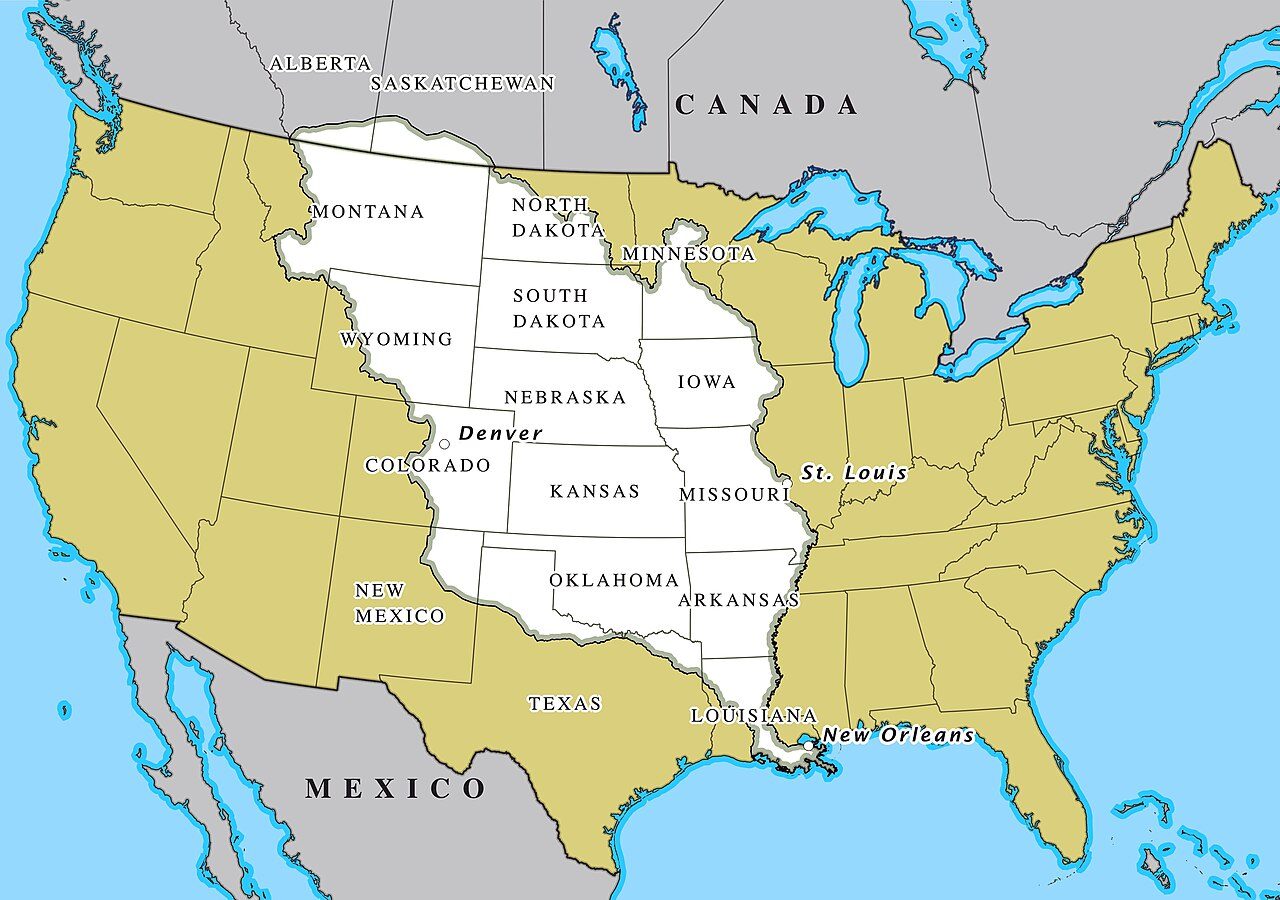
At a Glance
- The price
- $15 million in total — $11.25 million to France plus up to $3.75 million in French debts to Americans that the U.S. assumed
- The land
- 828,000 square miles west of the Mississippi, from the Gulf of Mexico to Canada and toward the Rockies — all or part of 15 future states
- The sellers
- Napoleon's France, which had secretly regained Louisiana from Spain in 1800 and now needed money for war with Britain
- The buyers
- Envoys Robert R. Livingston and James Monroe, authorised to spend up to $10 million on New Orleans and the Floridas alone
- The catch
- President Jefferson doubted the Constitution allowed the purchase; he proceeded anyway, and the Senate ratified the treaty on 20 October 1803
- The fine print
- The documents were dated 30 April 1803 but signed a day or two later; formal transfer in New Orleans came on 20 December 1803
Events on this day
- 1006The brightest supernova in recorded history, SN 1006, appears in the constellation Lupus; astronomers from China to Europe record a new star visible in daylight.
- 1789George Washington takes the oath on the balcony of Federal Hall in New York, becoming the first president of the United States.
- 1803The Louisiana Purchase treaty is signed in Paris, doubling the United States — the featured story above.
- 1812Louisiana enters the Union as the 18th state — the first state carved from the territory bought nine years earlier.
- 1939The New York World's Fair opens in Flushing Meadows, displaying television and a vision of the 'World of Tomorrow' to a Depression-weary nation.
- 1945Adolf Hitler kills himself in his Berlin bunker, as does Eva Braun, his wife of one day; Soviet troops are streets away.
- 1975North Vietnamese forces capture Saigon; South Vietnam's president surrenders unconditionally and the Vietnam War ends.
- 1993CERN announces that the World Wide Web — its protocols and code — will be free for anyone to use, opening the internet to the world.
Born on this day
- 1777Carl Friedrich Gauss — German mathematician, the 'Prince of Mathematicians', whose work reshaped number theory, astronomy and physics.
- 1916Claude Shannon — American mathematician and engineer who founded information theory and laid the groundwork for the digital computer.
- 1926Cloris Leachman — American actor, Oscar winner and one of television's most decorated performers.
- 1982Kirsten Dunst — American actor who grew from child star to acclaimed lead in films from Interview with the Vampire to Melancholia.
Died on this day
- 1883Édouard Manet — French painter whose Olympia and Le Déjeuner scandalised Paris and opened the road to modern art, dead at 51.
- 1945Adolf Hitler — dictator of Nazi Germany, by his own hand in Berlin at 56 (see Events).
- 1945Eva Braun — Hitler's long-time companion and wife of one day, dead beside him at 33.
- 1989Sergio Leone — Italian director of the Dollars westerns and Once Upon a Time in America, dead in Rome at 60.
The featured story: the Louisiana Purchase, 30 April 1803
Thomas Jefferson sent his envoys to Paris to buy a city, not an empire. The United States of 1803 ended at the Mississippi, but its farmers' produce floated down that river to Spanish-held New Orleans, and when Spain secretly returned Louisiana to Napoleon's France, Jefferson feared a powerful empire planted across America's outlet to the sea. Livingston, and then Monroe, were authorised to offer up to $10 million for New Orleans and the Floridas. What they found in April 1803 was a Napoleon abruptly willing to sell everything: his American ambitions wrecked by the slave revolution in Saint-Domingue (Haiti) and by the army it consumed, and war with Britain about to resume, he chose cash and spite — money for his treasury, and a strengthened America as a maritime rival to humble Britain.
The negotiation took days, not months. The treaty of cession and two financial conventions, dated 30 April 1803, transferred, in the National Archives' summary, 828,000 square miles west of the Mississippi for $15 million — about four cents an acre, in a transaction that doubled the size of the United States. The price was structured as $11.25 million in bonds to France plus American assumption of up to $3.75 million in French debts owed to U.S. citizens. Neither side could say exactly what had been sold: the boundaries were so vague that Jefferson wondered whether the purchase reached the Pacific, and Spain protested that France had promised never to sell at all.
Jefferson then had to swallow his own principles. A strict constructionist who doubted the Constitution gave the federal government power to acquire territory and incorporate its inhabitants, he considered a constitutional amendment, then — warned that Napoleon might change his mind — proceeded by treaty instead and let the theory follow the fact. The Senate ratified on 20 October 1803; France handed Louisiana to the United States at New Orleans on 20 December. Within months Jefferson had dispatched Lewis and Clark to find out what he had bought, beginning the exploration — and the accelerated dispossession of the Native nations who actually lived on the land — that would carry the republic to the Pacific.
The purchase is usually called the greatest real-estate bargain in history, and in acreage it was. Its consequences were less simple: the doubling set the stage for the Missouri Compromise and the fight over slavery's expansion that ended in civil war, and for a century of treaties and wars that transferred the land from its Indigenous owners to the United States. But on the day itself, the fact was stark enough. Two signatures in Paris redrew the map of a continent — the largest peaceful transfer of territory in modern history, made because a dictator needed money and a president was willing to bend his philosophy to geography.
Why this date matters
April 30 is the year's great hinge between beginnings and endings. The American experiment formally begins here in 1789, doubles in 1803, and in 1975 ends its longest war to that date on the same square of the calendar. Tyranny ends here too, in a bunker in 1945, while in 1993 a laboratory in Switzerland quietly gives away the invention that would define the next century. No other date packs a founding, an expansion, a collapse and a gift of that size into twenty-four hours.
Sources
- Encyclopaedia Britannica — On This Day: April 30
- HISTORY — What Happened on April 30
- National Archives — Louisiana Purchase Treaty (1803)
- Library of Congress — Louisiana Purchase: Primary Documents in American History
The facts on this page were checked against these sources on 19 November 2026. The History Trail's permanent pages are researched and written for this site; the live profiles elsewhere on The History Trail are assembled automatically from Wikipedia and Wikidata.
About the Author
Researched and written by the The History Trail Editorial Team — the accountable editorial function behind this site's permanent story pages. The team works from the published sources cited on each page; it does not invent historians, reviewers or credentials, and it corrects errors openly.
Fact Check
Every load-bearing fact on this page traces to one of the sources listed above, and significant claims link to their source in the text. Our checking method is described on the methodology page; errors can be reported via the corrections page.
Sources & Citations
Cite this page as: The History Trail Editorial Team, The History Trail — this article's title, publication and update dates are shown beneath its headline. The full source list appears under Sources above; the site's source standards are on the sources page.