
On This Day
November 1 in History
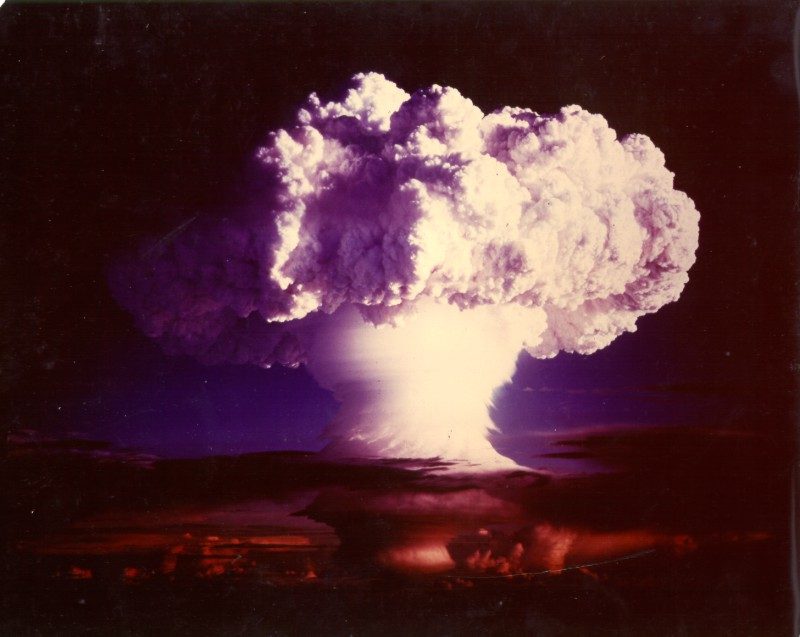
On 1 November 1952, on the island of Elugelab in Enewetak Atoll, the United States detonated Ivy Mike, the first full-scale thermonuclear device. Its 10.4-megaton explosion erased the island and opened the age of the hydrogen bomb. November 1 is also the day of the Lisbon earthquake of 1755, the unveiling of the Sistine Chapel ceiling, the first issue of Ebony and the founding act of the European Union.
Choose another date: open the On This Day calendar to browse events, births and deaths for any day of the year.
At a Glance
- The order
- 31 January 1950 — Truman directs work on all forms of atomic weapons, including the hydrogen 'superbomb'
- The design
- The Teller–Ulam configuration: X-rays from a fission primary compress and ignite a fusion secondary
- The device
- Codenamed Mike; over 6 metres tall and 70+ tonnes with its cryogenic plant — an experiment, not a deliverable weapon
- The shot
- 7:15 a.m. local time, 1 November 1952, Elugelab Island, Enewetak Atoll, Marshall Islands
- The yield
- 10.4 megatons, about 700 times the Hiroshima bomb; Elugelab replaced by an underwater crater
- The report
- AEC chairman Gordon Dean to President-elect Eisenhower: 'The island of Elugelab is missing!'
Events on this day
- 1512Michelangelo's painted ceiling of the Sistine Chapel is shown to the public for the first time in the Vatican.
- 1755A massive earthquake and tsunami devastate Lisbon, killing an estimated 40,000 to 60,000 people in Portugal's capital.
- 1765The Stamp Act takes effect in the American colonies, Britain's first direct tax on colonial legal and commercial papers, provoking fierce resistance.
- 1800President John Adams moves into the newly built President's House in Washington — the building soon known as the White House.
- 1861Abraham Lincoln names George B. McClellan general in chief of the Union army, replacing the aged Winfield Scott.
- 1911Italian lieutenant Giulio Gavotti drops grenades from his aircraft over Ottoman forces in Libya — the first aerial bombing in warfare.
- 1945John H. Johnson publishes the first issue of Ebony, the magazine that chronicles Black American life for generations.
- 1946The New York Knickerbockers beat the Toronto Huskies 68–66 in Toronto in the first game in NBA history.
- 1950Two Puerto Rican nationalists try to assassinate President Harry S. Truman at Blair House in Washington; a White House policeman is killed.
- 1952The United States detonates Ivy Mike, the first full-scale thermonuclear device, at Enewetak Atoll — the featured story above.
- 1959Montreal goaltender Jacques Plante returns to a game wearing a facemask after a facial injury, pioneering the mask in the NHL.
- 1993The Maastricht Treaty takes effect, formally establishing the European Union.
Born on this day
- 1762Spencer Perceval — British prime minister, the only holder of the office ever assassinated, shot in 1812.
- 1871Stephen Crane — American novelist and poet, author of The Red Badge of Courage.
- 1880Sholem Asch — Polish American writer whose Yiddish novels and plays reached a worldwide audience.
- 1935Edward Said — Palestinian American scholar whose book Orientalism founded the field of postcolonial studies.
- 1957Lyle Lovett — American singer-songwriter whose work crosses country, jazz and blues.
- 1972Toni Collette — Australian actor acclaimed in film, television and theatre.
Died on this day
- 1894Alexander III — emperor of Russia, whose death brings his son Nicholas II, the last tsar, to the throne.
- 1903Theodor Mommsen — German historian of Rome and Nobel laureate in literature.
- 1972Ezra Pound — American modernist poet, a central and controversial figure of 20th-century poetry.
- 1982King Vidor — American film director whose career spanned the silent and sound eras.
- 1987René Lévesque — journalist and politician who founded the Parti Québécois and led Quebec as premier.
- 1999Walter Payton — Chicago Bears running back, one of the greatest players in American football history.
The featured story: the first hydrogen bomb, 1 November 1952
In January 1950, five months after the Soviet Union tested its first atomic bomb, President Harry S. Truman ordered American scientists to push ahead with a far more powerful weapon: the 'super', a bomb that would draw its energy not only from splitting atoms but from fusing them, as the sun does. The breakthrough design, worked out by Edward Teller and Stanisław Ulam in 1951 and turned into hardware by a team at Los Alamos that included the young physicist Richard Garwin, used the X-rays from a fission explosion to compress and ignite fusion fuel. The test of that idea was codenamed Mike, in the Operation Ivy series.
Mike was not a bomb anyone could drop. Nicknamed the 'Sausage', the device stood more than six metres tall and, with the refrigeration plant needed to keep its liquid deuterium fuel cold, weighed over 70 tonnes. It was assembled in a huge corrugated building on Elugelab, a small island in Enewetak Atoll in the Marshall Islands, and fired by remote control from a ship some 30 miles away. Everything about it was an experiment: the question was simply whether staged radiation implosion would work at full scale.
At 7:15 on the morning of 1 November 1952 local time, it did. The explosion yielded 10.4 megatons — roughly 700 times the power of the Hiroshima bomb — and produced a fireball miles wide. Elugelab was simply gone, replaced by an underwater crater more than a mile across and some 50 metres deep. The Atomic Energy Commission's chairman, Gordon Dean, reported the result to the incoming president, Dwight D. Eisenhower, in a sentence that became famous: 'The island of Elugelab is missing!'
The test transformed the arms race. Within a year the Soviet Union had detonated its own thermonuclear device, and by the middle of the decade both superpowers were building deliverable hydrogen bombs small enough for aircraft and, soon, missiles — weapons hundreds of times more destructive than those of 1945, stockpiled in the thousands. The Pacific proving grounds also left a harder legacy: fallout, displaced islanders and contaminated atolls, argued over for decades. November 1, 1952 is the morning the Cold War acquired the means to end civilisation, demonstrated on an island that no longer exists.
Why this date matters
November 1 is a date of firsts that changed the scale of things: the Sistine ceiling revealed, the first aerial bomb, the first NBA game, the first issue of Ebony, a union of European states. But its centre of gravity is 1952, when a Pacific island was vaporised to prove that fusion — the fire of the stars — could be weaponised. The day also carries an older warning about nature's own scale, in the earthquake that flattened Lisbon in 1755 and forced Europe to rethink providence, cities and risk. Beginnings, on this date, tend to be irreversible.
Sources
- Encyclopaedia Britannica — On This Day: November 1
- HISTORY — What Happened on November 1
- U.S. Army Heritage and Education Center — The Island is Missing!
- Wikimedia — On This Day feed: November 1
The facts on this page were checked against these sources on 19 November 2026. The History Trail's permanent pages are researched and written for this site; the live profiles elsewhere on The History Trail are assembled automatically from Wikipedia and Wikidata.
About the Author
Researched and written by the The History Trail Editorial Team — the accountable editorial function behind this site's permanent story pages. The team works from the published sources cited on each page; it does not invent historians, reviewers or credentials, and it corrects errors openly.
Fact Check
Every load-bearing fact on this page traces to one of the sources listed above, and significant claims link to their source in the text. Our checking method is described on the methodology page; errors can be reported via the corrections page.
Sources & Citations
Cite this page as: The History Trail Editorial Team, The History Trail — this article's title, publication and update dates are shown beneath its headline. The full source list appears under Sources above; the site's source standards are on the sources page.