
Things
NASA
NASA - the National Aeronautics and Space Administration - is the United States' civilian space agency, created in 1958 in direct response to the Soviet launch of Sputnik. It landed the first humans on the Moon in 1969, flew the reusable Space Shuttle for thirty years, helped build the International Space Station, and now runs the Artemis programme to return astronauts to the Moon.
At a Glance
- Full name
- National Aeronautics and Space Administration, an independent agency of the US federal government
- Created
- By the National Aeronautics and Space Act, signed 29 July 1958; operations began 1 October 1958
- Predecessor
- The National Advisory Committee for Aeronautics (NACA, founded 1915), absorbed intact with 8,000 employees and a $100 million budget
- The trigger
- Sputnik 1, the Soviet Union's first artificial satellite, launched 4 October 1957
- Headquarters
- Washington, D.C., with ten field centres across the United States
- Defining achievement
- Apollo 11, 20 July 1969: Neil Armstrong and Buzz Aldrin land on the Moon; 12 astronauts walked on it in six landings
- Today
- Robotic missions across the solar system, the International Space Station partnership, and the Artemis lunar programme
Introduction
Britannica defines NASA as the independent US governmental agency established in 1958 for the research and development of vehicles and activities for the exploration of space within and outside Earth's atmosphere. That dry definition covers an extraordinary range: aeronautics research that still shapes every airliner, weather and Earth-observing satellites, telescopes that have rewritten astronomy, robots on Mars, and the only human voyages ever made to another world.
NASA was deliberately civilian. President Dwight D. Eisenhower and Congress chose to separate America's peaceful space programme from its military missile work, and that choice - made in the middle of the Cold War, for reasons of national prestige - shaped everything the agency became. Its history is therefore two stories at once: a scientific institution, and an instrument of a superpower contest that ended decades ago while the institution carried on.
Origins: Sputnik and the End of NACA
NASA's ancestor was the National Advisory Committee for Aeronautics, created by Congress in 1915 to coordinate American aviation research. For four decades NACA ran wind tunnels and test aircraft, including the X-series that broke the sound barrier. It was respected, quiet and entirely concerned with the atmosphere - until 4 October 1957, when the Soviet Union launched Sputnik 1, the world's first artificial satellite.
NASA's own official history calls the result a full-scale crisis, with a Pearl Harbor effect on American opinion: the beeping Soviet sphere seemed to prove a technological gap. The United States answered first with Explorer 1 on 31 January 1958, which documented the radiation zones now called the Van Allen belts. Then Congress acted. Eisenhower signed the National Aeronautics and Space Act on 29 July 1958, and on 1 October NASA began operations, absorbing NACA intact - its 8,000 employees, $100 million annual budget, three major laboratories and two test facilities - and soon adding the Jet Propulsion Laboratory and the Army Ballistic Missile Agency team in Huntsville, where Wernher von Braun's engineers were building large rockets.
Mercury, Gemini and Apollo: The Race to the Moon
NASA moved in stages. Project Mercury (flights 1961-63) asked whether a human could survive in space at all: Alan Shepard made a 15-minute suborbital flight on 5 May 1961, and John Glenn became the first American to orbit Earth on 20 February 1962. Project Gemini (1965-66) taught the skills a Moon voyage needed - rendezvous, docking and spacewalks, beginning with Edward White's on 3 June 1965.
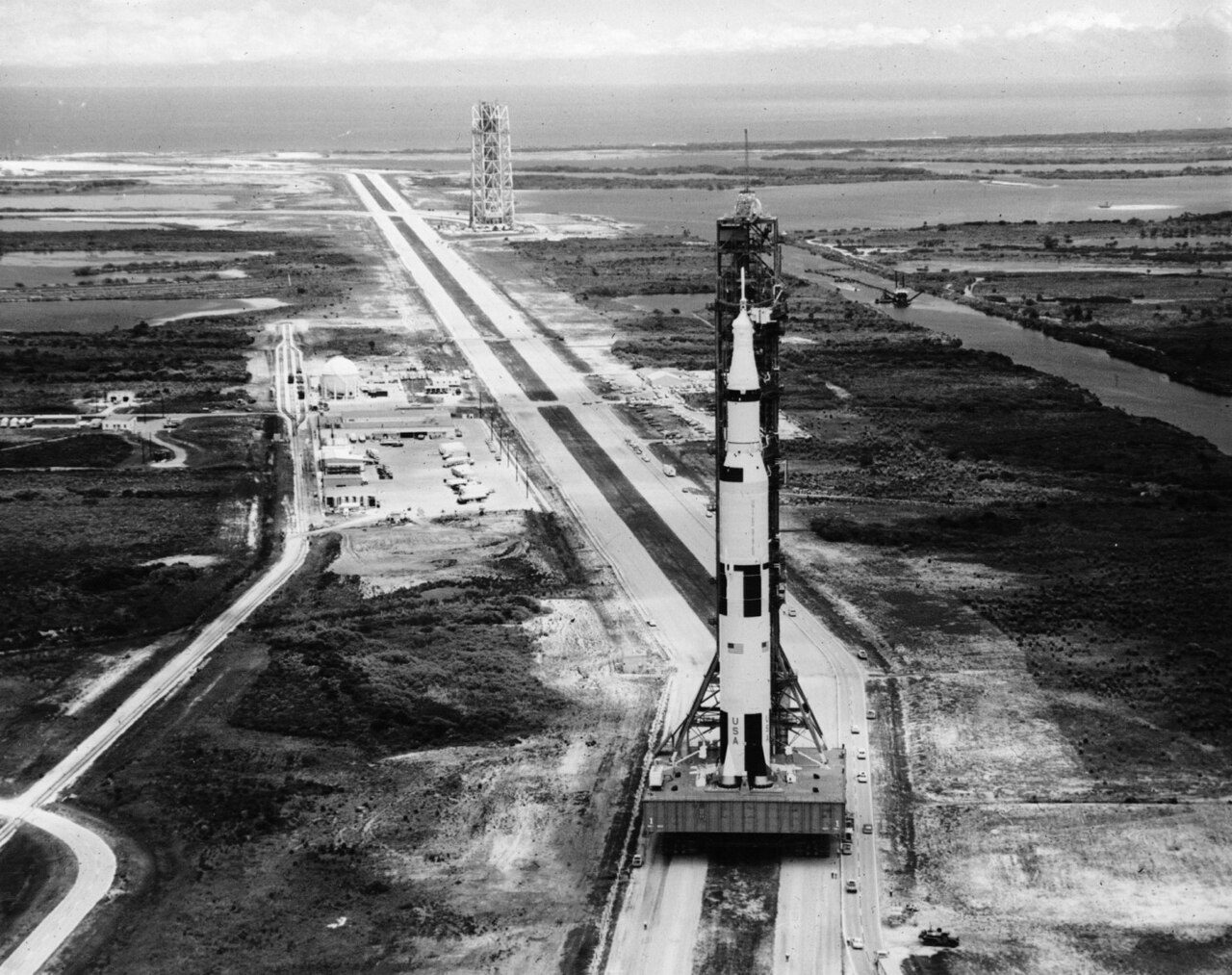
Apollo became the priority on 25 May 1961, when President John F. Kennedy committed the nation to landing a man on the Moon and returning him safely before the decade ended. The programme cost $25.4 billion and survived its darkest day, the launch-pad fire of 27 January 1967 that killed Gus Grissom, Edward White and Roger Chaffee. Apollo 8 orbited the Moon at Christmas 1968. On 20 July 1969 Apollo 11 landed Neil Armstrong and Buzz Aldrin on the surface while Michael Collins waited in orbit. Five more landings followed; Apollo 13, crippled by an exploding oxygen tank in April 1970, was brought home by improvisation; and Apollo 17 closed the programme in December 1972. Twelve astronauts had walked on the Moon. In 1975 NASA and the Soviet Union flew the joint Apollo-Soyuz mission - the rivals docking in orbit.
The Shuttle, the Station and the Telescopes
After a six-year gap, NASA returned to human flight with the Space Shuttle, first launched on 12 April 1981: a reusable orbiter that took off like a rocket and landed like a glider. The era carried triumph and tragedy together. Sally Ride became the first American woman in space in 1983. On 28 January 1986 Challenger broke apart 73 seconds after launch, killing all seven aboard; the fleet was grounded for over two years. On 1 February 2003 Columbia disintegrated during re-entry, again killing seven. The Shuttle flew its last mission in 2011, having deployed and repeatedly serviced the Hubble Space Telescope, launched in 1990, whose flawed mirror was corrected by astronauts in December 1993.
The Shuttle also built the International Space Station. Russia joined the United States and other partners in 1993; assembly in orbit began in late 1998, and the station grew into the largest structure humans have put in space and a permanent, multinational laboratory. Alongside the crewed programme, NASA's robots visited every planet: Mariner, Viking, Pioneer and the Voyagers, which left the Sun's neighbourhood carrying records of Earth. In November 2022 Artemis I flew the uncrewed Orion spacecraft around the Moon and back in 25 days - the first integrated test of the system meant to return astronauts to the lunar surface.
Timeline
- 1915
Congress creates the National Advisory Committee for Aeronautics (NACA), NASA's predecessor.
- 4 October 1957
The Soviet Union launches Sputnik 1, the first artificial satellite, triggering the crisis that creates NASA.
- 29 July 1958
President Eisenhower signs the National Aeronautics and Space Act.
- 1 October 1958
NASA begins operations, absorbing NACA's 8,000 employees, three laboratories and $100 million budget.
- 5 May 1961
Alan Shepard becomes the first American in space on a 15-minute Mercury flight.
- 25 May 1961
President Kennedy commits the United States to landing a man on the Moon before the decade ends.
- 27 January 1967
An Apollo capsule fire on the launch pad kills astronauts Grissom, White and Chaffee.
- 20 July 1969
Apollo 11: Armstrong and Aldrin land on the Moon; Collins remains in lunar orbit.
- 12 April 1981
The first Space Shuttle mission, STS-1, launches; the reusable era begins.
- 28 January 1986
Challenger is lost 73 seconds after launch with all seven crew; the Shuttle is grounded for over two years.
- 24 April 1990
The Hubble Space Telescope is launched aboard Discovery; astronauts install corrective optics in December 1993.
- 16 November 2022
Artemis I launches Orion on an uncrewed 25-day flight around the Moon and back.
Significance
NASA's significance is partly technological - satellite weather forecasting, Earth observation and communications grew from its early applications programmes - and partly demonstrative. Apollo showed what a state could do when it spent $25.4 billion and employed hundreds of thousands on a single peaceful goal, and it did so in the open, on live television. The agency also normalised international cooperation in space: Apollo-Soyuz in 1975, then the station partnership that has kept former rivals working together in orbit ever since. Its aeronautics research, the forgotten first A in its name, continues quietly in every modern aircraft.
Myths and disputes
Two claims about NASA need plain correction. First, the Moon landings were not faked. The claim rests on misread photographs and flags, and it is contradicted by the physical evidence the missions left and returned: lunar samples brought back to Earth, retroreflectors still used by observatories, and six landing sites photographed since by orbiting spacecraft. This page treats the hoax claim as what it is - a conspiracy theory, not a historical dispute among experts.
Second, even Armstrong's famous first words carry a genuine, smaller dispute. NASA's official history prints them with a bracket: That's one small step for [a] man, one giant leap for mankind. Armstrong maintained he said the a; the transmission as heard seems to drop it. The bracket is the honest solution, and NASA uses it. A third misconception is simpler: NASA is not the whole of American space activity, and never was - military space programmes ran separately from the start, by design.
Legacy
NASA's legacy is a working model of civilian big science: an agency born from a panic that outlived its founding rivalry and kept producing knowledge - about the Moon and Mars, about Earth's climate, and about the universe Hubble opened up. The Artemis programme now aims to land astronauts on the Moon again, more than half a century after Apollo 17, this time to stay longer and with international and commercial partners built in from the start. Whether it succeeds on schedule or not, the institution Eisenhower signed into being in 1958 remains the reference point against which every other space agency is measured.
Sources
- NASA - A Brief History of NASA (Garber and Launius)
- Encyclopaedia Britannica - National Aeronautics and Space Administration
- NASA - A Brief History of the Hubble Space Telescope
- NASA - Artemis I
- Science Museum Group Collection - National Aeronautics and Space Administration
The facts on this page were checked against these sources on 19 November 2026. The History Trail's permanent pages are researched and written for this site; the live profiles elsewhere on The History Trail are assembled automatically from Wikipedia and Wikidata.
About the Author
Researched and written by the The History Trail Editorial Team — the accountable editorial function behind this site's permanent story pages. The team works from the published sources cited on each page; it does not invent historians, reviewers or credentials, and it corrects errors openly.
Fact Check
Every load-bearing fact on this page traces to one of the sources listed above, and significant claims link to their source in the text. Our checking method is described on the methodology page; errors can be reported via the corrections page.
Sources & Citations
Cite this page as: The History Trail Editorial Team, The History Trail — this article's title, publication and update dates are shown beneath its headline. The full source list appears under Sources above; the site's source standards are on the sources page.