
Years
1968 in History
1968 is remembered as the year the postwar order cracked in public: the Tet Offensive shattered confidence in the Vietnam War, Martin Luther King Jr. and Robert F. Kennedy were assassinated within two months, Soviet-led forces crushed the Prague Spring, and the year closed with Apollo 8 carrying the first humans to the Moon.
At a Glance
- Defining events
- The assassinations of Martin Luther King Jr. (4 April) and Robert F. Kennedy (5 June)
- War turning point
- The Tet Offensive, from 30 January, and the My Lai massacre, 16 March
- Cold War turning point
- Warsaw Pact invasion of Czechoslovakia, 20 August, ending the Prague Spring
- Civil rights milestone
- Civil Rights Act of 1968 signed 11 April, outlawing housing discrimination
- Closed the year
- Apollo 8, launched 21 December — the first crewed voyage to the Moon
- Remembered for
- Protest, assassination and invasion — and a Christmas Eve broadcast from lunar orbit
The defining story: the assassinations that shook America
The year opened with two shocks in a single month. On 5 January Alexander Dubček came to power in Czechoslovakia and began the reforms remembered as the Prague Spring, while in Vietnam, on 30 January, North Vietnamese and Viet Cong forces launched the Tet Offensive, attacking more than a hundred cities and bases across South Vietnam, including the United States Embassy in Saigon. Tet was a military defeat for its attackers but a political earthquake in America: on 27 February Walter Cronkite, the most trusted voice in American broadcasting, told viewers the war could end only in a negotiated stalemate, and on 29 February the Kerner Commission blamed white racism for the riots of 1967 and warned of a nation splitting into two societies, separate and unequal.
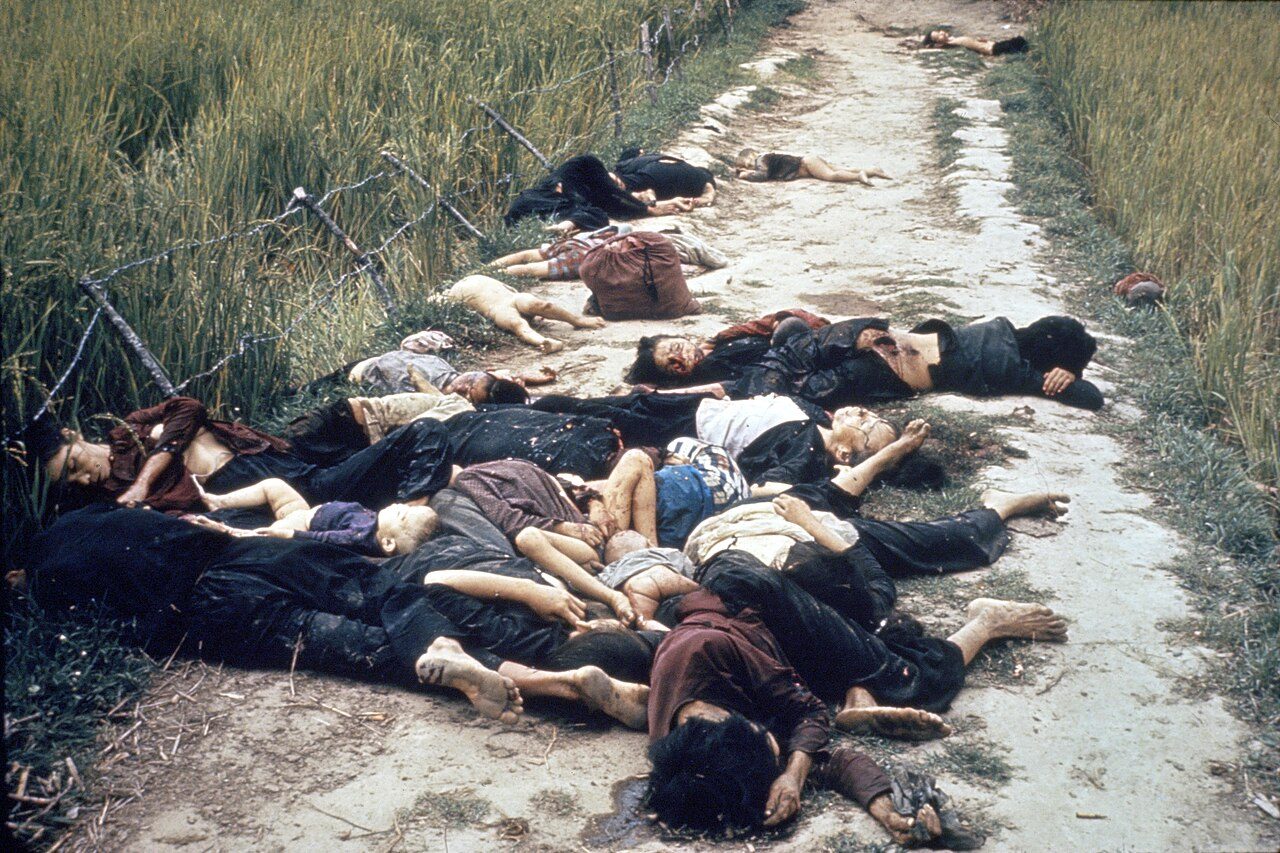
On 16 March the war produced its darkest episode of the year, when soldiers of Charlie Company murdered at least 300 and perhaps as many as 500 unarmed civilians at My Lai in South Vietnam — a massacre exposed only in 1969, when it became a turning point in American support for the war. The same day, Senator Robert F. Kennedy announced his candidacy for the presidency, challenging a president of his own party over the war. In Memphis, Martin Luther King Jr. was supporting a strike by sanitation workers whose colleagues had been killed in a faulty garbage truck; on 28 March he led a march that erupted in violence, and on 3 April he delivered his Mountaintop speech at Mason Temple.
On 4 April, King was shot on the balcony of the Lorraine Motel in Memphis and died an hour later, aged 39. Grief and anger set off rioting in more than a hundred American cities, and tens of thousands attended his funeral in Atlanta on 9 April. Within a week, on 11 April, President Lyndon B. Johnson signed the Civil Rights Act of 1968, the Fair Housing Act King had campaigned for, outlawing discrimination in the sale and rental of housing. Two months later the violence returned: minutes after winning the California Democratic primary on 5 June, Robert F. Kennedy was shot by Sirhan Sirhan in the Ambassador Hotel pantry in Los Angeles, and he died the following day, aged 42. King's assassin, James Earl Ray, was captured at London's Heathrow Airport on 8 June.
Europe's hope ended in August. On the night of 20 August, Soviet-led Warsaw Pact forces invaded Czechoslovakia to crush Dubček's reforms; the country offered no military resistance, the reforms were repealed under what was called normalisation, and Moscow codified the Brezhnev Doctrine to justify the intervention. Yet the year that had begun with Tet ended with escape velocity: Apollo 7 flew the first crewed Apollo mission in October, and on 21 December Apollo 8 lifted off with Borman, Lovell and Anders, the first crew ever to leave Earth orbit and travel to the Moon.
Timeline of 1968
- 5 January
Alexander Dubček comes to power in Czechoslovakia, opening the reform season known as the Prague Spring.
- 30 January
The Tet Offensive begins in Vietnam, as North Vietnamese and Viet Cong forces attack more than a hundred cities and bases across the South.
- 27 February
Walter Cronkite tells American viewers that the Vietnam War can end only in a negotiated stalemate.
- 16 March
American soldiers murder hundreds of unarmed civilians at My Lai; Robert F. Kennedy announces his presidential candidacy the same day.
- 4 April
Martin Luther King Jr. is assassinated on the balcony of the Lorraine Motel in Memphis, aged 39.
- 11 April
President Johnson signs the Civil Rights Act of 1968, outlawing discrimination in the sale and rental of housing.
- 5 June
Robert F. Kennedy is shot in Los Angeles minutes after winning the California primary; he dies the next day.
- 1 July
The Nuclear Non-Proliferation Treaty is opened for signature, committing signatories to halt the spread of nuclear weapons.
- 20 August
Soviet-led Warsaw Pact forces invade Czechoslovakia to crush the Prague Spring reforms.
- 28 August
Police and anti-war protesters clash violently outside the Democratic National Convention in Chicago.
- 16 October
At the Mexico City Olympics, Tommie Smith and John Carlos raise gloved fists on the medal podium in protest at racial injustice.
- 5 November
Richard Nixon narrowly defeats Hubert Humphrey to win the presidency amid war and a year of assassinations.
- 21 December
Apollo 8 launches with Borman, Lovell and Anders, the first crewed mission to leave Earth orbit and travel to the Moon.
- 24 December
The Apollo 8 astronauts, the first humans in lunar orbit, read the opening of Genesis in a live Christmas Eve broadcast.
Why 1968 still matters
1968 redrew the limits of the possible on both sides of the Cold War. In the United States, Tet destroyed official credibility about Vietnam, the two assassinations removed the civil rights movement's moral centre and the Democratic Party's most unifying candidate, and the Chicago convention showed a governing party breaking apart on live television. The Fair Housing Act, passed within a week of King's murder, was the last great statute of the civil rights era — proof that the year's violence could still move law, even as it narrowed the country's patience. Richard Nixon's narrow victory in November began a new political era built in reaction to everything 1968 had unleashed.
In Eastern Europe the lesson was the opposite one: reform from inside communism would be answered with tanks. The invasion of Czechoslovakia and the Brezhnev Doctrine announced that no satellite state would be allowed to leave Moscow's orbit, a settlement that held for twenty-one years, until 1989. The Non-Proliferation Treaty, opened for signature that July, took the other path — an attempt, however imperfect, to cap the nuclear danger by agreement rather than force.
And above it all, Apollo 8 changed the species' address. The first humans to leave Earth orbit spent Christmas Eve reading Genesis from lunar orbit, and their flight made the Moon landing of the following July thinkable. That is why 1968 refuses to settle into a single story: it is at once the year of My Lai and of Earthrise's voyage, of two coffins carried through American cities and of three men circling the Moon — the decade's hopes and its violence arriving together. The Mexico City Olympics gave the year two of its defining images in a single week: Tommie Smith and John Carlos with gloved fists raised on the podium on 16 October, and, two days later, Bob Beamon's long jump of 8.90 metres, a world record improved by an almost unbelievable 55 centimetres.
1968 on The History Trail
Five of this site's featured stories belong to 1968, a measure of how much of the century turned in a single year.
- March 16 in History — The My Lai massacre, and the day Robert F. Kennedy entered the presidential race.
- April 4 in History — Martin Luther King Jr. is assassinated in Memphis while supporting striking sanitation workers.
- June 5 in History — Robert F. Kennedy is shot in Los Angeles after winning the California primary.
- August 20 in History — Warsaw Pact forces invade Czechoslovakia and crush the Prague Spring.
- December 21 in History — Apollo 8 launches, the first crewed mission to travel to the Moon.
- Post-it Note — A permanent story page on this site that reaches back into this era.
- Toyota — A permanent story page on this site connected with this period.
Sources
- Encyclopaedia Britannica — On This Day: January 5
- Encyclopaedia Britannica — On This Day: January 30
- Encyclopaedia Britannica — On This Day: February 27
- Army Historical Foundation — My Lai
- HISTORY — What Happened on April 4
- Encyclopaedia Britannica — On This Day: April 11
The facts on this page were checked against these sources on 19 November 2026. The History Trail's permanent pages are researched and written for this site; the live profiles elsewhere on The History Trail are assembled automatically from Wikipedia and Wikidata.
About the Author
Researched and written by the The History Trail Editorial Team — the accountable editorial function behind this site's permanent story pages. The team works from the published sources cited on each page; it does not invent historians, reviewers or credentials, and it corrects errors openly.
Fact Check
Every load-bearing fact on this page traces to one of the sources listed above, and significant claims link to their source in the text. Our checking method is described on the methodology page; errors can be reported via the corrections page.
Sources & Citations
Cite this page as: The History Trail Editorial Team, The History Trail — this article's title, publication and update dates are shown beneath its headline. The full source list appears under Sources above; the site's source standards are on the sources page.