
On This Day
August 20 in History
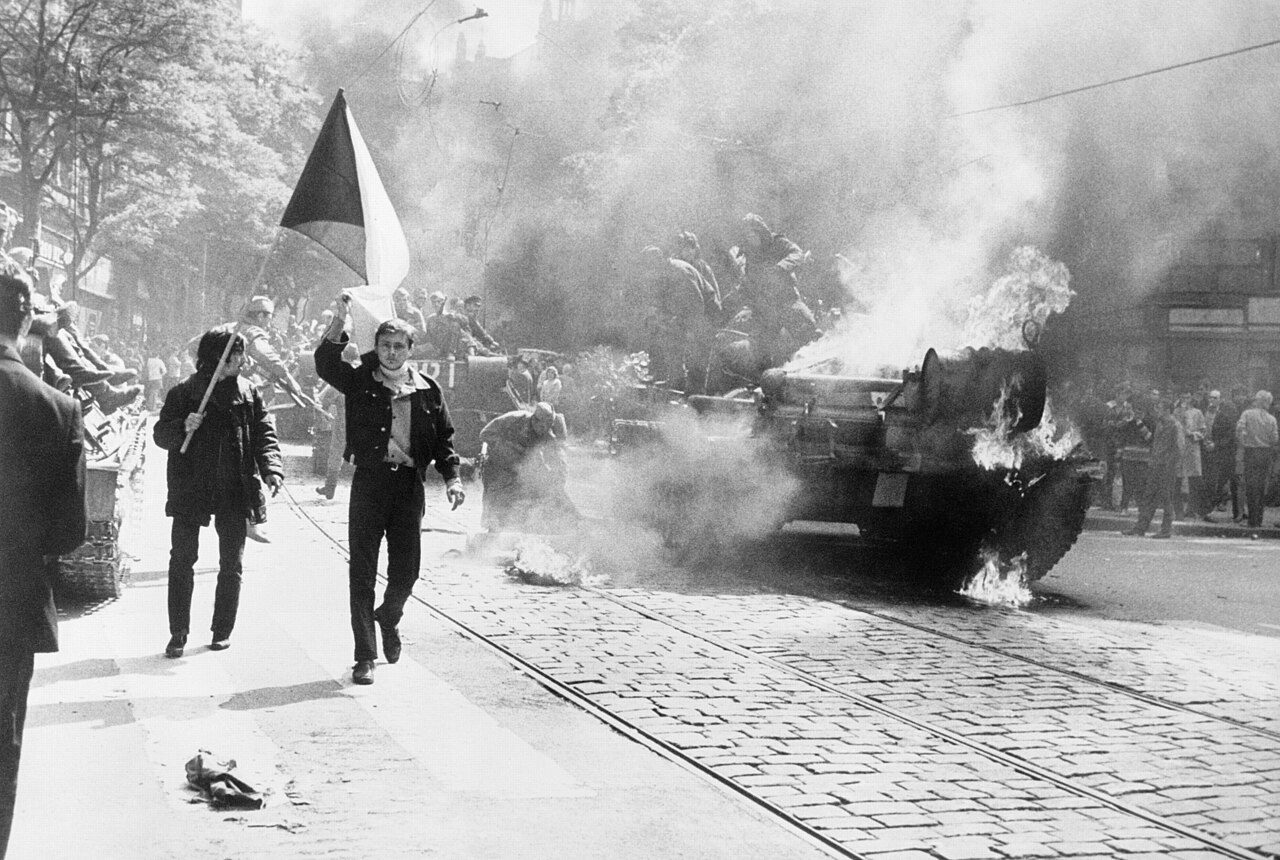
On the night of 20 August 1968, Soviet-led Warsaw Pact forces invaded Czechoslovakia, crushing Alexander Dubček's Prague Spring reforms and teaching the communist world the Brezhnev Doctrine: no country would be allowed to leave Moscow's orbit. August 20 is also the day Viking 1 and Voyager 2 set out for the planets, and the day Trotsky was struck down with an ice axe in Mexico City.
Choose another date: open the On This Day calendar to browse events, births and deaths for any day of the year.
At a Glance
- The trigger
- Alexander Dubček's Prague Spring reforms — 'socialism with a human face' — had loosened censorship and one-party control in Czechoslovakia
- The invasion
- Began on the night of 20–21 August 1968, led by the Soviet Union with troops from other Warsaw Pact states
- The scale
- The first wave is put at about 200,000 troops and 5,000 tanks in HISTORY's account; other accounts give higher figures
- The response
- Czechoslovakia's leaders ordered no military resistance; Dubček and his colleagues were seized and taken to Moscow
- The doctrine
- Moscow justified the invasion with what became known as the Brezhnev Doctrine — a claimed right to intervene wherever socialism was threatened
- The aftermath
- The reforms were repealed in a period called 'normalisation' under Gustáv Husák, and Dubček was expelled from the party
Events on this day
- 1794American forces under Anthony Wayne defeat a Native American confederacy at the Battle of Fallen Timbers in Ohio, opening the Northwest Territory to settlement.
- 1866The National Labor Union, the first national labour federation in the United States, is founded in Baltimore; it campaigns for the eight-hour day.
- 1914German troops occupy Brussels, two weeks into the invasion of Belgium that opens the First World War in the west.
- 1920Team owners meeting in Canton, Ohio, form the American Professional Football Conference, the forerunner of the NFL.
- 1940Exiled revolutionary Leon Trotsky is attacked with an ice axe at his home in Mexico City by NKVD agent Ramón Mercader; he dies the next day.
- 1944The Soviet Union launches the Second Jassy–Kishinev Offensive against German and Romanian forces in Romania.
- 1960Senegal leaves the Mali Federation and becomes an independent republic.
- 1964President Lyndon Johnson signs the Economic Opportunity Act, the near-billion-dollar centrepiece of his War on Poverty.
- 1968Soviet-led Warsaw Pact forces invade Czechoslovakia to crush the Prague Spring reforms — the featured story above.
- 1975NASA launches Viking 1, which becomes the first spacecraft to land successfully on Mars and send back pictures from the surface.
- 1977NASA launches Voyager 2, which goes on to visit all four giant planets and to enter interstellar space in 2018.
- 1980Reinhold Messner completes the first solo ascent of Mount Everest, climbing without supplementary oxygen.
- 2023Spain beat England in Sydney to win the Women's World Cup for the first time.
Born on this day
- 1833Benjamin Harrison — the 23rd president of the United States.
- 1890H. P. Lovecraft — American writer of weird fiction, creator of the Cthulhu Mythos.
- 1910Eero Saarinen — Finnish-American architect, designer of the Gateway Arch in St Louis.
- 1918Jacqueline Susann — American author whose novel Valley of the Dolls became a publishing phenomenon.
- 1948Robert Plant — English singer, the frontman of Led Zeppelin.
- 1949Phil Lynott — Irish musician, the frontman of Thin Lizzy.
Died on this day
- 2001Fred Hoyle — English astronomer who coined the term 'Big Bang' for the theory he opposed, dead at 86.
- 2014B. K. S. Iyengar — Indian teacher who carried yoga to the West and founded his own school of it.
- 2017Jerry Lewis — American comedian and filmmaker, the frenetic star of The Nutty Professor, dead in Las Vegas at 91.
The featured story: Warsaw Pact forces invade Czechoslovakia, 20 August 1968
In January 1968 Alexander Dubček became leader of Czechoslovakia's Communist Party and began the experiment remembered as the Prague Spring: 'socialism with a human face'. Censorship was loosened until it effectively vanished, newspapers began printing what they liked, Slovaks were promised a fairer place in the state, and reformers talked of a freer economy and a more open politics — all, Dubček insisted, within the Warsaw Pact and under continued Communist rule. For Moscow the experiment was intolerable anyway: an example of a communist country liberalising itself, on the Soviet Union's own doorstep, might be copied.
Through the summer the Soviet leadership pressed Dubček to reverse course, and he temporised. On the night of 20 August 1968 the argument ended. Soviet-led Warsaw Pact forces — HISTORY's account puts the first wave at some 200,000 troops and 5,000 tanks, and other accounts give higher figures — poured across Czechoslovakia's borders from every side while Soviet aircraft seized Prague's airport. By morning the capital was occupied, its radio surrounded, and Dubček and his colleagues were under arrest, soon to be flown to Moscow.
Czechoslovakia did not fight. Its leaders, hoping to prevent a bloodbath on the Hungarian model of 1956, ordered the army to stay in barracks, and the resistance that the invasion met was civilian: crowds arguing with bewildered tank crews, road signs removed or turned around to confuse the invaders, a free radio broadcasting from hiding places for days. It changed nothing material. In Moscow the Czechoslovak leaders were forced to sign away most of the reforms; Dubček lingered in office for months, a caretaker of his own defeat, before being replaced in April 1969 by Gustáv Husák.
What followed was called 'normalisation': twenty years of tightened censorship, purged institutions and quiet conformity, which lasted until the regime itself collapsed in 1989. Moscow, meanwhile, drew from the invasion a general rule — the Brezhnev Doctrine, the claimed right of the socialist bloc to intervene by force wherever socialism seemed threatened — which hung over Eastern Europe until the late 1980s. The night of 20 August 1968 thus decided the fate of two generations: it taught a whole region that reform from inside communism would be answered with tanks, a lesson unlearned only when the tanks stayed home in 1989.
Why this date matters
August 20 is the Cold War's darkest date in Europe: the night an alliance invaded its own member to stop it thinking for itself. But the same date also holds two of humanity's furthest leaps — Viking 1 setting out for Mars in 1975 and Voyager 2 for the outer planets in 1977, both launched on 20 August, as if the day compensated for the tanks with spacecraft. Add Trotsky's ice axe in 1940 and the founding of the NFL in 1920, and the pattern is a contest between control and exploration: states reaching to hold things down, and machines and climbers reaching up and out.
Sources
- Encyclopaedia Britannica — On This Day: August 20
- HISTORY — This Day in History: August 20
- US Department of State, Office of the Historian — The Soviet Invasion of Czechoslovakia, 1968
- NASA Jet Propulsion Laboratory — Voyager 2 launch, 1977
The facts on this page were checked against these sources on 19 November 2026. The History Trail's permanent pages are researched and written for this site; the live profiles elsewhere on The History Trail are assembled automatically from Wikipedia and Wikidata.
About the Author
Researched and written by the The History Trail Editorial Team — the accountable editorial function behind this site's permanent story pages. The team works from the published sources cited on each page; it does not invent historians, reviewers or credentials, and it corrects errors openly.
Fact Check
Every load-bearing fact on this page traces to one of the sources listed above, and significant claims link to their source in the text. Our checking method is described on the methodology page; errors can be reported via the corrections page.
Sources & Citations
Cite this page as: The History Trail Editorial Team, The History Trail — this article's title, publication and update dates are shown beneath its headline. The full source list appears under Sources above; the site's source standards are on the sources page.