
On This Day
March 16 in History
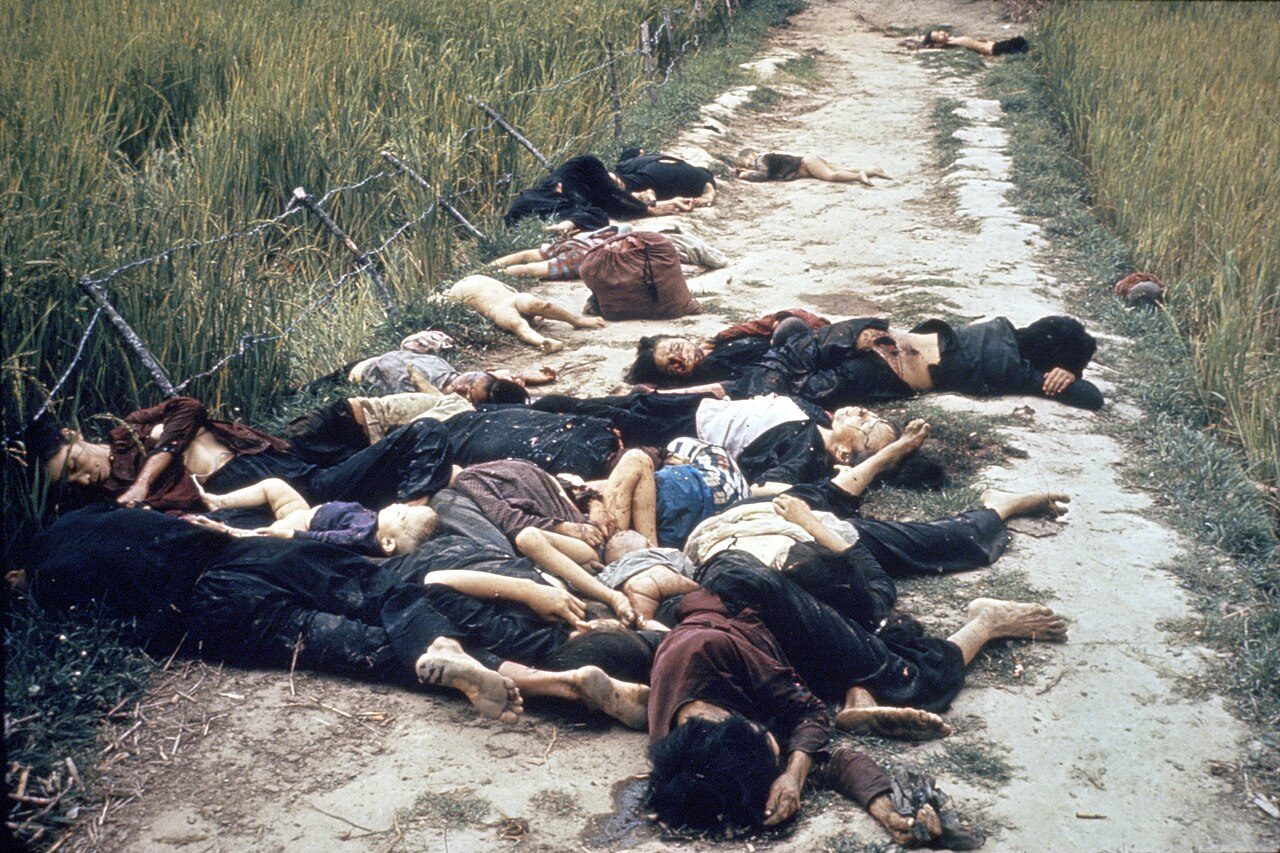
On 16 March 1968, soldiers of the U.S. Army's Charlie Company entered the Vietnamese hamlet of My Lai and, over about four hours, murdered hundreds of unarmed civilians — the Army Historical Foundation puts the toll at at least 300 and perhaps as many as 500. Once exposed, the massacre became a turning point in American support for the Vietnam War. March 16 is also the day West Point was founded in 1802 and Samoset greeted the Plymouth colonists in 1621.
Choose another date: open the On This Day calendar to browse events, births and deaths for any day of the year.
At a Glance
- Date and place
- 16 March 1968, in the hamlet of My Lai, part of Son My village, Quang Ngai Province, South Vietnam
- The unit
- Charlie Company, 1st Battalion, 20th Infantry Regiment; the platoon at the centre of the killings was led by Lt William L. Calley Jr.
- The toll
- At least 300 and perhaps as many as 500 unarmed civilians, according to the Army Historical Foundation; Britannica gives 'as many as 500'
- Duration
- The killings ran from about 07:00 to 11:00 on the morning of 16 March
- The victims
- Unarmed villagers — old men, women and children among them; no enemy force was present
- The same morning
- Senator Robert F. Kennedy announced his candidacy for the U.S. presidency, challenging his own party over the war
Events on this day
- 1621Samoset, an Abenaki sagamore who has learned English from Maine fishermen, walks into the Plymouth colony and greets the startled Pilgrims in their own language.
- 1802The United States Military Academy is founded at West Point, New York, initially as a training centre for the Corps of Engineers.
- 1926Robert Goddard launches the world's first liquid-fuelled rocket, from a farm at Auburn, Massachusetts.
- 1945U.S. forces capture the island of Iwo Jima from Japan after a month of some of the Pacific war's fiercest fighting.
- 1968American soldiers murder hundreds of unarmed civilians at My Lai in Vietnam — the featured story above.
- 1968Senator Robert F. Kennedy announces his candidacy for the presidency of the United States, challenging a president of his own party over the Vietnam War.
- 1974The Grand Ole Opry House opens in Nashville with a first broadcast featuring Roy Acuff — and President Richard Nixon playing the piano.
- 1978The tanker Amoco Cadiz runs aground off Brittany, spilling some 69 million gallons of crude oil in what is then the largest oil spill in history.
- 1995Mississippi belatedly ratifies the Thirteenth Amendment abolishing slavery — 130 years after it took effect; the ratification is only officially registered in 2013.
- 2014A referendum in Crimea, held under Russian occupation and unrecognised internationally, reports 97 percent support for joining Russia.
Born on this day
- 1750Caroline Herschel — German-born astronomer, the first woman to discover a comet, in 1786.
- 1751James Madison — American statesman, 'Father of the Constitution' and fourth president of the United States.
- 1799Anna Atkins — English botanist and photographer, maker of the first book illustrated with photographs.
- 1822Rosa Bonheur — French artist famed for her powerful paintings of animals.
- 1926Jerry Lewis — American comedian and actor, first as Dean Martin's partner and then as a solo star.
- 1933Sanford I. Weill — American banker who built the financial giant Citigroup.
Died on this day
- 37Tiberius — second emperor of Rome, who succeeded Augustus and ended his reign in seclusion on Capri.
- 1940Selma Lagerlöf — Swedish author, the first woman to win the Nobel Prize in Literature.
- 1970Tammi Terrell — American Motown singer famed for her duets with Marvin Gaye, dead of a brain tumour at 24.
- 1971Thomas E. Dewey — American politician, governor of New York and twice the Republican nominee for president.
- 1979Jean Monnet — French political economist, a founding architect of European unity.
The featured story: the My Lai massacre, 16 March 1968
In the spring of 1968 the Vietnam War was at its most fevered. Weeks after the Tet Offensive had shattered official optimism, American units in Quang Ngai Province were taking casualties from an enemy they rarely saw — mines, booby traps and snipers — in villages they believed sheltered the Viet Cong. On the morning of 16 March, Charlie Company of the 1st Battalion, 20th Infantry Regiment, was helicoptered into the hamlet cluster of Son My, expecting to engage an enemy battalion. The platoon at the centre of what followed was led by Lieutenant William L. Calley Jr.
No enemy battalion was there. What the soldiers found in the hamlet of My Lai were unarmed villagers — old men, women, children, babies — cooking breakfast fires and beginning the day's work. Over the next four hours, from about seven in the morning until eleven, American soldiers murdered them in their hundreds: in their homes, in ditches, in groups herded together and shot. The Army Historical Foundation's account puts the toll at at least 300 and perhaps as many as 500 unarmed civilians. Britannica gives the figure as 'as many as 500'. There was no return fire, because there was no one to return it.
The Army's first reports described the operation as a victory over enemy forces, and the truth was buried for more than a year. It emerged in 1969, and with it the photographs: Ronald L. Haeberle, the Army's own photographer on the operation, had documented the killing, and his images — of women and children dead on a road, of villagers moments before they were shot — made denial impossible. The same day as the massacre, by a coincidence history did not plan, Senator Robert F. Kennedy had announced his candidacy for the presidency on a platform of ending the war.
My Lai became the darkest symbol of the war in the United States, deepening public opposition and leaving questions about orders, obedience and accountability that the Army still studies in its own classrooms. A memorial now stands at Son My, where the survivors rebuilt their village around the ditches. The massacre's lesson — that the collapse of restraint, once begun, has no natural stopping point — is why 16 March 1968 remains the date by which the war's moral cost is measured.
Why this date matters
March 16 is a study in how nations meet strangers. In 1621 it produced one of history's most astonishing greetings — Samoset's English 'welcome' on the Plymouth shore — and the founding of West Point, the academy that would train America's officers. In 1968 it produced the opposite of a greeting: soldiers killing the very villagers they claimed to defend, on the same morning their country was offered a political alternative to the war. Set the two side by side and the date becomes a measuring instrument for American power — what it can build, and what it can destroy, before breakfast.
Sources
- Encyclopaedia Britannica — On This Day: March 16
- HISTORY — What Happened on March 16
- Army Historical Foundation — My Lai
- Time.now — People Who Died on March 16
The facts on this page were checked against these sources on 19 November 2026. The History Trail's permanent pages are researched and written for this site; the live profiles elsewhere on The History Trail are assembled automatically from Wikipedia and Wikidata.
About the Author
Researched and written by the The History Trail Editorial Team — the accountable editorial function behind this site's permanent story pages. The team works from the published sources cited on each page; it does not invent historians, reviewers or credentials, and it corrects errors openly.
Fact Check
Every load-bearing fact on this page traces to one of the sources listed above, and significant claims link to their source in the text. Our checking method is described on the methodology page; errors can be reported via the corrections page.
Sources & Citations
Cite this page as: The History Trail Editorial Team, The History Trail — this article's title, publication and update dates are shown beneath its headline. The full source list appears under Sources above; the site's source standards are on the sources page.