
Years
1967 in History
1967 is remembered for endings and firsts that collided: Che Guevara was executed in a Bolivian schoolhouse on 9 October and became a global icon in death; Thurgood Marshall became the first Black justice of the United States Supreme Court; Israel's Six-Day War redrew the Middle East map in June; and three Apollo astronauts died on a launch pad in January, on the same day nations agreed to keep weapons out of space.
At a Glance
- Defining event
- Che Guevara, captured in Bolivia, is executed at La Higuera on 9 October 1967
- War
- The Six-Day War, 5–10 June — Israel defeats Egypt, Jordan and Syria
- Court first
- Thurgood Marshall confirmed 30 August as the first Black Supreme Court justice; sworn in 2 October
- Space tragedy
- Apollo 1 fire kills Grissom, White and Chaffee at Cape Kennedy, 27 January
- Law landmark
- Loving v. Virginia strikes down bans on interracial marriage, 12 June
- Closed the year
- Christiaan Barnard performs the first human heart transplant in Cape Town, 3 December
The defining story: the death of Che Guevara
Ernesto 'Che' Guevara arrived in Bolivia in 1966 hoping to repeat Cuba. The Argentine-born doctor, Fidel Castro's most famous commander, led a small guerrilla column that was meant to ignite a continental revolution. Instead the campaign failed on every level the on-site record lists: the Bolivian Communist Party refused to support him, local peasants informed on the guerrillas rather than joining them, and his force — never more than a few dozen — was whittled down by hunger, asthma, desertion and the army. On 8 October 1967 Bolivian rangers trained and advised by the United States captured him, wounded in the leg, in the Yuro ravine.
He was held overnight in the schoolhouse at La Higuera. The Bolivian high command, in consultation with Washington, decided he should not live to stand trial, fearing the courtroom stage a trial would give him. On the afternoon of 9 October a Bolivian sergeant entered the schoolhouse and shot him. Guevara was thirty-nine. His body was flown to Vallegrande, laid out on a hospital laundry sink and displayed to the press as proof of death; his hands were cut off and preserved for identification, and the body was buried in secret near the airstrip.
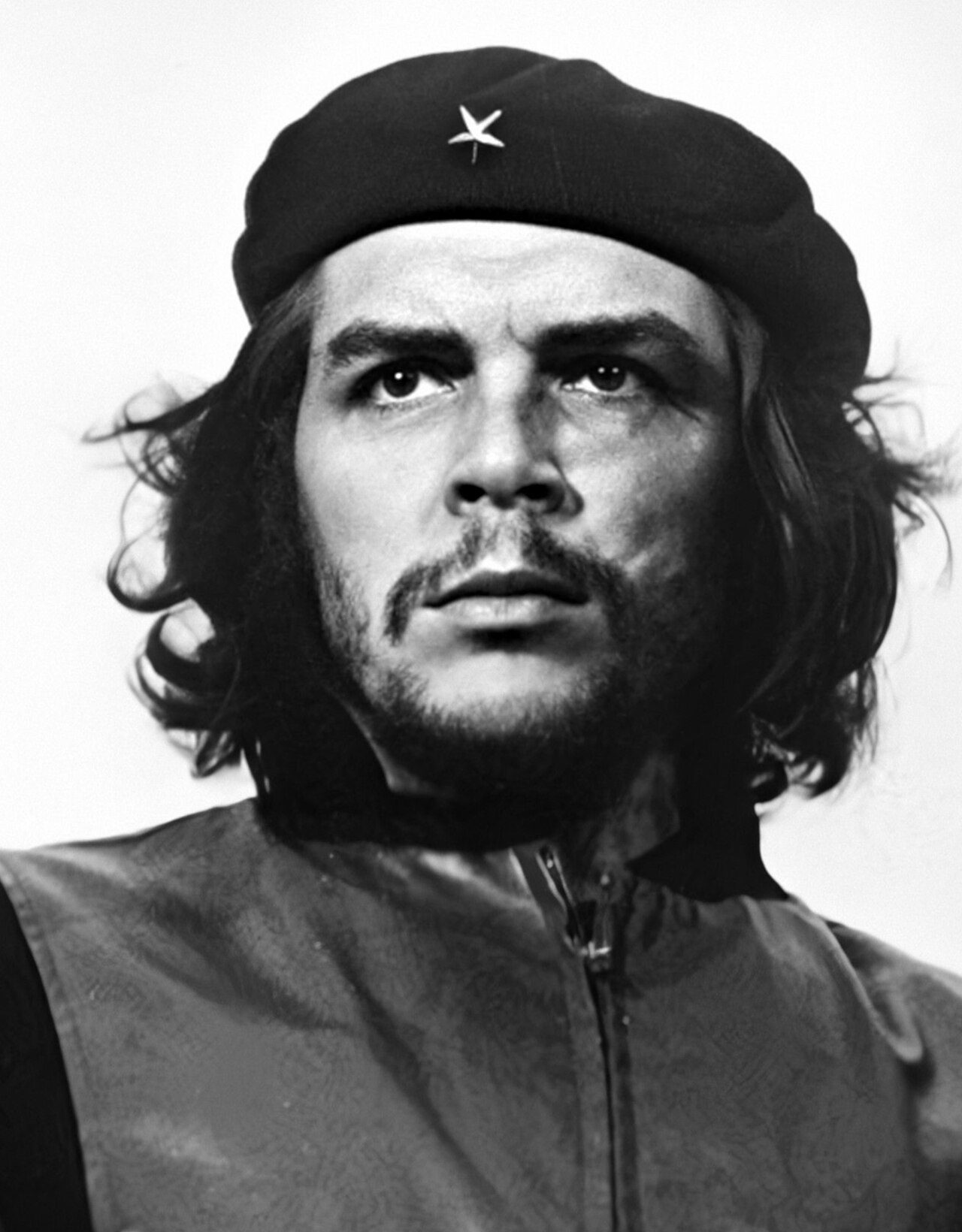
The erasure backfired completely. The photograph of the dead Che circled the world, and Alberto Korda's 1960 portrait of Guevara in his beret — the hero image on this page, little noticed when it was taken — was reproduced after his death until it became perhaps the most famous photographic image of the twentieth century. The grave kept its secret for thirty years: only in 1997 were remains identified as Guevara's excavated near the Vallegrande airstrip and reburied with honours at Santa Clara in Cuba, the city whose capture had been his greatest victory.
Guevara's death was one pole of a year that also remade maps and courts. In June, Israel's surprise strike opening the Six-Day War destroyed most of Egypt's air force on the ground; by the ceasefire of 10 June Israel held the Golan Heights, captured on 9 June. In Washington, the Supreme Court struck down bans on interracial marriage in Loving v. Virginia on 12 June, and on 30 August the Senate confirmed Thurgood Marshall — the lawyer who had argued Brown v. Board of Education — as the Court's first Black justice; he was sworn in on 2 October. The year had opened darker: on 27 January a fire in a launch rehearsal killed Apollo 1's crew of Gus Grissom, Ed White and Roger Chaffee, the same day the Outer Space Treaty was signed in London, Moscow and Washington.
Timeline of 1967
- 2 January
Ronald Reagan is sworn in as governor of California, beginning his rise in national politics.
- 15 January
The Green Bay Packers beat the Kansas City Chiefs 35–10 in the first Super Bowl.
- 27 January
A fire during a launch rehearsal kills Apollo 1 astronauts Gus Grissom, Ed White and Roger Chaffee at Cape Kennedy; the Outer Space Treaty is signed the same day.
- 22 February
General Suharto takes full power in Indonesia, beginning more than three decades of authoritarian rule.
- 28 April
Heavyweight champion Muhammad Ali refuses induction into the United States Army; he is stripped of his title and barred from boxing at his peak.
- 1 June
The Beatles release Sgt. Pepper's Lonely Hearts Club Band, soon hailed as a landmark in popular music.
- 5 June
The Six-Day War begins as Israel launches a surprise strike that destroys most of Egypt's air force on the ground.
- 10 June
The Six-Day War ends as Israel and Syria accept a United Nations ceasefire.
- 12 June
In Loving v. Virginia, the United States Supreme Court unanimously strikes down state laws banning interracial marriage.
- 17 June
China successfully tests its first hydrogen bomb, four years after its first atomic test.
- 23 July
A police raid on an unlicensed bar in Detroit sparks five days of rioting in which 43 people die.
- 30 August
Thurgood Marshall is confirmed as the first Black justice of the United States Supreme Court.
- 9 October
Che Guevara, captured the day before in Bolivia, is executed in the schoolhouse at La Higuera.
- 3 December
Christiaan Barnard performs the first human heart transplant at Groote Schuur Hospital, Cape Town.
Why 1967 still matters
Guevara's afterlife is 1967's strangest legacy: everything he attempted in Bolivia failed, and the failure, sealed by an execution and a photograph, made him immortal — a standing lesson, as the 9 October record puts it, in the difference between winning and being remembered. Korda's portrait outlived the politics it was made for, printed on posters and shirts far beyond anything Guevara himself would have recognised, while the schoolhouse at La Higuera became a museum and his last campaign a pilgrim trail.
The year's legal firsts proved more durable than its martyrology. Marshall served twenty-four years on the Court, holding consistently against the death penalty and for the rights of the accused and the poor, and Loving v. Virginia removed the last state bans on interracial marriage. The Six-Day War's ceasefire lines shaped Middle East diplomacy for generations, and the Apollo 1 fire forced the redesign that made the Moon landings possible two years later — NASA flew the uncrewed Saturn V, Apollo 4, that November.
Even the year's quieter entries pointed forward: ASEAN was founded on 8 August, China's first hydrogen bomb test on 17 June completed its entry into the nuclear club, and Barnard's heart transplant on 3 December opened the age of transplant surgery. In Detroit, five days of rioting that left 43 dead showed the American crisis that Marshall's appointment alone could not answer. 1967 is thus a year of thresholds — a court opened, a map redrawn, a revolutionary killed — each still working itself out.
1967 on The History Trail
Che Guevara's execution and Thurgood Marshall's confirmation anchor this year on The History Trail.
- October 9 in History — Che Guevara is executed in Bolivia and becomes a global icon.
- August 30 in History — Thurgood Marshall is confirmed as the first Black Supreme Court justice.
- June 5 in History — The Six-Day War begins with Israel's surprise strike.
- January 27 in History — The Apollo 1 fire kills three astronauts at Cape Kennedy.
- December 3 in History — Christiaan Barnard performs the first human heart transplant.
- Saturn V — The rocket whose first flight, as Apollo 4, came in November 1967.
Sources
- HISTORY — Che Guevara Is Executed
- Encyclopaedia Britannica — On This Day: August 30
- Encyclopaedia Britannica — On This Day: June 5
- Encyclopaedia Britannica — On This Day: January 27
- Encyclopaedia Britannica — On This Day: June 12
- Encyclopaedia Britannica — On This Day: April 28
The facts on this page were checked against these sources on 19 November 2026. The History Trail's permanent pages are researched and written for this site; the live profiles elsewhere on The History Trail are assembled automatically from Wikipedia and Wikidata.
About the Author
Researched and written by the The History Trail Editorial Team — the accountable editorial function behind this site's permanent story pages. The team works from the published sources cited on each page; it does not invent historians, reviewers or credentials, and it corrects errors openly.
Fact Check
Every load-bearing fact on this page traces to one of the sources listed above, and significant claims link to their source in the text. Our checking method is described on the methodology page; errors can be reported via the corrections page.
Sources & Citations
Cite this page as: The History Trail Editorial Team, The History Trail — this article's title, publication and update dates are shown beneath its headline. The full source list appears under Sources above; the site's source standards are on the sources page.