
On This Day
December 21 in History
On 21 December 1968 Apollo 8 lifted off from Cape Kennedy carrying Frank Borman, James Lovell and William Anders on the first crewed voyage ever to leave Earth orbit and travel to the Moon. The boldest flight of the space age so far, it reached lunar orbit on Christmas Eve and came home six days after launch. December 21 is also the day the first basketball game was played, Pan Am flight 103 was destroyed over Lockerbie, and General George Patton died.
Choose another date: open the On This Day calendar to browse events, births and deaths for any day of the year.
At a Glance
- Launch
- 21 December 1968, 7:51 a.m. EST, from Launch Complex 39A, Kennedy Space Center — the first crewed launch of the Saturn V rocket
- Crew
- Commander Frank Borman, command module pilot James Lovell and lunar module pilot William Anders
- The go-ahead
- About two hours and fifty minutes after liftoff, Mission Control approved trans-lunar injection — the burn that sent humans out of Earth orbit for the first time
- At the Moon
- Apollo 8 entered lunar orbit on 24 December and circled the Moon ten times, broadcasting a Christmas Eve reading from Genesis
- The photograph
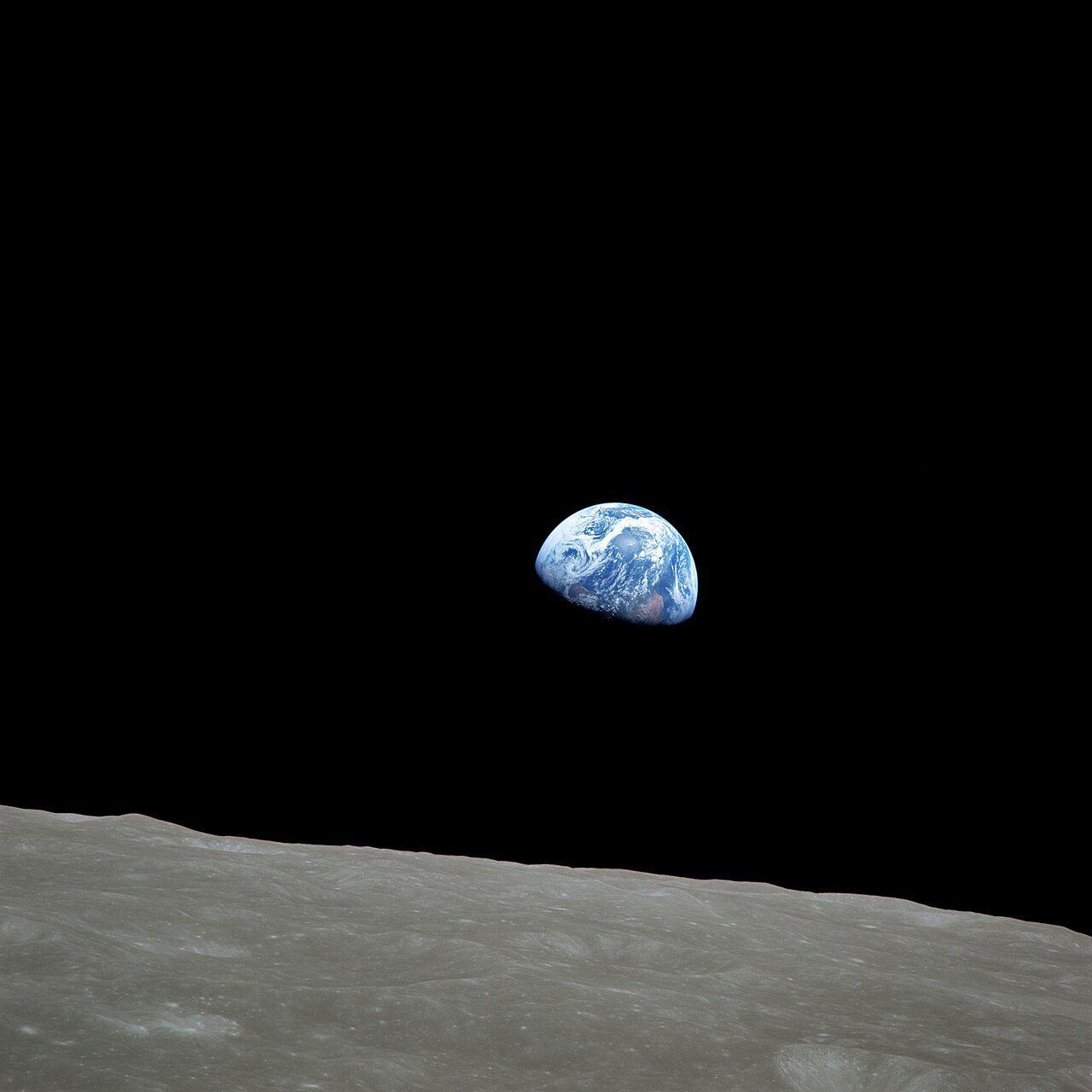
- Anders's Earthrise picture, taken on the fourth lunar orbit, became one of the most famous photographs ever made
- Home
- Splashdown in the Pacific on 27 December 1968, after a mission lasting just over six days
Events on this day
- 1864Union general William Tecumseh Sherman's March to the Sea ends as his army enters Savannah, Georgia, the Confederate port city he would offer to President Lincoln as a Christmas gift.
- 1866Lakota, Cheyenne and Arapaho warriors ambush a U.S. Army detachment near Fort Phil Kearny, Wyoming, killing Captain William Fetterman and all 80 men with him — the army's worst defeat in the West until Little Bighorn.
- 1891James Naismith introduces the game of basketball, as 18 students at the YMCA Training School in Springfield, Massachusetts, play the first game under his 13 rules, throwing a soccer ball into peach baskets.
- 1913The first crossword puzzle is published, Arthur Wynne's diamond-shaped 'word-cross' appearing in the New York World newspaper.
- 1937Walt Disney's Snow White and the Seven Dwarfs, the first full-length animated feature film, premieres in Los Angeles.
- 1958Charles de Gaulle is elected the first president of France's Fifth Republic by an electoral college, three months after the new constitution was approved.
- 1967The Graduate, Mike Nichols's film starring Dustin Hoffman and Anne Bancroft, opens in New York and becomes a defining film of its generation.
- 1968Apollo 8 launches from Florida with Borman, Lovell and Anders aboard, the first crewed mission to leave Earth orbit and travel to the Moon — the featured story above.
- 1970Elvis Presley is received at the White House by President Richard Nixon, having written to offer his help in the federal campaign against drug abuse.
- 1979The Lancaster House Agreement is signed in London, setting the terms for elections and independence in Rhodesia, which becomes Zimbabwe the following year.
- 1988A bomb destroys Pan Am flight 103 over Lockerbie, Scotland, killing all 259 people on board and 11 people on the ground; Libya later accepted responsibility and paid compensation.
- 2012PSY's 'Gangnam Style' becomes the first video on YouTube to be viewed one billion times.
Born on this day
- 1804Benjamin Disraeli — British statesman and novelist, twice prime minister and the dominant Conservative leader of the Victorian age.
- 1911Josh Gibson — American baseball catcher of the Negro leagues, one of the most powerful hitters in the game's history.
- 1940Frank Zappa — American composer and bandleader whose work with the Mothers of Invention defied every musical category.
- 1948Samuel L. Jackson — American actor, among the highest-grossing film stars of all time.
- 1959Florence Griffith Joyner — American sprinter whose 1988 world records for the 100 and 200 metres still stand.
Died on this day
- 1945George S. Patton — American general who commanded the Third Army across France and Germany, dead of injuries from a car crash near Mannheim at 60.
- 1992Stella Adler — American acting teacher whose students included Marlon Brando and Robert De Niro.
- 1992Albert King — American blues guitarist whose playing shaped generations of rock and blues musicians.
- 1996Margret Rey — German-American author who, with her husband H. A. Rey, created the Curious George children's books.
The featured story: Apollo 8 launches for the Moon, 21 December 1968
Apollo 8 was not supposed to go to the Moon. As NASA recounts, the mission was reshaped in the summer of 1968: with the lunar module behind schedule and intelligence suggesting the Soviet Union might attempt a crewed flight around the Moon, managers took the audacious decision to send the command and service module alone, without a lunar lander, all the way to lunar orbit. It would be only the second crewed Apollo flight and the very first time astronauts rode the giant Saturn V rocket.
The launch came at 7:51 on the morning of 21 December 1968 from Launch Complex 39A in Florida. After less than three hours in Earth orbit spent checking the spacecraft, the Saturn V's third stage fired again — the trans-lunar injection burn — and Borman, Lovell and Anders became the first human beings to leave Earth orbit, accelerating towards a point in space where the Moon would be three days later. No crew had ever been so far from home, or so dependent on a single engine firing correctly to bring them back.
Early on Christmas Eve, Apollo 8 slipped behind the Moon and, out of radio contact, fired its main engine to enter lunar orbit. It circled the Moon ten times. The crew were the first people to see the lunar far side with their own eyes, and on the fourth orbit Anders photographed the Earth rising over the grey horizon — the Earthrise image that would reshape how humanity pictured its planet. That evening, in what was then the most-watched television broadcast in history, the three men read the opening verses of Genesis to a world listening from lunar orbit.
On Christmas Day the engine fired again, perfectly, to send them home, and on 27 December Apollo 8 splashed down in the Pacific near the carrier Yorktown. Coming at the end of a grim year of assassinations and unrest, the flight was widely felt as 1968's redeeming achievement. It proved the navigation, communications and life-support needed for a landing, and it put the Apollo programme decisively back on schedule: seven months later, Apollo 11 landed on the Moon.
Why this date matters
December 21 is a hinge of the year — the winter solstice, the shortest day — and its history keeps that threshold quality. A general reaches the sea and ends a campaign; a new game is invented in a gymnasium; a cartoon becomes a feature film; and in 1968 three men leave the Earth altogether, travelling further from home than anyone before them. It is a date of departures: of armies arriving, of rockets leaving, and of a bombed airliner that never arrived at all. More than any other late-December day, it measures how far human beings can go when they decide to move.
Sources
- Encyclopaedia Britannica — On This Day: December 21
- HISTORY — What Happened on December 21
- NASA — A Bold Step: Apollo 8 Sends First Human Flight Beyond Earth
- Smithsonian National Air and Space Museum — Apollo 8
The facts on this page were checked against these sources on 19 November 2026. The History Trail's permanent pages are researched and written for this site; the live profiles elsewhere on The History Trail are assembled automatically from Wikipedia and Wikidata.
About the Author
Researched and written by the The History Trail Editorial Team — the accountable editorial function behind this site's permanent story pages. The team works from the published sources cited on each page; it does not invent historians, reviewers or credentials, and it corrects errors openly.
Fact Check
Every load-bearing fact on this page traces to one of the sources listed above, and significant claims link to their source in the text. Our checking method is described on the methodology page; errors can be reported via the corrections page.
Sources & Citations
Cite this page as: The History Trail Editorial Team, The History Trail — this article's title, publication and update dates are shown beneath its headline. The full source list appears under Sources above; the site's source standards are on the sources page.