
Years
1965 in History
1965 is the year of Selma and the Great Society. Alabama troopers' attack on voting-rights marchers at the Edmund Pettus Bridge on Bloody Sunday forced the Voting Rights Act into law within five months, while President Johnson built Medicare and Medicaid at home, escalated the war in Vietnam, and watched Leonov and White make the first spacewalks.
At a Glance
- Defining event
- Bloody Sunday at Selma on 7 March leads to the Voting Rights Act, signed on 6 August
- The programme
- The Great Society is proclaimed on 4 January; Medicare, Medicaid and the Voting Rights Act all pass within the year
- An era ends
- Winston Churchill dies on 24 January at 90
- Escalation
- Rolling Thunder is approved on 13 February; the first US combat troops land at Da Nang on 8 March
- Space firsts
- Leonov makes the first spacewalk on 18 March; Edward White makes the first American spacewalk on 3 June
- Unrest
- The Watts riots from 11 August: six days, 34 killed and nearly 4,000 arrested, by the record's figures
The defining story: Selma and the right to vote
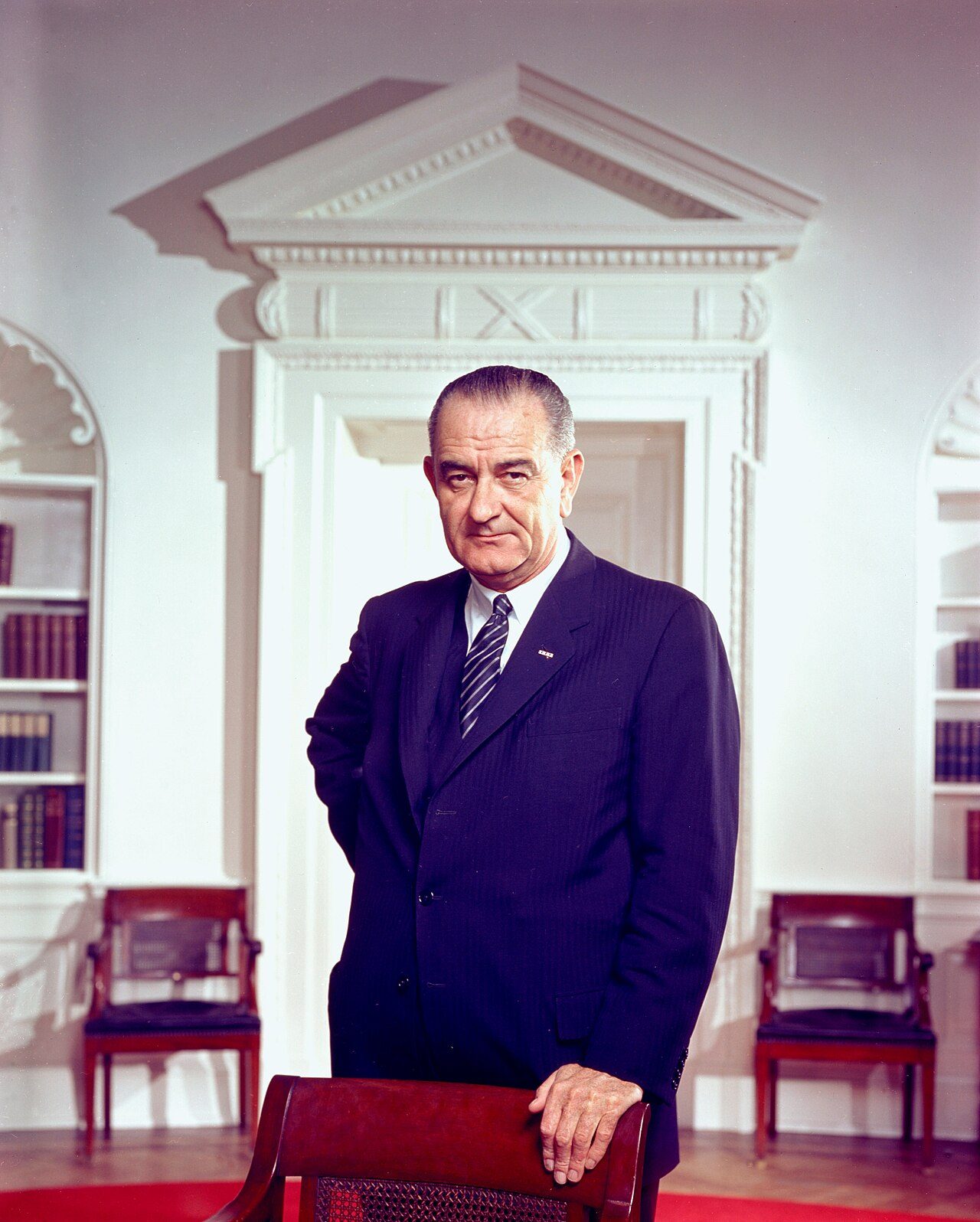
The year opened with a promise. On 4 January, in his State of the Union address — the first delivered in a prime-time television slot — President Lyndon B. Johnson proclaimed the Great Society: federal support for education, hospital care for the elderly through what became Medicare, enforcement of the Civil Rights Act of 1964, and the removal of barriers to voting. Johnson had been road-testing the phrase since May 1964. Three weeks later, on 24 January, Winston Churchill died in London at 90, the prime minister who had led Britain through the Second World War, and an era closed with him.
The voting promise was answered in Alabama. In Dallas County, of some 15,000 Black citizens of voting age, only a few hundred were registered to vote. On 7 March — Bloody Sunday — about 600 marchers led by John Lewis and Hosea Williams set out from Selma toward Montgomery and were charged on the Edmund Pettus Bridge by state troopers and Sheriff Jim Clark's mounted posse, with billy clubs, bullwhips and tear gas; Lewis's skull was fractured. The bridge, the record notes, was named for a Confederate general and a leader of the Alabama Ku Klux Klan. On 15 March Johnson addressed Congress to demand voting rights, adopting the movement's own words: 'We shall overcome.' On 21 March King led some 3,200 marchers out of Selma, and on 25 March the march reached the Alabama state capitol. On 6 August Johnson signed the Voting Rights Act.
The Great Society's other pillar followed: on 30 July Johnson signed the law creating Medicare and Medicaid at the Truman Library in Missouri, enrolling former president Harry Truman as Medicare's first beneficiary. Within the year, the record notes, Congress had passed Medicare and Medicaid, the Voting Rights Act and landmark education laws. But the year's other war was growing. On 13 February Johnson approved Operation Rolling Thunder, the sustained bombing of North Vietnam; on 8 March the first US combat troops arrived in Vietnam, Marines landing at Da Nang; and on 14 November the Battle of Ia Drang began, the first major battle between regular US and North Vietnamese forces. On 21 February Malcolm X had been assassinated while speaking at the Audubon Ballroom in New York, and on 11 August the Watts riots began in Los Angeles after the arrest of Marquette Frye: six days of unrest in which, by the record's figures, 34 people were killed, more than 1,000 injured and nearly 4,000 arrested, with nearly 14,000 National Guard troops called in.
Above the turmoil, the space race produced its most beautiful firsts. On 18 March Alexei Leonov left Voskhod 2 and made the first spacewalk in history — 12 minutes and 9 seconds of free-floating — surviving a suit that ballooned in the vacuum until he vented its pressure to squeeze back through the airlock. On 3 June Edward White floated outside Gemini 4 for 23 minutes, the first American spacewalk, less than three months after Leonov's. And on 14 July Mariner 4 flew past Mars and transmitted the first close-up photographs of another planet.
Timeline of 1965
- 4 January
President Johnson proclaims the Great Society in his State of the Union address.
- 24 January
Winston Churchill, who led Britain through the Second World War, dies in London at 90.
- 13 February
President Johnson approves Operation Rolling Thunder, the sustained bombing of North Vietnam.
- 21 February
Malcolm X is assassinated while speaking at the Audubon Ballroom in New York City.
- 7 March
Alabama troopers attack voting-rights marchers at the Edmund Pettus Bridge in Selma — Bloody Sunday.
- 8 March
The first US combat troops arrive in Vietnam, as Marines land at Da Nang.
- 18 March
Alexei Leonov leaves Voskhod 2 and makes the first spacewalk in history.
- 25 March
King and thousands of marchers complete the Selma to Montgomery march at the Alabama capitol.
- 3 June
Edward White floats outside Gemini 4 for 23 minutes, the first American spacewalk.
- 14 July
Mariner 4 flies past Mars and transmits the first close-up photographs of another planet.
- 30 July
Johnson signs the law creating Medicare and Medicaid at the Truman Library in Missouri.
- 6 August
President Johnson signs the Voting Rights Act.
- 11 August
The Watts riots begin in Los Angeles after the arrest of Marquette Frye.
- 11 November
Rhodesia, under Ian Smith, unilaterally declares independence from Britain.
Why 1965 still matters
The Voting Rights Act was, in the on-site record's words, the law that finally enforced the right of Black Americans in the South to vote — the completion of the work begun at Selma, where a county with some 15,000 Black citizens of voting age had managed to register only a few hundred. Together with Medicare and Medicaid, signed the same summer, it forms the durable core of the Great Society: programmes argued over ever since, but never repealed, that still structure American healthcare and American elections.
The spacewalks changed the Moon race from a contest of capsules into a rehearsal for working outside them. Leonov's twelve minutes and White's twenty-three were the first times human beings operated in open space, tethered to their ships — the skill every Apollo surface mission would depend on. Mariner 4's grainy Mars photographs, arriving the same summer, began the robotic exploration of the planets in earnest.
The year's warnings were equally durable. Watts showed that legal victory in the South had not answered the North and West's grievances — police abuse, employment discrimination, residential segregation and poverty, in the record's list of causes — and the escalation in Vietnam, from Rolling Thunder in February to Ia Drang in November, committed the United States to the war that would consume the decade and, with it, much of the Great Society's promise.
1965 on The History Trail
The year's biggest stories have full pages of their own on The History Trail.
- January 4 in History — Johnson proclaims the Great Society in his State of the Union address.
- March 7 in History — Bloody Sunday at the Edmund Pettus Bridge in Selma.
- March 18 in History — Alexei Leonov makes the first spacewalk in history.
- June 3 in History — Edward White makes the first American spacewalk.
- August 11 in History — the Watts riots begin in Los Angeles.
- NASA — the agency whose Gemini flights and Mariner probes filled 1965.
Sources
- Encyclopaedia Britannica — Great Society
- Encyclopaedia Britannica — On This Day: January 24
- Encyclopaedia Britannica — On This Day: February 21
- Encyclopaedia Britannica — On This Day: March 7
- Smithsonian Institution — Edmund Pettus Bridge (National Museum of African American History and Culture)
- Smithsonian Magazine — Alexei Leonov's First Spacewalk Wasn't Quite as Dramatic as We Thought
- NASA — Gemini June 3, 1965
The facts on this page were checked against these sources on 19 November 2026. The History Trail's permanent pages are researched and written for this site; the live profiles elsewhere on The History Trail are assembled automatically from Wikipedia and Wikidata.
About the Author
Researched and written by the The History Trail Editorial Team — the accountable editorial function behind this site's permanent story pages. The team works from the published sources cited on each page; it does not invent historians, reviewers or credentials, and it corrects errors openly.
Fact Check
Every load-bearing fact on this page traces to one of the sources listed above, and significant claims link to their source in the text. Our checking method is described on the methodology page; errors can be reported via the corrections page.
Sources & Citations
Cite this page as: The History Trail Editorial Team, The History Trail — this article's title, publication and update dates are shown beneath its headline. The full source list appears under Sources above; the site's source standards are on the sources page.