
On This Day
March 7 in History
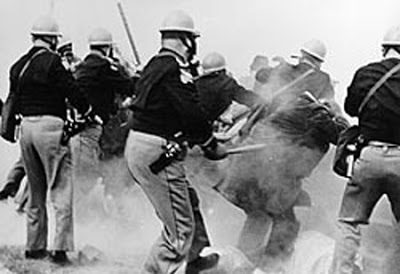
On 7 March 1965 some 600 civil rights marchers set out from Selma, Alabama, for the state capital to demand the right to vote — and were beaten back at the Edmund Pettus Bridge by state troopers and a sheriff's posse with clubs, whips and tear gas. Televised that night to a horrified nation, 'Bloody Sunday' forced the Voting Rights Act into being within five months. March 7 is also the day Bell patented the telephone and Hitler remilitarised the Rhineland.
Choose another date: open the On This Day calendar to browse events, births and deaths for any day of the year.
At a Glance
- The cause
- In Dallas County, Alabama, of some 15,000 Black citizens of voting age, only a few hundred were registered to vote
- The march
- About 600 marchers, led by John Lewis and Hosea Williams, walking from Selma to Montgomery after the killing of activist Jimmie Lee Jackson
- The place
- The Edmund Pettus Bridge over the Alabama River — named for a Confederate general and Ku Klux Klan leader
- The violence
- State troopers and Sheriff Jim Clark's mounted posse charged with billy clubs, bullwhips and tear gas; Lewis's skull was fractured
- The result
- A completed march under federal protection two weeks later, and the Voting Rights Act signed on 6 August 1965
Events on this day
- 161Marcus Aurelius and Lucius Verus become co-emperors of Rome on the death of Antoninus Pius.
- 1644The Massachusetts Bay Colony creates a two-house legislature, the first bicameral legislature in North America.
- 1850Senator Daniel Webster delivers his 'Seventh of March' speech backing the Compromise of 1850, enraging the abolitionists who had revered him.
- 1862The Battle of Pea Ridge begins in Arkansas, the largest Civil War battle west of the Mississippi.
- 1876Alexander Graham Bell receives his U.S. patent for the telephone — the most valuable patent ever granted, by common consent.
- 1923Robert Frost's poem 'Stopping by Woods on a Snowy Evening' is published in the New Republic.
- 1936Hitler sends German troops into the demilitarised Rhineland, tearing up the Treaty of Versailles while France and Britain stand aside.
- 1965Alabama troopers attack voting-rights marchers at the Edmund Pettus Bridge in Selma on Bloody Sunday — the featured story above.
- 1987Mike Tyson defeats James 'Bonecrusher' Smith to add the WBA title, becoming, at 20, the youngest heavyweight champion to win a major belt.
- 2010Kathryn Bigelow becomes the first woman to win the Academy Award for Best Director, for The Hurt Locker.
Born on this day
- 1792John Herschel — English astronomer who catalogued the southern skies and coined terms still used in photography.
- 1849Luther Burbank — American plant breeder who developed hundreds of new varieties, including the Burbank potato.
- 1872Piet Mondrian — Dutch painter who reduced art to grids of black lines and primary colours.
- 1875Maurice Ravel — French composer of Boléro and Daphnis et Chloé.
- 1908Anna Magnani — Italian actress, the volcanic star of Rome, Open City.
- 1938Janet Guthrie — American racing driver, the first woman to compete in the Indianapolis 500 and the Daytona 500.
- 1952Viv Richards — West Indian cricketer, the most feared batsman of his era.
Died on this day
- 1274Thomas Aquinas — Italian theologian and philosopher whose Summa Theologiae shaped Catholic thought for centuries.
- 1932Aristide Briand — French statesman who shared the 1926 Nobel Peace Prize for the Locarno treaties.
- 1988Divine (Harris Glenn Milstead) — American actor and drag performer, star of John Waters's Pink Flamingos and Hairspray.
- 1999Stanley Kubrick — American director of 2001: A Space Odyssey and A Clockwork Orange, dead days after completing Eyes Wide Shut.
- 2024Steve Lawrence — American singer and comedian, half of the duo Steve and Eydie.
The featured story: Bloody Sunday in Selma, 7 March 1965
Selma's Black citizens had been trying to register to vote for years, and Dallas County had made sure almost none succeeded: of some 15,000 Black residents of voting age, only a few hundred were on the rolls, kept off by literacy tests, poll taxes, economic reprisal and the simple closing of the registrar's office. In February 1965 a young activist, Jimmie Lee Jackson, was shot by a state trooper during a night march in nearby Marion and died days later. The movement answered with a march: 54 miles from Selma to the state capitol in Montgomery, to lay the demand for the ballot at Governor George Wallace's door. On Sunday 7 March, about 600 people, led by the young SNCC chairman John Lewis and SCLC's Hosea Williams, walked out of Brown Chapel in orderly pairs.
They got as far as the Edmund Pettus Bridge — a steel arch named for a Confederate brigadier and Alabama Klan leader. On the far side, a wall of state troopers in gas masks waited, backed by Sheriff Jim Clark's mounted posse. Major John Cloud ordered the marchers to disperse and gave them, by Lewis's account, about a minute; then the troopers charged. Clubs rose and fell, whips cracked, tear gas bloomed, and the posse's horses rode into the fleeing crowd. Lewis's skull was fractured by a trooper's club. Amelia Boynton, who had invited Dr. King to Selma, was beaten unconscious; a photograph of her crumpled body travelled the world. Seventeen marchers were hospitalised and dozens more treated for injuries.
The decisive weapon turned out to be television. That evening ABC interrupted its Sunday-night film — Judgment at Nuremberg, the story of Nazi crimes on trial — to show its Selma footage, and millions of Americans watched troopers gas and beat peaceful marchers in the middle of a film about the world's conscience. The juxtaposition is still cited as one of the moments television changed the country. Within days, clergy and sympathisers poured into Selma from across the nation; President Johnson, addressing Congress on 15 March, took up the movement's own words: 'We shall overcome.' A federal court authorised the march, the Alabama National Guard was federalised to protect it, and on 21 March thousands set out again — reaching Montgomery five days later, 25,000 strong.
The Voting Rights Act, signed on 6 August 1965, suspended the literacy tests and sent federal registrars into counties like Dallas; within a few years Black registration across the South was transformed. John Lewis, his head bandaged, had told reporters on the bridge that he did not know how he would bear it — he bore it into Congress, where he served for 33 years, returning to the bridge every anniversary. Bloody Sunday is the day the American franchise was widened by people who walked, unarmed and in their Sunday clothes, into clubs and gas — and let the cameras watch.
Why this date matters
March 7 is the calendar's day for crossing lines on foot. German soldiers crossed into the Rhineland on it in 1936 while the world watched and did nothing; twenty-nine years later, Alabama marchers crossed a bridge in Selma and the world watched and, this time, acted. Between those crossings the date also hands Bell his telephone patent in 1876, publishes Frost's quietest poem in 1923, and makes a co-emperor of Marcus Aurelius in 161. It is a day about thresholds — who may cross them, who guards them, and what it costs to walk up to one in daylight.
Sources
- Encyclopaedia Britannica — On This Day: March 7
- HISTORY — What Happened on March 7
- Smithsonian Institution — Edmund Pettus Bridge (National Museum of African American History and Culture)
- Encyclopedia of Alabama — Bloody Sunday (photograph record)
The facts on this page were checked against these sources on 19 November 2026. The History Trail's permanent pages are researched and written for this site; the live profiles elsewhere on The History Trail are assembled automatically from Wikipedia and Wikidata.
About the Author
Researched and written by the The History Trail Editorial Team — the accountable editorial function behind this site's permanent story pages. The team works from the published sources cited on each page; it does not invent historians, reviewers or credentials, and it corrects errors openly.
Fact Check
Every load-bearing fact on this page traces to one of the sources listed above, and significant claims link to their source in the text. Our checking method is described on the methodology page; errors can be reported via the corrections page.
Sources & Citations
Cite this page as: The History Trail Editorial Team, The History Trail — this article's title, publication and update dates are shown beneath its headline. The full source list appears under Sources above; the site's source standards are on the sources page.