
Years
1966 in History
1966 is remembered above all for 16 May, when a party circular in Beijing formally launched Mao Zedong's Cultural Revolution — a decade of Red Guard violence, purges and destruction that ended only with Mao's death in 1976. The same year made Indira Gandhi India's first woman prime minister, put the first soft landings on the Moon, and gave American suspects their Miranda rights.
At a Glance
- Defining event
- The May 16 Notification launches China's Cultural Revolution, 16 May 1966
- New leader
- Indira Gandhi chosen Congress Party leader on 19 January, becoming India's first woman prime minister
- Space first
- Soviet probe Luna 9 makes the first successful soft landing on the Moon, 3 February
- Rights landmark
- Miranda v. Arizona requires suspects to be told their rights, 13 June
- Movement founded
- Huey Newton and Bobby Seale found the Black Panther Party in Oakland, 15 October
- Closed the year
- Walt Disney dies in Burbank on 15 December, aged 65
The defining story: a memo that launched a revolution
The document that changed China in 1966 was not a declaration of war or a new constitution. On 16 May the Central Committee of the Chinese Communist Party issued the May 16 Notification, a circular that dissolved a party cultural committee and warned that representatives of the bourgeoisie had burrowed into the party, the government and the army. With that bureaucratic prose, Mao Zedong formally launched the Great Proletarian Cultural Revolution, and the on-site record of the day notes what followed: a decade of Red Guard violence, purges and destruction, ending only with Mao's death in 1976.
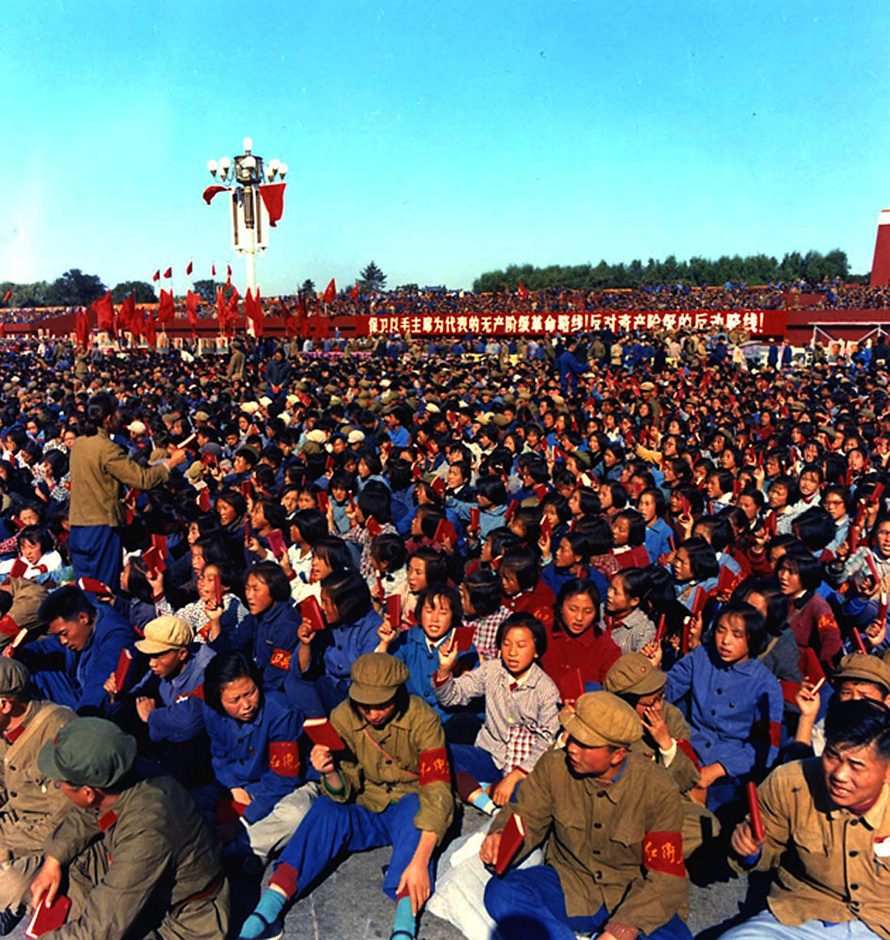
Mao's target was, in part, his own party. Sidelined by pragmatists after the disasters of the Great Leap Forward, he appealed over the leadership's head to China's youth, urging students to attack the Four Olds — old ideas, old culture, old customs and old habits. Students formed Red Guard units, denounced their teachers in big-character posters, and within months were ransacking homes, burning books and smashing temples. The photograph on this page, Red Guards massed in Tiananmen Square in 1966 clutching copies of Quotations from Chairman Mao, shows the movement the Notification had licensed that spring.
The violence soon escaped even Mao's control. The head of state, Liu Shaoqi, was expelled from the party and died in detention in 1969; rival Red Guard factions fought pitched battles; and the army had to be sent in before a generation of urban students was exiled to the countryside. In 1981 the Communist Party itself judged the revolution responsible for the most severe setback and the heaviest losses suffered by the party, the state and the people since the founding of the People's Republic — a verdict the featured record for 16 May preserves.
China's upheaval shared the year with a very different transfer of power. When India's prime minister Lal Bahadur Shastri died suddenly in January, Congress Party legislators voted on 19 January between Morarji Desai and Indira Gandhi, and chose Gandhi by 355 votes to 169 — making her India's first woman prime minister, sworn in five days later. The elders who backed her expected a manageable leader; instead she would dominate Indian politics for most of the next two decades. Around those two stories the space race ran on uncrewed: Luna 9 soft-landed on the Moon on 3 February, Luna 10 became the first spacecraft to orbit it on 31 March, and NASA's Surveyor 1 made the first American soft landing on 2 June.
Timeline of 1966
- 13 January
Lyndon Johnson appoints Robert C. Weaver to head Housing and Urban Development — the first African American cabinet member in United States history.
- 17 January
A United States B-52 collides with its tanker over Palomares, Spain, dropping four hydrogen bombs; three fall on land and one in the sea.
- 19 January
Indira Gandhi is chosen leader of India's Congress Party, becoming the country's first woman prime minister.
- 3 February
The Soviet probe Luna 9 makes the first successful soft landing on the Moon and transmits photographs from its surface.
- 1 March
The Soviet probe Venera 3 strikes Venus, becoming the first human-made object to reach the surface of another planet.
- 16 May
The Chinese Communist Party issues the May 16 Notification, formally launching the Cultural Revolution.
- 2 June
NASA's Surveyor 1 makes the first American soft landing on the Moon, transmitting photographs from the surface.
- 13 June
In Miranda v. Arizona, the United States Supreme Court rules that suspects must be told their rights before interrogation.
- 30 June
The National Organization for Women is founded in Washington, becoming the flagship of American feminism's second wave.
- 8 September
Star Trek premieres on American television on NBC, beginning a three-season run that grows into a vast franchise.
- 15 October
Huey Newton and Bobby Seale found the Black Panther Party in Oakland, California.
- 21 October
A coal-waste tip slides onto the Welsh village of Aberfan, engulfing homes and a school; more than 140 people are killed, most of them children.
- 30 November
Barbados becomes independent of the United Kingdom, with Errol Barrow as its first prime minister.
- 15 December
Walt Disney, American animator and studio founder, dies of lung cancer in Burbank at 65.
Why 1966 still matters
The Cultural Revolution is 1966's longest shadow. It closed China's schools and universities, persecuted millions and destroyed temples, manuscripts and artworks on a scale the on-site record compares to no invader's work — and it did not formally end until Mao died ten years later, when his widow's Gang of Four was arrested. The party's own 1981 verdict, quoted on the 16 May record, remains the official frame through which China still discusses the decade the Notification began.
The year's other beginnings compounded more quietly. Gandhi's election inside a party room set the pattern of Indian politics — dynastic, centralised and fiercely personal — for the rest of the century, and proved a poor, newly independent nation of nearly 500 million could hand its highest office to a woman by internal vote. In the United States, the Miranda ruling rewrote every arrest that followed it, the National Organization for Women organised feminism's second wave, and the Black Panther Party, founded in Oakland in October, changed the language of Black politics.
Even the uncrewed spaceflights mattered beyond their year: Luna 9's soft landing and Surveyor 1's photographs proved a spacecraft could set down gently on the Moon and work there — the technical premise on which the crewed landings of 1969 were built. And on 8 September a television series called Star Trek began a three-season run that grew into a vast franchise, carrying 1966's faith that the future could be explored, argued with and improved into popular culture for good.
1966 on The History Trail
The Cultural Revolution and Indira Gandhi's rise anchor this year on The History Trail, with the Moon landings close behind.
- May 16 in History — The May 16 Notification launches China's Cultural Revolution.
- January 19 in History — Congress legislators choose Indira Gandhi to lead India.
- February 3 in History — Luna 9 makes the first successful soft landing on the Moon.
- June 13 in History — The Miranda ruling requires suspects to be told their rights.
- October 21 in History — The Aberfan disaster buries a Welsh village school.
- FIFA World Cup — The tournament whose story runs through this era of the game.
Sources
- Encyclopaedia Britannica — Cultural Revolution
- HISTORY — What Happened on May 16
- Encyclopaedia Britannica — On This Day: January 19
- HISTORY — Indira Gandhi Becomes Indian Prime Minister
- Encyclopaedia Britannica — On This Day: February 3
- Encyclopaedia Britannica — On This Day: June 13
- Encyclopaedia Britannica — On This Day: October 21
- Encyclopaedia Britannica — On This Day: December 15
The facts on this page were checked against these sources on 19 November 2026. The History Trail's permanent pages are researched and written for this site; the live profiles elsewhere on The History Trail are assembled automatically from Wikipedia and Wikidata.
About the Author
Researched and written by the The History Trail Editorial Team — the accountable editorial function behind this site's permanent story pages. The team works from the published sources cited on each page; it does not invent historians, reviewers or credentials, and it corrects errors openly.
Fact Check
Every load-bearing fact on this page traces to one of the sources listed above, and significant claims link to their source in the text. Our checking method is described on the methodology page; errors can be reported via the corrections page.
Sources & Citations
Cite this page as: The History Trail Editorial Team, The History Trail — this article's title, publication and update dates are shown beneath its headline. The full source list appears under Sources above; the site's source standards are on the sources page.