
On This Day
August 11 in History
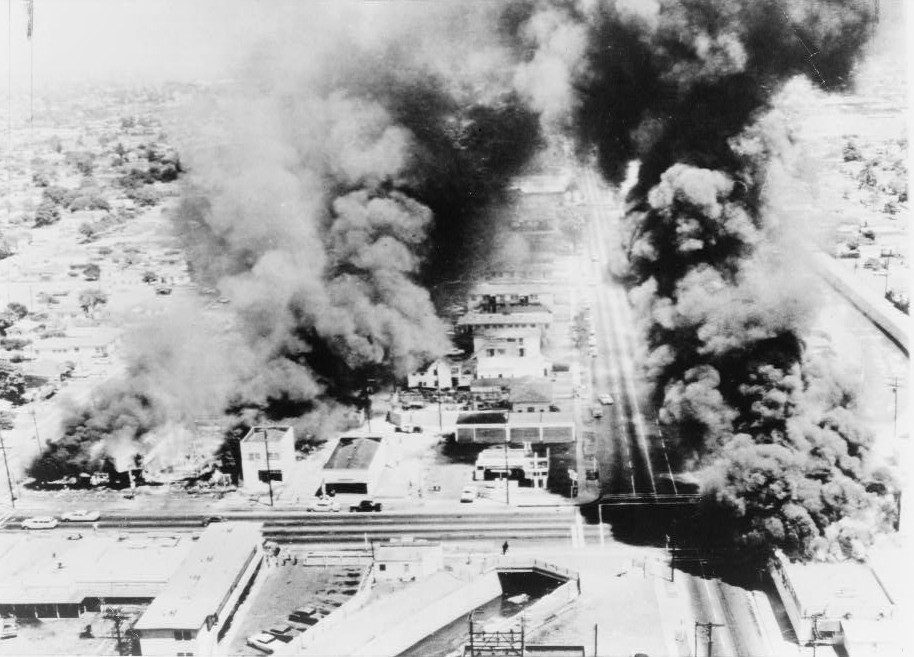
On 11 August 1965, a routine traffic stop in the Watts district of Los Angeles — the arrest of 21-year-old Marquette Frye — exploded into six days of rioting that left 34 people dead, more than 1,000 injured and whole blocks burned. It was the worst urban unrest in America of its era, and it announced that the civil rights struggle was not only a Southern one. August 11 is also the day hip-hop was born in the Bronx and Alcatraz received its first prisoners.
Choose another date: open the On This Day calendar to browse events, births and deaths for any day of the year.
At a Glance
- The spark
- 11 August 1965 — Marquette Frye, 21, is stopped near Watts by California Highway Patrol officer Lee Minikus on suspicion of drunk driving
- The escalation
- A scuffle at the scene, a gathering crowd and a rumour that police had kicked a pregnant woman turn a routine arrest into a riot
- The scale
- Six days of unrest across Watts and South-Central Los Angeles; nearly 14,000 California Army National Guard troops are called in to restore order
- The toll
- 34 people killed and more than 1,000 injured, with nearly 4,000 arrested
- The damage
- More than $40 million worth of property destroyed, with whole commercial blocks burned out
- The causes
- Long-standing grievances in Watts: police abuse, employment discrimination, residential segregation and poverty
Events on this day
- 1492The first papal conclave ever held in the Sistine Chapel elects Rodrigo Borgia as Pope Alexander VI.
- 1786Captain Francis Light establishes a British trading settlement on Penang Island, founding the colony of Penang off the Malay coast.
- 1909The American steamship Arapahoe, disabled off Cape Hatteras, sends the first SOS distress signal ever used by a United States ship at sea.
- 1919The Weimar Constitution is promulgated, formally establishing Germany as a democratic republic after the First World War.
- 1919Curly Lambeau and George Calhoun found a football team in Green Bay, Wisconsin — the future Green Bay Packers — at a meeting in a newspaper office.
- 1929Babe Ruth of the New York Yankees becomes the first baseball player in history to hit 500 career home runs.
- 1934The federal prison on Alcatraz Island in San Francisco Bay receives its first civilian prisoners, fourteen men transferred from McNeil Island.
- 1942The actress Hedy Lamarr and the composer George Antheil receive a United States patent for a frequency-hopping communication system, a forerunner of modern spread-spectrum technology.
- 1960Chad becomes independent from France, the first of France's African colonies to take independence in the 'Year of Africa'.
- 1965A traffic stop in the Watts district of Los Angeles ignites six days of rioting — the featured story above.
- 1973At a back-to-school party at 1520 Sedgwick Avenue in the Bronx, DJ Kool Herc loops drum breaks between two turntables — the party later celebrated as the birth of hip-hop.
- 1992The Mall of America, the largest shopping mall in the United States, opens in Bloomington, Minnesota.
- 1994Major League Baseball players begin a strike that lasts 232 days and forces the cancellation of the World Series for the first time since 1904.
Born on this day
- 1897Enid Blyton — English author of the Famous Five and Noddy books, among the best-selling children's writers of all time.
- 1921Alex Haley — American author of Roots, the family saga that traced his ancestry from West Africa through slavery to freedom.
- 1943Pervez Musharraf — Pakistani general who took power in a coup in 1999 and ruled Pakistan as its president.
- 1965Viola Davis — American actress, one of the few performers to have won Oscar, Emmy and Tony awards.
Died on this day
- 1937Edith Wharton — American novelist, the first woman to win the Pulitzer Prize for fiction, for The Age of Innocence.
- 1956Jackson Pollock — American painter, the leading figure of abstract expressionism, killed in a car crash at 44.
- 1994Peter Cushing — English actor of the Hammer horror films and of Star Wars.
- 2014Robin Williams — American comedian and actor of Good Morning, Vietnam and Good Will Hunting, dead at 63.
The featured story: the Watts riots begin, 11 August 1965
Watts, in South-Central Los Angeles, was a Black neighbourhood carrying every burden the postwar boom had left behind: overcrowded and segregated housing, poor schools, scarce jobs, and a police force — overwhelmingly white, led by the hard-line Chief William Parker — whose treatment of Black residents was a standing grievance. The civil rights movement had won its great legislative victories in the South, but in Watts the promises of the era had changed little. What the district had in abundance was heat, frustration and a sense that its complaints were heard by no one. It took one traffic stop to set all of it alight.
On the evening of 11 August 1965, a California Highway Patrol officer, Lee Minikus, stopped 21-year-old Marquette Frye near the edge of Watts on suspicion of drunk driving. Frye failed a sobriety test; his brother, a passenger, went to fetch their mother, who arrived and berated her son — and then the scene turned. Accounts gathered by the official inquiry describe a scuffle as officers tried to complete the arrest, Frye's mother jumping on an officer's back, and a crowd gathering in the summer heat. Through the crowd ran a rumour — false, but entirely believable to those who heard it — that the police had kicked a pregnant woman. By nightfall the crowd was throwing stones and bottles, and Watts was rising.
The unrest burned for six days. Crowds looted and set fire to businesses along the commercial corridors; snipers fired on police and fire crews; whole blocks went up in flames. The governor called in the California Army National Guard — nearly 14,000 troops at the peak — who sealed off a vast curfew zone and patrolled streets that looked, in the photographs of the time, like a war zone. When order was finally restored, 34 people were dead, more than 1,000 had been injured, nearly 4,000 had been arrested, and property damage exceeded $40 million. It was the deadliest and most destructive urban unrest in the United States of its era, and it was not surpassed in Los Angeles until the city erupted again in 1992.
The official McCone Commission, appointed to explain the riots, pointed to unemployment, poor schools, inadequate transport and the accumulated resentment of police practices — the very grievances residents had been naming for years. Watts became a national byword, and a warning: that the crisis of race in America was not a Southern peculiarity but a condition of its great cities, North and West as well. The neighbourhood rebuilt slowly, and its name never lost its charge. What began as an argument at the side of a road on 11 August 1965 remains the defining American urban uprising of the 1960s — the moment the decade's promises and its angers collided in a single district of Los Angeles.
Why this date matters
August 11 is a date of pressure finding its outlet. It holds a prison receiving its first inmates and a city district exploding against the conditions that filled prisons; a baseball strike and a constitution for a fragile republic; the first SOS ever sent by an American ship — itself a call from a vessel in distress. And it holds, in a recreation room in the Bronx in 1973, the most joyful possible answer to the Watts story eight years earlier: the same urban America, making a new culture out of two turntables and a break in the music.
Sources
- Encyclopaedia Britannica — On This Day: August 11
- Encyclopaedia Britannica — Watts Riots of 1965
- Wikimedia — On This Day feed: August 11
- timeanddate — On This Day: August 11
The facts on this page were checked against these sources on 19 November 2026. The History Trail's permanent pages are researched and written for this site; the live profiles elsewhere on The History Trail are assembled automatically from Wikipedia and Wikidata.
About the Author
Researched and written by the The History Trail Editorial Team — the accountable editorial function behind this site's permanent story pages. The team works from the published sources cited on each page; it does not invent historians, reviewers or credentials, and it corrects errors openly.
Fact Check
Every load-bearing fact on this page traces to one of the sources listed above, and significant claims link to their source in the text. Our checking method is described on the methodology page; errors can be reported via the corrections page.
Sources & Citations
Cite this page as: The History Trail Editorial Team, The History Trail — this article's title, publication and update dates are shown beneath its headline. The full source list appears under Sources above; the site's source standards are on the sources page.