
On This Day
November 2 in History
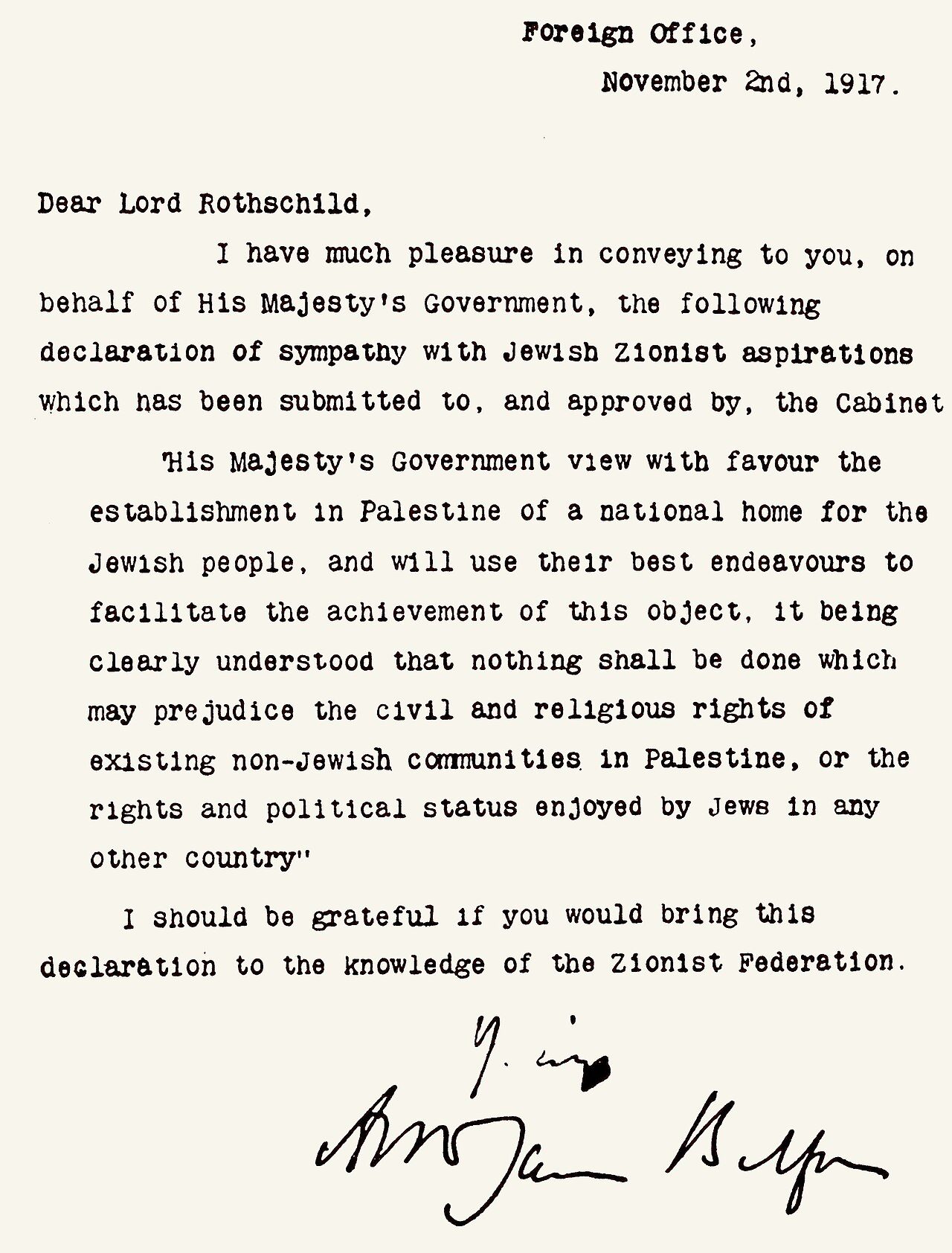
On 2 November 1917 the British foreign secretary Arthur Balfour signed a short letter that became the Balfour Declaration: Britain would view 'with favour the establishment in Palestine of a national home for the Jewish people'. Written into the League of Nations Mandate in 1922, it shaped the next century of Middle Eastern history. November 2 is also the day of the Spruce Goose's only flight, Truman's 1948 upset victory and the arrival of the first crew at the International Space Station.
Choose another date: open the On This Day calendar to browse events, births and deaths for any day of the year.
At a Glance
- The document
- A letter from Foreign Secretary Arthur Balfour to Lord Rothschild, dated 2 November 1917
- The promise
- Britain views 'with favour the establishment in Palestine of a national home for the Jewish people'
- The safeguard
- Nothing to prejudice 'the civil and religious rights of existing non-Jewish communities in Palestine'
- Approved
- By the British War Cabinet on 31 October 1917, after months of drafting and Zionist lobbying led by Chaim Weizmann
- Published
- In The Times, 9 November 1917
- Made law
- Incorporated into the League of Nations Mandate for Palestine in 1922
Events on this day
- 1889North Dakota and South Dakota join the United States as the 39th and 40th states.
- 1917Britain issues the Balfour Declaration, supporting a national home for the Jewish people in Palestine — the featured story above.
- 1920KDKA Pittsburgh makes the first commercial radio broadcast in the United States, reporting the Harding–Cox election results.
- 1930Haile Selassie is crowned emperor of Ethiopia in Addis Ababa, in a ceremony watched by the world's press.
- 1932Australian soldiers open the 'Emu War', firing machine guns at emus destroying crops in Western Australia — the emus largely win.
- 1947Howard Hughes pilots his giant wooden flying boat, the Spruce Goose, on its first and only flight at Long Beach, California.
- 1948President Harry S. Truman defeats Thomas E. Dewey in the great election upset, despite newspapers having printed Dewey's victory.
- 1960A London jury acquits Penguin Books in the Lady Chatterley's Lover obscenity trial, freeing D. H. Lawrence's novel for open sale.
- 1963South Vietnamese president Ngo Dinh Diem is killed after a military coup overthrows his government.
- 1983President Ronald Reagan signs the bill creating a United States federal holiday honouring Martin Luther King, Jr.
- 2000The first resident crew arrives at the International Space Station, beginning an unbroken human presence in orbit that continues today.
Born on this day
- 1699Jean-Baptiste-Siméon Chardin — French painter of still lifes and quiet domestic scenes, master of luminous realism.
- 1734Daniel Boone — American frontiersman and explorer who blazed the Wilderness Road through the Cumberland Gap.
- 1755Marie Antoinette — Austrian archduchess who became queen of France and was executed in the Revolution.
- 1795James K. Polk — 11th president of the United States, who expanded its territory to the Pacific.
- 1865Warren G. Harding — newspaper editor who became the 29th president of the United States.
- 1913Burt Lancaster — American actor, the athletic star of Elmer Gantry and Atlantic City.
Died on this day
- 1887Jenny Lind — Swedish soprano, the 'Swedish Nightingale', one of the most celebrated singers of the 19th century.
- 1950George Bernard Shaw — Irish playwright and critic, Nobel laureate, dead at 94 in England.
- 1963Ngo Dinh Diem — president of South Vietnam, killed in the coup that overthrew him (also in today's events).
- 1975Pier Paolo Pasolini — Italian film director and writer, murdered near Rome in a still-disputed case.
- 2004Theo van Gogh — Dutch filmmaker murdered in Amsterdam after making a film critical of Islam's treatment of women.
The featured story: the Balfour Declaration, 2 November 1917
The Balfour Declaration is one of the shortest documents ever to reshape a region: a letter of a few dozen words, dated 2 November 1917, from the British foreign secretary, Arthur James Balfour, to Lord Lionel Walter Rothschild, a leader of Britain's Jewish community, asking him to bring it to the attention of the Zionist Federation. Its key sentence declared that His Majesty's Government viewed 'with favour the establishment in Palestine of a national home for the Jewish people' and would use their 'best endeavours' to achieve it.
Britain in 1917 was fighting the Ottoman Empire, which ruled Palestine, and the declaration was an act of wartime statecraft as much as of sympathy. Zionist leaders, above all Chaim Weizmann, had lobbied for years; the cabinet that approved the text on 31 October hoped to rally Jewish opinion in America and Russia to the Allied cause and to secure a British position in Palestine after the war. The wording was fought over for months. 'National home' was deliberately chosen over 'state', and a safeguard was added: nothing was to be done 'which may prejudice the civil and religious rights of existing non-Jewish communities in Palestine' — the overwhelming majority of its population, who were not named as a people and whose political rights were not mentioned.
The letter was published in The Times a week later, on 9 November 1917. In 1922 the League of Nations wrote the declaration into the Mandate for Palestine, the legal instrument under which Britain governed the territory, giving the promise international standing. Britain thus administered Palestine for three decades while committed to a national home for one people and to protecting the rights of another — obligations that proved impossible to reconcile as Jewish immigration grew, especially after the Holocaust, and Palestinian opposition hardened.
The consequences run to the present day. In 1948 the State of Israel was proclaimed as the Mandate ended, in a war that displaced hundreds of thousands of Palestinians — an estimated 700,000 fled or were expelled, in what Palestinians call the Nakba. Israelis regard the declaration as an early international recognition of their national claim; Palestinians regard it as a promise made by an empire over land that was not its to give. Few letters in history are still argued about, word by word, more than a century later.
Why this date matters
November 2 is a day on which the modern world's machinery — mass media, mass politics, permanent life in orbit — keeps switching on: the first commercial radio broadcast in 1920, the Spruce Goose's single flight, television-age election drama in 1948, the first crew taking up residence on the International Space Station in 2000. But its weightiest entry is 67 words long. The Balfour Declaration shows how a single carefully hedged letter, written for the needs of a war in 1917, can bind governments and peoples for more than a hundred years.
Sources
- Encyclopaedia Britannica — On This Day: November 2
- HISTORY — What Happened on November 2
- The Rothschild Archive — Walter Rothschild and the Balfour Declaration
- Wikimedia — On This Day feed: November 2
The facts on this page were checked against these sources on 19 November 2026. The History Trail's permanent pages are researched and written for this site; the live profiles elsewhere on The History Trail are assembled automatically from Wikipedia and Wikidata.
About the Author
Researched and written by the The History Trail Editorial Team — the accountable editorial function behind this site's permanent story pages. The team works from the published sources cited on each page; it does not invent historians, reviewers or credentials, and it corrects errors openly.
Fact Check
Every load-bearing fact on this page traces to one of the sources listed above, and significant claims link to their source in the text. Our checking method is described on the methodology page; errors can be reported via the corrections page.
Sources & Citations
Cite this page as: The History Trail Editorial Team, The History Trail — this article's title, publication and update dates are shown beneath its headline. The full source list appears under Sources above; the site's source standards are on the sources page.