
On This Day
November 7 in History
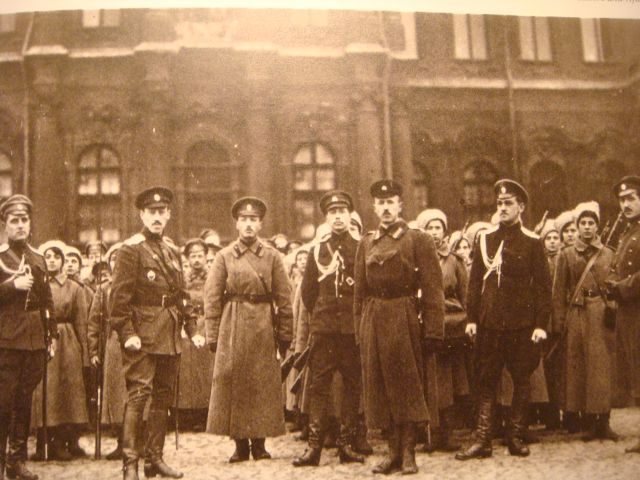
On 7 November 1917 — 25 October by Russia's old calendar, hence the October Revolution — Bolshevik forces organised by the Petrograd Soviet's Military Revolutionary Committee seized the bridges, stations and telegraph of the capital and arrested the Provisional Government in the Winter Palace, bringing Lenin's party to power. November 7 is also the day Jeannette Rankin became the first woman elected to Congress, the Tacoma Narrows Bridge collapsed and Magic Johnson announced he was HIV-positive.
Choose another date: open the On This Day calendar to browse events, births and deaths for any day of the year.
At a Glance
- The name
- 'October' because Russia used the Julian calendar: 25 October Old Style is 7 November New Style
- The organisers
- The Petrograd Soviet's Military Revolutionary Committee, directed by Trotsky, acting for Lenin's Bolsheviks
- The method
- Bridges, stations, telegraph, telephone exchange and State Bank occupied in one night, mostly unopposed
- The climax
- The cruiser Aurora's blank shot; the Winter Palace entered and the ministers arrested at about 2 a.m.
- The proclamation
- The Congress of Soviets adopts the Decrees on Peace and Land and elects a Council of People's Commissars under Lenin
- The sequel
- Civil war until 1922; the Soviet Union founded that December
Events on this day
- 1659France and Spain sign the Treaty of the Pyrenees, ending their long war and redrawing the border still used today.
- 1861Union forces under Ulysses S. Grant fight the Battle of Belmont, Missouri, Grant's first battle of the Civil War.
- 1872The cargo ship Mary Celeste sails from New York; she is found a month later in the Atlantic, abandoned, her crew never traced.
- 1885The last spike of Canada's first transcontinental railway is driven at Craigellachie, British Columbia.
- 1914The first issue of The New Republic magazine is published in the United States.
- 1916Montana's Jeannette Rankin is elected to the U.S. House of Representatives, the first woman ever elected to Congress.
- 1917The Bolsheviks seize power in Petrograd in the October Revolution — the featured story above.
- 1932The U.S. Supreme Court overturns the Scottsboro convictions in Powell v. Alabama, a landmark ruling on the right to counsel.
- 1940The Tacoma Narrows Bridge in Washington twists itself apart in high wind and collapses into Puget Sound, four months after opening.
- 1944Franklin D. Roosevelt is elected to an unprecedented fourth term as president of the United States.
- 1967Carl Stokes is elected mayor of Cleveland, Ohio, the first African American mayor of a major American city.
- 1991Basketball star Magic Johnson announces that he is HIV-positive and retires from the Los Angeles Lakers.
- 1996NASA launches the Mars Global Surveyor orbiter toward Mars.
- 2000The U.S. presidential election between George W. Bush and Al Gore ends in a statistical tie in Florida and a 36-day recount fight.
Born on this day
- 1728James Cook — English navigator and cartographer whose Pacific voyages redrew the map of the world.
- 1867Marie Curie — Polish-born French physicist, pioneer of radioactivity and the only person to win Nobel Prizes in two sciences.
- 1888C. V. Raman — Indian physicist whose discovery of the Raman effect won him the Nobel Prize in Physics.
- 1913Albert Camus — French novelist and philosopher of the absurd, author of The Stranger and The Plague.
- 1943Joni Mitchell — Canadian singer-songwriter, one of the defining songwriters of her generation.
Died on this day
- 1627Jahangir — Mughal emperor of India, patron of painting and author of candid memoirs.
- 1944Richard Sorge — Soviet master spy in Tokyo, hanged by Japan after warning Moscow of the German invasion it ignored.
- 1962Eleanor Roosevelt — longest-serving First Lady of the United States and a chief architect of the Universal Declaration of Human Rights.
- 1980Steve McQueen — American actor, the 'King of Cool' of Bullitt and The Great Escape, dead at 50 in Mexico.
The featured story: the October Revolution, 7 November 1917
It is called the October Revolution, and it happened in November. Russia still kept the Julian calendar, thirteen days behind the West, so the Bolshevik rising of 25 October by Russian reckoning fell on 7 November 1917 by the Gregorian calendar — the date the rest of the world uses, and the date on which the Soviet state would always celebrate it. The revolution it completed had begun in February, when the Tsar fell and a Provisional Government took power, sharing it uneasily with the soviets — councils of workers and soldiers. By the autumn the government of Alexander Kerensky was exhausted by a failing war, a collapsing economy and its own delays, while Lenin's Bolsheviks, promising 'Peace, Land and Bread', had won majorities in the Petrograd and Moscow soviets.
The seizure itself was organised by the Petrograd Soviet's Military Revolutionary Committee, directed in practice by Leon Trotsky, and timed to present the Second All-Russian Congress of Soviets, meeting that day, with a finished fact. In the night of 6–7 November, Red Guards, soldiers and sailors loyal to the committee occupied Petrograd's bridges, railway stations, telegraph office, telephone exchange and the State Bank, mostly without firing a shot. Kerensky slipped out of the capital to look for loyal troops. The ministers of the Provisional Government held out in the Winter Palace, guarded by cadets and a women's battalion.
In the evening the cruiser Aurora, its crew won over, fired a blank round as a signal, and after some shelling from the Peter and Paul Fortress the palace was entered; the ministers were arrested at about two in the morning. The death toll in the capital was small — a handful, by most accounts. Meanwhile the Congress of Soviets, its moderate socialists walking out in protest, proclaimed the transfer of power, adopted Lenin's Decrees on Peace and on Land, and elected a government of People's Commissars with Lenin at its head.
What followed was not the palace drama of later Soviet film but five years of civil war, in which millions died and from which the Bolsheviks emerged in sole control of Russia, founding the Soviet Union in 1922. The October Revolution split the world ideologically for the rest of the twentieth century: it inspired communist parties and revolutions abroad, terrified governments into reform or repression, and fixed 7 November as one of the century's hinge dates — the day a party of professional revolutionaries, in a capital of two million people, took a state almost by walking into its empty offices.
Why this date matters
November 7 is the calendar's great day of contested power. A revolution seizes a capital in 1917; a woman enters Congress for the first time in 1916; a Black mayor takes a great American city in 1967; an American election in 2000 ends with nobody knowing who has won. Even its engineering story is about forces escaping control — a bridge shaking itself to pieces in the wind. The day rewards those who organise and punishes those who assume: Kerensky assumed the state would defend itself, and found that it would not.
Sources
- Encyclopaedia Britannica — On This Day: November 7
- HISTORY — What Happened on November 7
- Encyclopaedia Britannica — On This Day: November 6
- Wikimedia — On This Day feed: November 7
The facts on this page were checked against these sources on 19 November 2026. The History Trail's permanent pages are researched and written for this site; the live profiles elsewhere on The History Trail are assembled automatically from Wikipedia and Wikidata.
About the Author
Researched and written by the The History Trail Editorial Team — the accountable editorial function behind this site's permanent story pages. The team works from the published sources cited on each page; it does not invent historians, reviewers or credentials, and it corrects errors openly.
Fact Check
Every load-bearing fact on this page traces to one of the sources listed above, and significant claims link to their source in the text. Our checking method is described on the methodology page; errors can be reported via the corrections page.
Sources & Citations
Cite this page as: The History Trail Editorial Team, The History Trail — this article's title, publication and update dates are shown beneath its headline. The full source list appears under Sources above; the site's source standards are on the sources page.