
Things
Russian Revolution
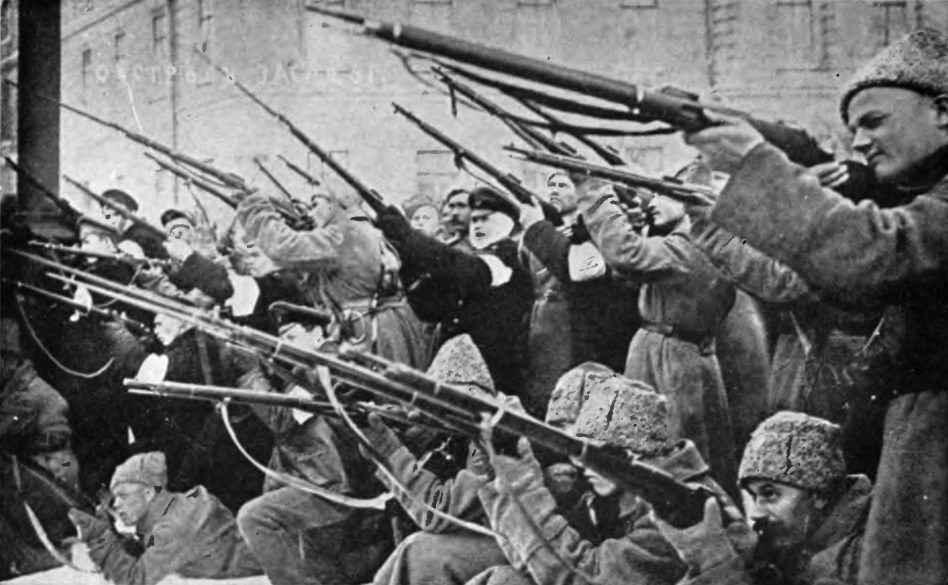
The Russian Revolution was not one event but two in a single year: in February 1917 (March by the modern calendar) protests and mutiny ended three centuries of Romanov rule, and in October (November) the Bolsheviks seized power from the Provisional Government that replaced it.
At a Glance
- When
- 1917 — February and October revolutions, followed by civil war
- Dates explained
- Russia used the Julian calendar, 13 days behind the Gregorian; 'February' fell in March and 'October' in November by modern reckoning
- Tsar who fell
- Nicholas II, who abdicated on 15 March 1917 (New Style)
- Interim rulers
- The Provisional Government, first led by Prince Georgy Lvov, later by Alexander Kerensky
- Seized power in October
- The Bolsheviks, led by Vladimir Lenin
- Elected assembly
- The Constituent Assembly, elected November 1917, met for one day in January 1918 before the Bolsheviks dissolved it
- Outcome
- Bolshevik victory in the civil war and the creation of the Soviet Union in 1922
Introduction
The Russian Revolution overthrew the tsar and then overthrew the government that replaced him, all within eight months of 1917. The first revolution, in February, began with bread protests in the capital, Petrograd, swelled into a general strike and an army mutiny, and ended with Nicholas II's abdication on 15 March 1917 by the Gregorian calendar. The second, in October, was a planned seizure of power by Vladimir Lenin's Bolsheviks against the Provisional Government. Between them they destroyed the Russian Empire and set Russia on the road to the Soviet Union.
The month names confuse every newcomer, so it is worth settling them at once. Russia still used the old Julian calendar, which in 1917 ran 13 days behind the Gregorian calendar used in most of Europe. The February Revolution is named for its Julian dates; by modern reckoning it happened in March. The October Revolution likewise happened, by modern reckoning, on 6–7 November. Historians keep the traditional names and give both dates where it matters, and this page does the same.
Background: An Empire the War Broke
The revolution had deep roots. Defeat by Japan in 1904–05 had triggered the Revolution of 1905, which forced Nicholas II to promise reforms and create a parliament, the Duma — promises he then repeatedly limited. Corruption and inefficiency were widespread, peasants wanted land, workers faced harsh conditions, and the empire's many ethnic minorities resented Russian domination. Then came the First World War. Russia's armies fought bravely but suffered terrible casualties, at times without enough rifles, while the economy buckled and food and fuel grew scarce in the cities.
By early 1917 the regime's legitimacy had almost gone. Nicholas had taken personal command of the army, leaving Petrograd under Empress Alexandra, who was widely believed to be influenced by the self-styled holy man Grigori Rasputin. Rasputin's murder by conservative nobles in December 1916 changed nothing. When protests over bread began on 8 March 1917 (23 February, Old Style) — International Women's Day — they were, Britannica notes, neither organised nor at first recognised as a revolution by any party. Within days the garrison mutinied rather than fire on the crowds, the Duma refused to disperse, and the tsar, abandoned by his generals, abdicated.
Timeline
- 1904–05
Defeat in the Russo-Japanese War sparks the Revolution of 1905; Nicholas II issues the October Manifesto and concedes a Duma, then curtails it.
- 1914–17
The First World War brings huge casualties, economic breakdown and food shortages, destroying confidence in the imperial government.
- 8 March 1917
Bread protests in Petrograd begin the February Revolution (23 February, Old Style). Strikes spread and troops mutiny.
- 15 March 1917
Nicholas II abdicates (2 March, Old Style). A Provisional Government formed by the Duma, led by Prince Lvov, takes power, sharing authority uneasily with the Petrograd Soviet of workers' and soldiers' deputies.
- April 1917
Lenin returns to Russia and demands no support for the Provisional Government, which continues the unpopular war and postpones land reform and elections.
- July 1917
After failed demonstrations and a disastrous offensive, Alexander Kerensky becomes head of the Provisional Government; Bolshevik leaders are arrested or driven underground.
- 7 November 1917
In the October Revolution (25 October, Old Style), Bolshevik forces seize key points in Petrograd and overthrow the Provisional Government with little bloodshed in the capital.
- November 1917
Elections to the Constituent Assembly give the Socialist Revolutionaries the largest share; the Bolsheviks win only about a quarter of the seats.
- 18–19 January 1918
The Constituent Assembly meets in Petrograd for a single session of about 13 hours, refuses to subordinate itself to the soviets, and is dissolved by the Bolshevik-led authorities.
- 1918–22
Civil war between the Bolshevik Red Army and White forces, with foreign intervention. The Bolsheviks win; in December 1922 the Union of Soviet Socialist Republics is proclaimed.
Significance: Dual Power and a Window That Closed
The eight months between the revolutions were a contest between two kinds of authority. The Provisional Government held formal state power, but the Petrograd Soviet — a council of workers' and soldiers' deputies — commanded the loyalty of the garrison and much of the street. The government intended to rule only until a democratically elected Constituent Assembly could settle Russia's future, yet it postponed that election, kept Russia in the war, and left the peasants' demand for land unanswered. Each failure transferred support to the Bolsheviks, whose slogans promised peace, land and bread, and all power to the soviets.
The dissolution of the Constituent Assembly in January 1918 closed the alternative path. The assembly was the most broadly elected body Russia had yet produced, and its single day of life is still cited as the moment a parliamentary outcome was foreclosed. What followed was civil war: White armies, former allies' intervention forces and regional movements fought the Red Army across the former empire, at enormous human cost, while the former tsar and his family, held at Yekaterinburg, were killed in July 1918 as White forces approached. Bolshevik victory left a one-party state in control of a devastated country.
Legacy: The Century It Made
The revolution's consequences ran for most of the twentieth century. It produced the world's first communist state, the Soviet Union, formally created in 1922 and ruled, in Britannica's summary, by the Bolsheviks and their successors from 1917 to 1991. It inspired communist parties and revolutions abroad, frightened governments into reform or repression, and set up the ideological divide that hardened into the Cold War after 1945.
Inside Russia, argument about 1917 never settled. The February Revolution is remembered as a spontaneous, popular rising that opened a democratic possibility; the October Revolution as either a heroic seizure of power by the working class or a coup that strangled that possibility at birth. Both readings start from the same eight months — a year in which an empire collapsed, a provisional democracy hesitated, and a disciplined minority took the state that was lying in the street.
Sources
- Encyclopaedia Britannica — Russian Revolution
- Encyclopaedia Britannica — The February Revolution
- Encyclopaedia Britannica — Russian Provisional Government
- Encyclopaedia Britannica — February Revolution
- Encyclopedia of Ukraine — All-Russian Constituent Assembly
The facts on this page were checked against these sources on 19 November 2026. The History Trail's permanent pages are researched and written for this site; the live profiles elsewhere on The History Trail are assembled automatically from Wikipedia and Wikidata.
About the Author
Researched and written by the The History Trail Editorial Team — the accountable editorial function behind this site's permanent story pages. The team works from the published sources cited on each page; it does not invent historians, reviewers or credentials, and it corrects errors openly.
Fact Check
Every load-bearing fact on this page traces to one of the sources listed above, and significant claims link to their source in the text. Our checking method is described on the methodology page; errors can be reported via the corrections page.
Sources & Citations
Cite this page as: The History Trail Editorial Team, The History Trail — this article's title, publication and update dates are shown beneath its headline. The full source list appears under Sources above; the site's source standards are on the sources page.