
Years
1918 in History
1918 is the year the First World War ended. Germany's Spring Offensive made its last great attempt to win before American troops arrived in strength; by autumn its allies had fallen away, the Kaiser had abdicated, and at 11 a.m. on 11 November the guns fell silent. The year also saw the Romanovs executed, new nations proclaimed across Europe, and the first cases of a flu pandemic.
At a Glance
- Defining event
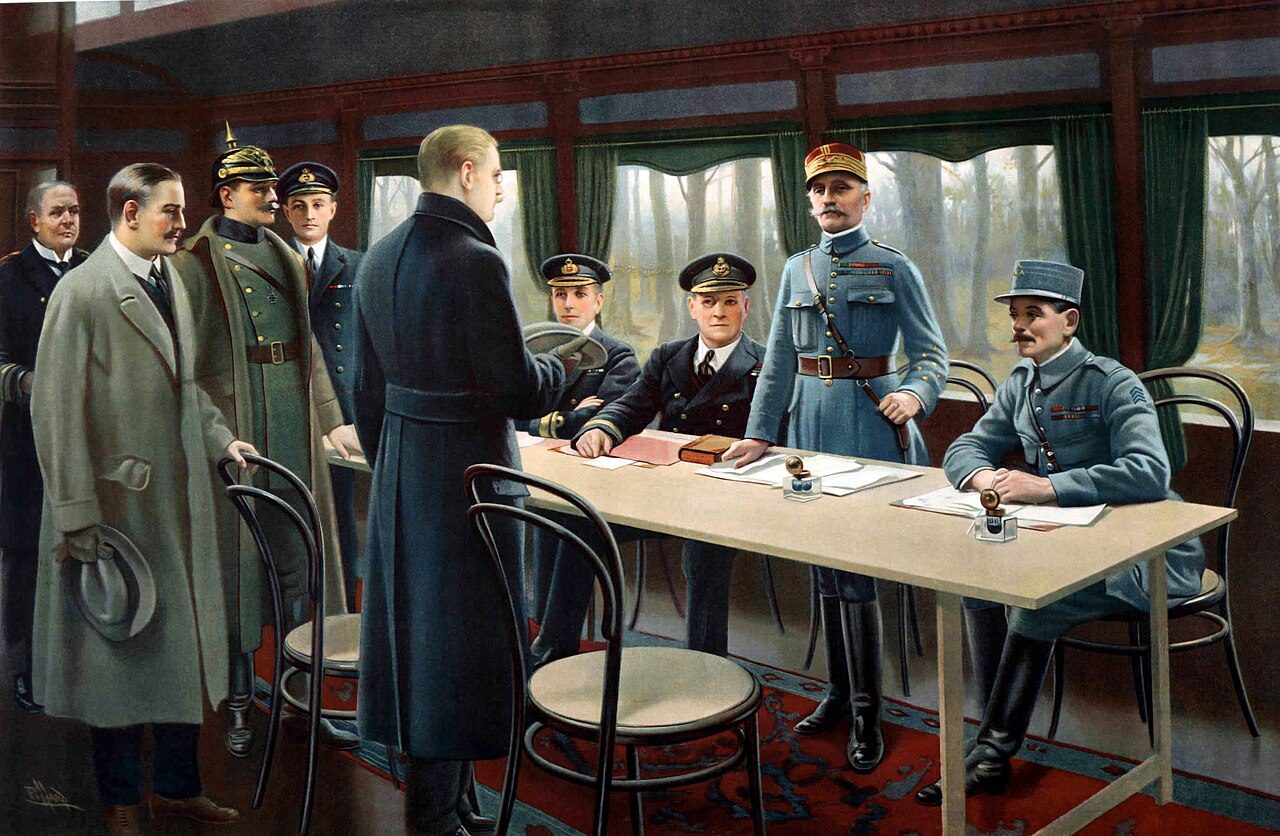
- The Armistice is signed in Foch's railway carriage at Compiègne and takes effect at 11 a.m. on 11 November, ending the fighting
- The peace programme
- Woodrow Wilson announces the Fourteen Points to Congress on 8 January
- Russia leaves the war
- Russia signs the Treaty of Brest-Litovsk on 3 March, ending its part in the war at a huge cost in territory
- Dynasty ended
- Nicholas II, Alexandra and their five children are executed at Yekaterinburg on 17 July
- Last offensives
- Germany launches the Spring Offensive on 21 March; the Second Battle of the Marne, from 15 July, is the turning point toward Allied victory
- Born this year
- Nelson Mandela, born 18 July — South Africa's future first democratically elected president
The defining story: the last year of the First World War
The year opened with a blueprint for peace. On 8 January 1918 President Woodrow Wilson announced the Fourteen Points, his programme for a settlement, to the United States Congress. The war, meanwhile, was being decided by exhaustion and arithmetic. In February Ukraine signed a separate peace with the Central Powers at Brest-Litovsk — the first peace treaty of the war — and Lithuania proclaimed its independence; on 3 March Russia itself signed the Treaty of Brest-Litovsk, ending its part in the war at a huge cost in territory. On 21 March Germany launched the Spring Offensive on the Western Front, its last great attempt to win the war before American troops arrived in strength.
The offensive failed, and the tide turned in summer. American troops fought their first major battle at Cantigny in May; the Royal Air Force had been formed in April, the world's first independent air force. On 15 July the Second Battle of the Marne began — Germany's last great offensive, and the turning point toward Allied victory. Two days later, in the early hours of 17 July, in a basement room in Yekaterinburg, Bolshevik guards shot and bayoneted Nicholas II, the former tsar, his wife Alexandra and their five children, ending three centuries of Romanov rule. Nelson Mandela was born the next day. Through the autumn the Allied advance breached the Hindenburg Line at the Canal du Nord, Germany's allies signed armistices one by one, and Fanya Kaplan's shooting of Lenin in August helped trigger the Red Terror in Russia.
By November Germany was beaten in everything but name: the High Seas Fleet had mutinied at Kiel, revolution was spreading through German cities, and on 9 November the Kaiser abdicated and Germany was proclaimed a republic. The new government sent a delegation under Matthias Erzberger to Marshal Foch's railway carriage in the Forest of Compiègne. Foch presented terms designed to make it impossible for Germany to resume the war — evacuation of occupied territory and the left bank of the Rhine, surrender of guns, machine guns and aircraft, internment of the fleet — and gave the Germans 72 hours. The armistice was signed in the early hours of 11 November.
At 11 a.m. the guns stopped, from the North Sea to Switzerland. Soldiers climbed out of the trenches into an unnatural quiet; in London, Paris and New York crowds poured into the streets. The war had killed some nine million soldiers — the figure HISTORY gives — and wounded more than twenty million, and it had destroyed four empires. The poet Wilfred Owen had been killed just a week earlier, one week before the armistice he did not live to see. In December, Wilson arrived in France — the first serving U.S. president to visit Europe — to negotiate the peace, and in Dublin Constance Markievicz became the first woman elected to the British Parliament, winning while imprisoned; she did not take her seat.
Timeline of 1918
- 8 January
President Woodrow Wilson announces the Fourteen Points, his programme for peace, to the United States Congress.
- 3 March
Russia signs the Treaty of Brest-Litovsk with the Central Powers, ending its part in the First World War.
- 21 March
Germany launches the Spring Offensive on the Western Front, its last great attempt to win the war.
- 1 April
The Royal Air Force is formed in Britain, the world's first independent air force.
- 28 May
American troops fight their first major battle of the First World War at Cantigny in France.
- 15 July
The Second Battle of the Marne begins — Germany's last great offensive and the turning point toward Allied victory.
- 17 July
Nicholas II, Alexandra and their five children are executed by the Bolsheviks at Yekaterinburg.
- 30 August
Fanya Kaplan shoots and wounds Vladimir Lenin in Moscow, helping trigger the Red Terror.
- 8 October
Sergeant Alvin C. York attacks a German machine-gun position in the Argonne, capturing 132 prisoners.
- 4 November
The poet Wilfred Owen is killed in action in France, one week before the Armistice.
- 9 November
Kaiser Wilhelm II abdicates and Germany is proclaimed a republic.
- 11 November
The Armistice between Germany and the Allies is signed at Compiègne, and the guns fall silent at 11 a.m.
- 13 December
Woodrow Wilson arrives in France, the first serving U.S. president to visit Europe, to negotiate the peace.
- 28 December
Constance Markievicz becomes the first woman elected to the British Parliament; she does not take her seat.
Why 1918 still matters
1918 still matters because the world it left behind is recognisably ours. Four empires — German, Austro-Hungarian, Ottoman and Russian — were destroyed or broken, and the year's proclamations, from Ukraine and Lithuania to the Greater Poland Uprising that began on 27 December, began the redrawing of Europe's map that the peace treaties would formalise. The Fourteen Points set the language of the settlement, and Wilson's arrival in France in December opened the era of American-led peacemaking. The armistice itself was only a ceasefire: the resentments the settlement left behind shaped the next twenty years, and the carriage at Compiègne became a symbol potent enough for Hitler to weaponise in 1940, when he forced France to sign its own armistice in the same carriage, on the same spot.
The date outlasted the settlement. Britain and the Commonwealth mark 11 November as Remembrance Day, with two minutes' silence at 11 a.m.; the United States broadened its Armistice Day into Veterans Day. And the year's quietest entry proved its deadliest legacy: the influenza that appeared at Fort Riley in March became a pandemic that circled the world alongside the troopships. In 1918 the war ended; the century it created began.
The year's creations were built to last longer than its empires. The Royal Air Force, formed in April by merging the Royal Flying Corps and the Royal Naval Air Service, was the world's first independent air force. The first regular U.S. airmail service began in May. Katherine Johnson, born in August, would as a NASA mathematician help carry American astronauts into orbit; Aleksandr Solzhenitsyn, born in December, would expose the Soviet Gulag and win the Nobel Prize in Literature. Even as the old order collapsed, 1918 was staffing the century that replaced it — and the influenza first recorded at Fort Riley in March was already travelling with the armies.
1918 on The History Trail
The History Trail tells 1918 through the war's last year, the Romanovs' end and the peace that followed.
- July 17 in History — the execution of the Romanov family at Yekaterinburg.
- November 11 in History — the Armistice ends the First World War.
- Influenza — the disease whose great pandemic began in 1918.
- Russian Revolution — the upheaval whose consequences ran through 1918.
- Treaty of Versailles — the settlement the Armistice made necessary.
Sources
- Encyclopaedia Britannica — On This Day: January 8
- HISTORY — This Day in History: March 21
- Encyclopaedia Britannica — On This Day: May 28
- Encyclopaedia Britannica — On This Day: July 15
- Encyclopaedia Britannica — On This Day: July 17
- HISTORY — What Happened on July 17
The facts on this page were checked against these sources on 19 November 2026. The History Trail's permanent pages are researched and written for this site; the live profiles elsewhere on The History Trail are assembled automatically from Wikipedia and Wikidata.
About the Author
Researched and written by the The History Trail Editorial Team — the accountable editorial function behind this site's permanent story pages. The team works from the published sources cited on each page; it does not invent historians, reviewers or credentials, and it corrects errors openly.
Fact Check
Every load-bearing fact on this page traces to one of the sources listed above, and significant claims link to their source in the text. Our checking method is described on the methodology page; errors can be reported via the corrections page.
Sources & Citations
Cite this page as: The History Trail Editorial Team, The History Trail — this article's title, publication and update dates are shown beneath its headline. The full source list appears under Sources above; the site's source standards are on the sources page.