
Years
1865 in History
1865 is the year the American Civil War ended and its victor was murdered within the same April week. Lee's surrender at Appomattox closed the war in the field; Booth's bullet at Ford's Theatre killed Abraham Lincoln five days later. The year also completed emancipation — announced in Texas on Juneteenth and written into the Constitution by the Thirteenth Amendment.
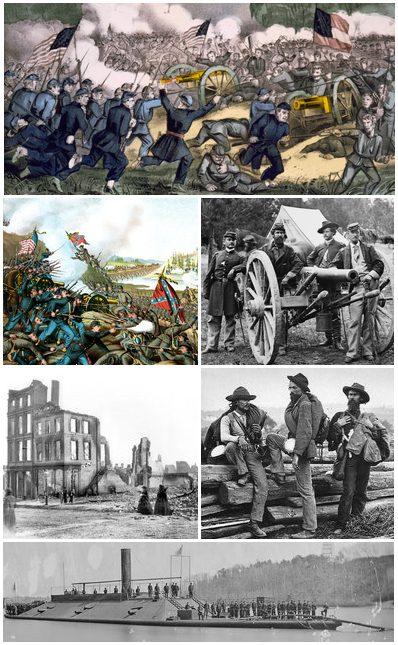
At a Glance
- Defining event
- Robert E. Lee surrenders to Ulysses S. Grant at Appomattox Court House on 9 April, effectively ending the Civil War
- The shock
- Abraham Lincoln is shot at Ford's Theatre on 14 April and dies the next morning — the first U.S. president assassinated
- Freedom completed
- The Thirteenth Amendment is proclaimed on 18 December, abolishing slavery throughout the United States
- Juneteenth
- General Order No. 3 announces freedom to the enslaved people of Texas on 19 June
- Opened the year
- The House of Representatives passes the Thirteenth Amendment on 31 January
- Last surrender
- Stand Watie, a Cherokee chief and Confederate brigadier, is the last Confederate general to surrender, on 23 June
The defining story: Appomattox, assassination and abolition
The year opened with the legal end of the question the war was fought over. On 31 January 1865 the U.S. House of Representatives passed the Thirteenth Amendment abolishing slavery, and Lincoln signed it the next day; it went to the states for ratification while the armies finished their work. In February, Union forces under General Sherman occupied Columbia, South Carolina, and much of the city burned in the night. In March, Lincoln signed the bill creating the Freedmen's Bureau to aid formerly enslaved people, and the Confederacy, in its last weeks, approved the enlistment of Black soldiers — a step it had resisted for four years. On 3 April Richmond, the Confederate capital, fell after a ten-month campaign.
On Palm Sunday, 9 April, in the parlour of Wilmer McLean's house at Appomattox Court House, Robert E. Lee surrendered the Army of Northern Virginia to Ulysses S. Grant. As Britannica's account puts it, that surrender was the effective end of the Civil War, though other Confederate forces remained in the field. Grant's terms were deliberately generous: officers and men were paroled and allowed to go home, officers kept their sidearms and horses, and when Lee mentioned that his men were hungry, Grant sent over 25,000 rations. Two days later Lincoln gave his last public address from the White House, speaking in support of limited Black suffrage in Louisiana.
On the evening of 14 April — Good Friday — the actor John Wilkes Booth, one of the most celebrated performers in America, entered the presidential box at Ford's Theatre. He knew the play, Our American Cousin, by heart, and he timed his single shot for the line that reliably drew the evening's biggest laugh, so the audience would hear it as part of the noise. He stabbed Major Rathbone, leapt to the stage breaking his leg, and escaped shouting Virginia's motto. Lincoln was carried across the street to the Petersen House and died at 7:22 the next morning, the first U.S. president assassinated; Andrew Johnson was sworn in hours later. Booth was cornered and killed in a Virginia barn on 26 April, the same day Joseph E. Johnston surrendered the largest remaining Confederate army to Sherman in North Carolina.
Freedom, meanwhile, was still arriving. On 19 June, Major General Gordon Granger issued General Order No. 3 in Galveston, announcing that all enslaved people in Texas were free — two and a half years after the Emancipation Proclamation, for an estimated 250,000 enslaved people in a state that had been the Confederacy's refuge. The day became Juneteenth. Through the summer the last Confederate forces surrendered, four of Lincoln's assassination conspirators were hanged, and on 6 December Georgia became the 27th state to ratify the Thirteenth Amendment. On 18 December Secretary of State William H. Seward proclaimed it part of the Constitution, abolishing slavery throughout the United States — including the loyal states the Emancipation Proclamation had never reached.
Timeline of 1865
- 31 January
The U.S. House of Representatives passes the Thirteenth Amendment abolishing slavery; Lincoln signs it the next day.
- 17 February
Union forces under General Sherman occupy Columbia, South Carolina, and much of the city burns in the night.
- 3 March
President Lincoln signs the bill creating the Freedmen's Bureau to aid formerly enslaved people in the South.
- 3 April
Richmond, the Confederate capital, falls to Union forces after a ten-month campaign.
- 9 April
Robert E. Lee surrenders the Army of Northern Virginia to Ulysses S. Grant at Appomattox Court House, effectively ending the Civil War.
- 14 April
John Wilkes Booth shoots Abraham Lincoln at Ford's Theatre; the president dies the next morning.
- 26 April
Booth is killed in Virginia, and Confederate general Joseph E. Johnston surrenders his army to Sherman — the largest Confederate surrender of the war.
- 17 May
The International Telegraph Union is founded in Paris.
- 19 June
General Order No. 3 announces freedom to the enslaved people of Texas — the day that becomes Juneteenth.
- 2 July
William and Catherine Booth found the Christian Mission in London's East End, the movement that becomes the Salvation Army.
- 5 July
The United States Secret Service begins operations, founded to combat counterfeiting.
- 7 July
Four of the conspirators in Lincoln's assassination, among them Mary Surratt, are hanged in Washington.
- 6 December
Georgia becomes the 27th state to ratify the Thirteenth Amendment, completing its adoption.
- 18 December
The Thirteenth Amendment is proclaimed part of the U.S. Constitution, abolishing slavery throughout the United States.
Why 1865 still matters
1865 still matters because it fixed the United States' modern shape in a single year: the Union preserved, slavery abolished in the Constitution itself, and Reconstruction begun. The Thirteenth Amendment was the first of the three Reconstruction Amendments, and its reach went where the wartime proclamation never could — into Kentucky and Delaware, where slavery had remained legal to the end. Its one exception, permitting involuntary servitude as a punishment for crime, has echoed through American law ever since. Lincoln's assassination, five days after victory, also changed the peace: the leniency he had sketched at Appomattox and in his last address gave way to a harder, contested Reconstruction under his successor.
The year's longest shadow may be a date rather than a document. Juneteenth, kept first by freedpeople in Texas through their churches, spread across the country with the Great Migration; Texas made it a state holiday in 1980, the first state to do so, and in 2021 it became a U.S. federal holiday — the oldest nationally celebrated commemoration of the end of slavery in the United States. And the war's ending had one last echo at sea: in August the Confederate cruiser CSS Shenandoah, still hunting Union shipping in the Pacific, learned from a British vessel that the war had ended months earlier.
The year also founded institutions that long outlived it. The Freedmen's Bureau, created in March, was charged with aiding formerly enslaved people in the South. The United States Secret Service began operations in July, founded to combat the counterfeiting that plagued Civil War-era currency. In Paris in May, the International Telegraph Union was founded — the body that became the International Telecommunication Union, described on this site as the world's oldest international organisation still working. Even the Salvation Army dates from 1865, founded in London's East End that July. The war ended; the machinery of the modern state and the modern charity began.
1865 on The History Trail
The History Trail follows 1865 from the Thirteenth Amendment's passage to its proclamation in December.
- April 9 in History — Lee surrenders to Grant at Appomattox Court House.
- April 14 in History — Abraham Lincoln is shot at Ford's Theatre.
- June 19 in History — Juneteenth: freedom is announced to the enslaved people of Texas.
- December 18 in History — the Thirteenth Amendment is proclaimed part of the Constitution.
- American Civil War — the full story of the war that ended in 1865.
Sources
- Encyclopaedia Britannica — Appomattox Court House
- Smithsonian National Museum of American History — The Surrender at Appomattox Court House
- Encyclopaedia Britannica — On This Day: April 14
- HISTORY — John Wilkes Booth shoots Abraham Lincoln
- National Archives — National Archives Safeguards Original 'Juneteenth' General Order
- HISTORY — Slavery's end announced in Texas on 'Juneteenth'
- Encyclopaedia Britannica — On This Day: January 31
The facts on this page were checked against these sources on 19 November 2026. The History Trail's permanent pages are researched and written for this site; the live profiles elsewhere on The History Trail are assembled automatically from Wikipedia and Wikidata.
About the Author
Researched and written by the The History Trail Editorial Team — the accountable editorial function behind this site's permanent story pages. The team works from the published sources cited on each page; it does not invent historians, reviewers or credentials, and it corrects errors openly.
Fact Check
Every load-bearing fact on this page traces to one of the sources listed above, and significant claims link to their source in the text. Our checking method is described on the methodology page; errors can be reported via the corrections page.
Sources & Citations
Cite this page as: The History Trail Editorial Team, The History Trail — this article's title, publication and update dates are shown beneath its headline. The full source list appears under Sources above; the site's source standards are on the sources page.