
Years
1867 in History
1867 redrew the map of the North: in the small hours of 30 March the United States bought Alaska from Russia for $7.2 million — mocked as 'Seward's Folly' — and on 1 July the British North America Act united four colonies as the Dominion of Canada. The same year created the Dual Monarchy of Austria-Hungary, ended France's Mexican adventure with Maximilian's execution, and returned power in Japan to the emperor.
At a Glance
- Defining event
- Alaska Purchase treaty signed, 30 March 1867, for $7.2 million
- The handover
- Alaska formally transferred at Sitka, 18 October
- Canada born
- British North America Act takes effect, 1 July; John A. Macdonald first prime minister
- Dual Monarchy
- Austro-Hungarian Compromise reached, 8 February; Franz Joseph crowned in Budapest, 8 June
- Mexico
- Emperor Maximilian executed at Querétaro, 19 June
- Japan turns
- The Tokugawa shogunate returns power to the emperor, 9 November, beginning the Meiji Restoration
The defining story: two cents an acre
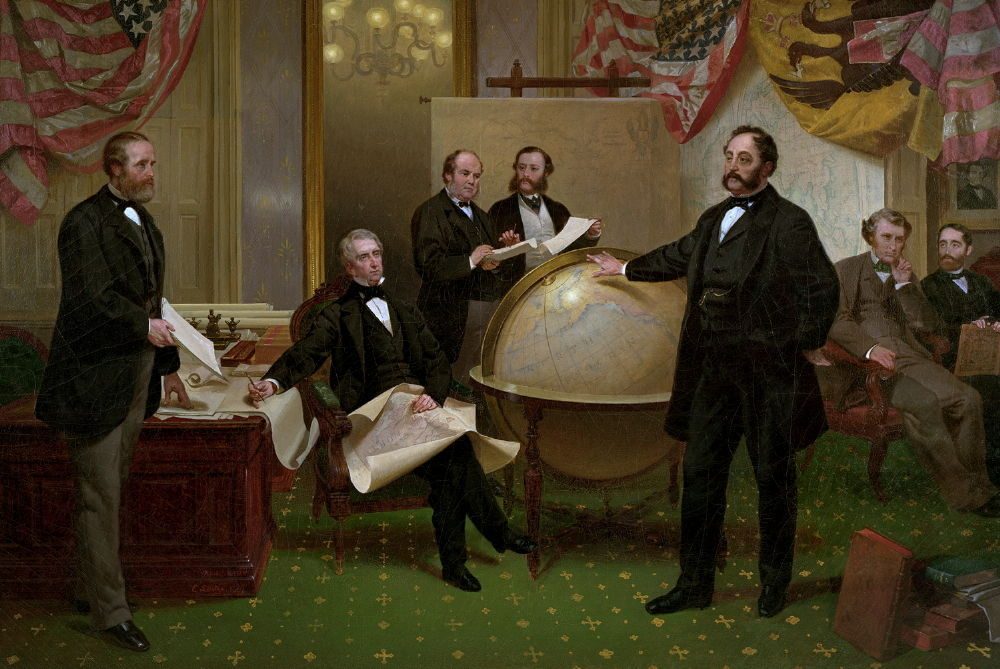
Alaska in 1867 was Russian America: a thin chain of fur-trading posts along a vast, cold coast, run at a loss and garrisoned by a few hundred men. The Crimean War had taught St Petersburg that the colony could not be defended against Britain and was better sold to the friendly United States than lost for nothing. Secretary of State William H. Seward needed no persuading. When the Russian minister Eduard de Stoeckl received his instructions and his price in March, the negotiation took days: de Stoeckl was summoned late on 29 March, the clerks were called back, and the treaty was drafted and signed in the small hours of 30 March — $7.2 million for some 586,000 square miles, about two cents an acre.
The Senate ratified within a fortnight, helped by Charles Sumner's famous speech in favour. Then came the ridicule: editorialists christened the purchase 'Seward's Folly' and 'Seward's Icebox', and the House, deep in the struggle against President Johnson, held up the money for more than a year. The flag changed first. At Sitka on 18 October 1867 Russian troops lowered their colours and the Stars and Stripes rose over Castle Hill — the Tlingit people, on whose land the ceremony took place, were not consulted at all. Congress finally appropriated the $7.2 million in the summer of 1868; the Treasury cheque, payable to de Stoeckl, is dated 1 August 1868.
North America's other new map was drawn the same summer. On 1 July the British North America Act took effect, uniting Nova Scotia, New Brunswick, Ontario and Quebec as the Dominion of Canada, with John A. Macdonald as its first prime minister. In January Congress had already granted African American men the vote in the District of Columbia, overriding President Andrew Johnson's veto — an early Reconstruction landmark in a year of constitutional rebuilding.
Europe and Asia rebuilt too. The Austro-Hungarian Compromise of 8 February created the Dual Monarchy, sealed on 8 June when Franz Joseph was crowned King of Hungary in Budapest. On 19 June Emperor Maximilian of Mexico, the Austrian archduke installed by Napoleon III, was executed by firing squad at Querétaro, ending France's Mexican adventure. And on 9 November the Tokugawa shogunate returned power to the Emperor of Japan, beginning the Meiji Restoration.
Timeline of 1867
- 8 January
Congress grants African American men the vote in the District of Columbia, overriding President Johnson's veto.
- 8 February
The Austro-Hungarian Compromise is reached, creating the Dual Monarchy of Austria-Hungary.
- 29 March
Cy Young, the American pitcher whose 511 career wins remain the record, is born.
- 30 March
The United States and Russia sign the treaty ceding Alaska for $7.2 million.
- 16 April
Wilbur Wright, who with his brother Orville built and flew the first powered aeroplane, is born.
- 8 June
Franz Joseph is crowned King of Hungary in Budapest, sealing the Austro-Hungarian Compromise.
- 8 June
Frank Lloyd Wright, American architect of Fallingwater and the Guggenheim Museum, is born.
- 19 June
Emperor Maximilian of Mexico is executed by firing squad at Querétaro.
- 1 July
The British North America Act takes effect, creating the Dominion of Canada.
- 25 August
Michael Faraday, the English scientist whose work on electromagnetism made the electric age possible, dies.
- 18 October
The United States formally takes possession of Alaska at Sitka.
- 7 November
Marie Curie, pioneer of radioactivity and the only person to win Nobel Prizes in two sciences, is born.
- 9 November
The Tokugawa shogunate returns power to the Emperor of Japan, beginning the Meiji Restoration.
- 23 December
Madam C. J. Walker, the American entrepreneur who built a hair-care empire, is born.
Why 1867 still matters
The folly aged into perhaps the most profitable land deal any government ever signed: gold at Juneau in 1880 and in the Klondike era, salmon fisheries, wartime strategic value, statehood in 1959, and in 1968 the largest oil field in North America at Prudhoe Bay. At two cents an acre, the mockery reversed completely — though the fuller history now told includes the Alaska Native peoples whose lands were transferred between two empires without their consent, a wrong partly addressed only in 1971.
Canada's 1 July union created the state that would grow province by province across the continent, while the Dual Monarchy fixed the form Austria-Hungary kept until 1918. Maximilian's execution ended Europe's last attempt to plant a monarchy in the Americas by force, and the shogunate's return of power opened Japan's headlong modernisation — three settlements of 1867 that structured the next half-century on three continents.
The year's births promised as much: Marie Curie would found the science of radioactivity, Wilbur Wright would help conquer the air, Frank Lloyd Wright would remake architecture, and Madam C. J. Walker, born Sarah Breedlove, would build a business empire from nothing. 1867 was a year of signatures — on treaties, acts and compromises — whose ink is still visible on every modern map.
1867 on The History Trail
A pre-dawn treaty and a new dominion lead this year on The History Trail.
- March 30 in History — The Alaska Purchase treaty is signed for $7.2 million.
- October 18 in History — Alaska is formally transferred to the United States at Sitka.
- July 1 in History — The Dominion of Canada comes into being.
- June 19 in History — Emperor Maximilian is executed at Querétaro.
- November 7 in History — Marie Curie is born in Warsaw.
- November 9 in History — The Tokugawa shogunate returns power to the emperor of Japan.
- January 8 in History — Congress grants African American men the vote in the District of Columbia.
Sources
- HISTORY — This Day in History: March 30
- Encyclopaedia Britannica — On This Day: October 18
- State of Alaska — Alaska Day proclamation
- Encyclopaedia Britannica — On This Day: July 1
- Encyclopaedia Britannica — On This Day: June 19
- Wikimedia — On This Day feed: November 7
The facts on this page were checked against these sources on 19 November 2026. The History Trail's permanent pages are researched and written for this site; the live profiles elsewhere on The History Trail are assembled automatically from Wikipedia and Wikidata.
About the Author
Researched and written by the The History Trail Editorial Team — the accountable editorial function behind this site's permanent story pages. The team works from the published sources cited on each page; it does not invent historians, reviewers or credentials, and it corrects errors openly.
Fact Check
Every load-bearing fact on this page traces to one of the sources listed above, and significant claims link to their source in the text. Our checking method is described on the methodology page; errors can be reported via the corrections page.
Sources & Citations
Cite this page as: The History Trail Editorial Team, The History Trail — this article's title, publication and update dates are shown beneath its headline. The full source list appears under Sources above; the site's source standards are on the sources page.