
Years
1863 in History
1863 is the year the American Civil War changed both its meaning and its direction. It opened with the Emancipation Proclamation turning a war for Union into a war against slavery, reached its turning point in July when Gettysburg and Vicksburg fell within a day of each other, and closed with Abraham Lincoln, in the Gettysburg Address, restating what the United States was for.
At a Glance
- Defining event
- The Battle of Gettysburg ends on 3 July, the turning point of the American Civil War
- Opened the year
- The Emancipation Proclamation takes effect on 1 January, declaring enslaved people in the rebellious states free
- Turning point
- Vicksburg surrenders on 4 July after a 47-day siege, giving the Union the Mississippi River
- Remembered for
- Lincoln's Gettysburg Address, 19 November — some 270 words in about two minutes
- Closed the year
- Lincoln's Proclamation of Amnesty and Reconstruction, 8 December, opens his plan for readmitting Southern states
- Beyond the war
- The world's first underground railway opens in London on 10 January
The defining story: emancipation, Gettysburg and Vicksburg
The year began with a signature. On 1 January 1863, in the middle of the American Civil War, President Abraham Lincoln's Emancipation Proclamation took effect, announcing, in the National Archives' summary, that all persons held as slaves within the rebellious areas 'are, and henceforward shall be free.' It changed the legal status of more than three million enslaved people in the Confederate states, and it changed the war itself: a struggle fought to restore the Union became a struggle also to end slavery. The proclamation had been promised one hundred days earlier, after the Union's narrow success at Antietam gave Lincoln the standing to act, and no rebellious state had returned to the Union by the deadline he set.
Its limits were real, and they shaped everything that followed. Issued as a war measure, the proclamation applied only to areas then in rebellion; it expressly left slavery untouched in the loyal border states and in Confederate districts already under Union occupation. In the rebel states themselves, freedom became real only as Union armies advanced and enslaved people reached Union lines. Yet the effects were immediate: emancipation made it politically impossible for Britain or France to intervene for the Confederacy, and the proclamation opened the Union army and navy to Black enlistment. In May the 54th Massachusetts, one of the first Black regiments, paraded through Boston on its way to the war; in July its men assaulted Fort Wagner in South Carolina, where their colonel, Robert Gould Shaw, was killed with many of them.
The military turn came in the first days of July. The Battle of Gettysburg opened in Pennsylvania on 1 July and ended on 3 July with the failure of Pickett's Charge, when about 12,500 Confederate soldiers advanced across open fields into Union fire. Britannica puts Union casualties at about 23,000 and Confederate casualties at about 28,000 — more than 50,000 men in three days. Robert E. Lee began his retreat to Virginia on the night of 4 July and never again mounted a major invasion of the North. On that same 4 July, a day's journey of war away, Vicksburg in Mississippi surrendered to Ulysses S. Grant after a 47-day siege, giving the Union control of the Mississippi River; the surrender of Port Hudson on 9 July completed that control.
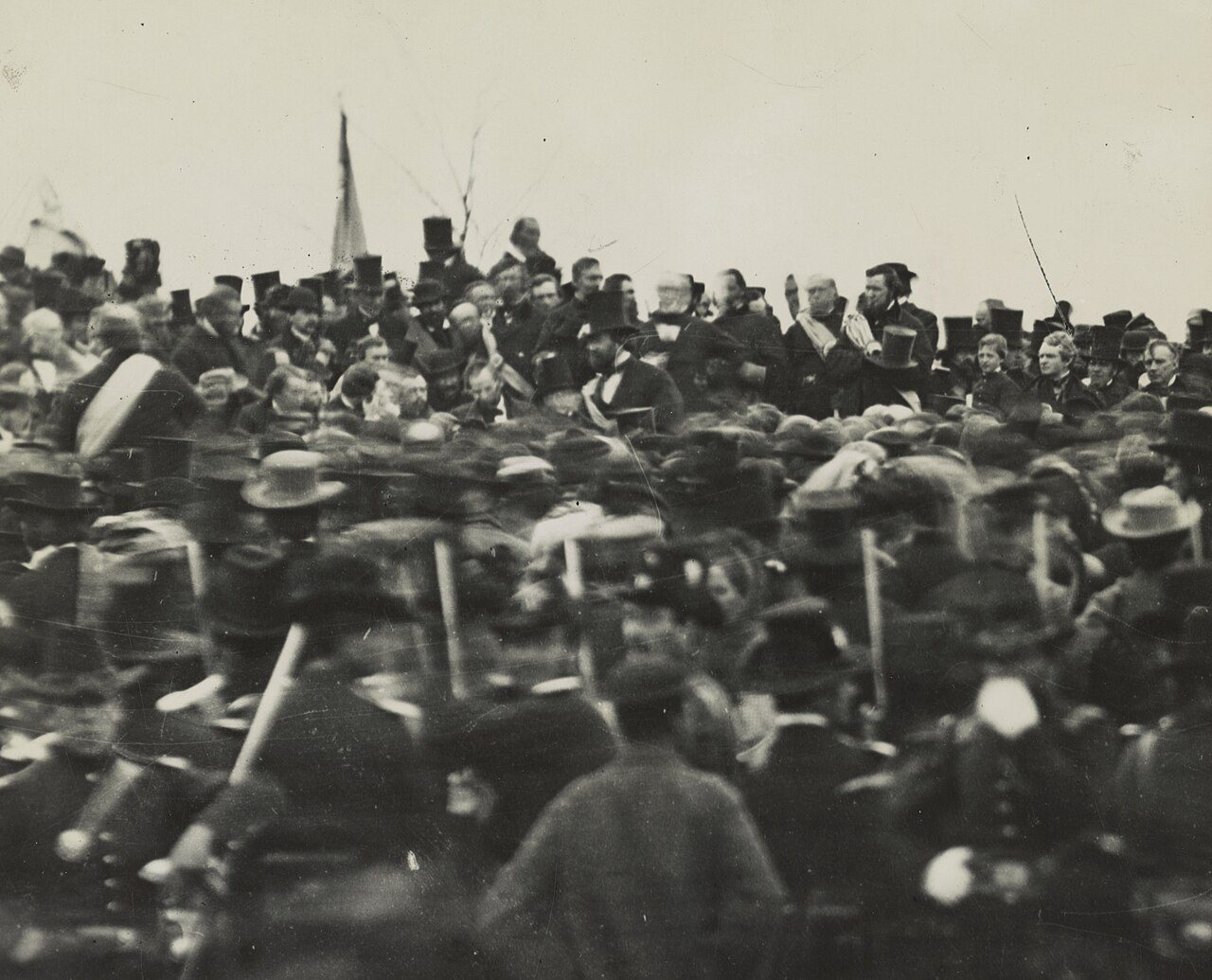
The autumn turned the year's meaning into words. In October Lincoln proclaimed a national Thanksgiving Day, and in November, after fighting around Chattanooga had begun to lift the Confederate siege of that city, he travelled to Pennsylvania for the dedication of the Soldiers' National Cemetery at Gettysburg. There, on 19 November, after Edward Everett's two-hour oration, Lincoln spoke for about two minutes — some 270 words that redefined the war as a test of whether a nation dedicated to the proposition that all men are created equal could endure.
Timeline of 1863
- 1 January
The Emancipation Proclamation takes effect, declaring enslaved people in the rebellious Confederate states free.
- 10 January
The Metropolitan Railway opens between Paddington and Farringdon in London — the first underground railway in the world.
- 29 January
In the Bear River Massacre, U.S. soldiers attack a Shoshone village in present-day Idaho, killing several hundred people.
- 3 March
Congress passes the Civil War conscription act, creating the first wartime draft of American citizens.
- 10 May
Confederate general Thomas 'Stonewall' Jackson dies of pneumonia, eight days after being wounded by his own men at Chancellorsville.
- 28 May
The 54th Massachusetts, one of the first Black regiments in the Union Army, parades through Boston and leaves for the war.
- 20 June
West Virginia is admitted to the Union as the 35th state, carved from Virginia by counties loyal to the Union cause.
- 3 July
The Battle of Gettysburg ends with the failure of Pickett's Charge, the turning point of the American Civil War.
- 4 July
Vicksburg, Mississippi, surrenders to Ulysses S. Grant after a 47-day siege, giving the Union control of the Mississippi River.
- 13 July
The New York City draft riots begin — four days of violence against the conscription law that leave more than a hundred people dead.
- 18 July
Troops of the 54th Massachusetts assault Fort Wagner in South Carolina; Colonel Robert Gould Shaw is killed with many of his men.
- 19 November
Abraham Lincoln delivers the Gettysburg Address at the dedication of the Soldiers' National Cemetery.
- 8 December
Lincoln issues his Proclamation of Amnesty and Reconstruction, setting his 'ten percent' plan for readmitting Southern states.
Why 1863 still matters
1863 still matters because it decided what the American Civil War had been about. Before this year, the Union's stated cause was reunion; after it, reunion and emancipation were inseparable, and by the war's end some 180,000 Black soldiers had served in Union ranks — in the National Archives' phrase, the liberated became liberators. Gettysburg and Vicksburg, falling in the same week, broke the Confederacy's realistic hope of winning the war on the battlefield or of persuading Europe to recognise it. The Confederacy fought on for nearly two more years, but after July 1863 it was fighting against the arithmetic of a Union that now held the Mississippi and the moral initiative.
The year's words outlasted its battles. The Gettysburg Address, spoken over graves whose reburial was still unfinished, became the United States' shortest and most quoted statement of purpose, and the version Lincoln wrote last is the one carved on the Lincoln Memorial. The proclamation of a national Thanksgiving, fixed on the last Thursday of November, gave the country a permanent ritual born in wartime. And because a presidential war order could be challenged or reversed once the war ended, 1863 also set up the work of 1865: Lincoln's push for the Thirteenth Amendment, which would abolish slavery throughout the United States in the Constitution itself.
The year also redrew the Union it saved. West Virginia, carved from Virginia by counties loyal to the Union cause, entered as the 35th state in June — the war literally remaking the map. The first wartime draft of American citizens, enacted in March, provoked the New York draft riots in July, four days of violence that left more than a hundred dead: a reminder that emancipation and conscription together strained the North even as its armies prevailed. And in London, in January, the world's first underground railway opened between Paddington and Farringdon — the modern city beginning its own revolution underground while America's was fought on the surface.
1863 on The History Trail
The History Trail tells 1863 day by day, from emancipation on New Year's Day to the Gettysburg Address in November.
- January 1 in History — the Emancipation Proclamation takes effect and changes the meaning of the Civil War.
- July 3 in History — the Battle of Gettysburg ends with the failure of Pickett's Charge.
- November 19 in History — Lincoln delivers the Gettysburg Address at the cemetery dedication.
- American Civil War — the full story of the war that 1863 turned.
- Why Turkey on Thanksgiving? — the holiday Lincoln proclaimed as a national observance in 1863.
- Association Football — the history of the world game whose modern era begins in this period.
Sources
- National Archives — Emancipation Proclamation (1863)
- Encyclopaedia Britannica — Emancipation Proclamation
- Encyclopaedia Britannica — On This Day: January 1
- Encyclopaedia Britannica — On This Day: July 3
- Encyclopaedia Britannica — Battle of Gettysburg
- Encyclopaedia Britannica — On This Day: July 4
The facts on this page were checked against these sources on 19 November 2026. The History Trail's permanent pages are researched and written for this site; the live profiles elsewhere on The History Trail are assembled automatically from Wikipedia and Wikidata.
About the Author
Researched and written by the The History Trail Editorial Team — the accountable editorial function behind this site's permanent story pages. The team works from the published sources cited on each page; it does not invent historians, reviewers or credentials, and it corrects errors openly.
Fact Check
Every load-bearing fact on this page traces to one of the sources listed above, and significant claims link to their source in the text. Our checking method is described on the methodology page; errors can be reported via the corrections page.
Sources & Citations
Cite this page as: The History Trail Editorial Team, The History Trail — this article's title, publication and update dates are shown beneath its headline. The full source list appears under Sources above; the site's source standards are on the sources page.