
On This Day
April 14 in History
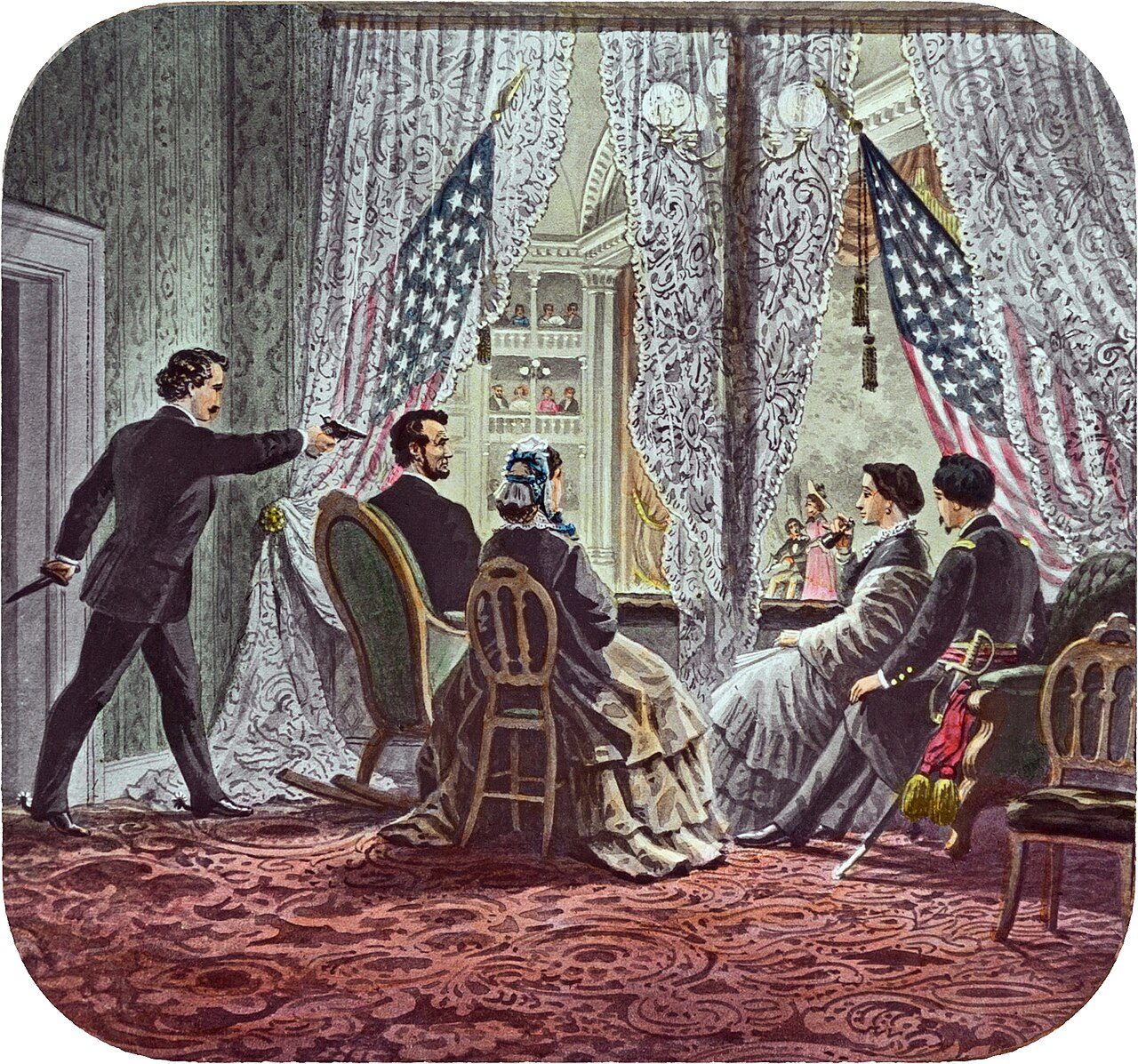
On the evening of 14 April 1865 — Good Friday, and five days after Robert E. Lee surrendered at Appomattox — President Abraham Lincoln was shot in his box at Ford's Theatre in Washington by the actor John Wilkes Booth. He died the next morning, the first American president to be assassinated. April 14 is also the day the Titanic struck her iceberg and the Eyjafjallajökull ash cloud began closing Europe's skies.
Choose another date: open the On This Day calendar to browse events, births and deaths for any day of the year.
At a Glance
- The date
- Good Friday, 14 April 1865, at about 10:15 p.m.
- The place
- The presidential box at Ford's Theatre, Washington, D.C., during a performance of Our American Cousin
- The assassin
- John Wilkes Booth, 26, one of America's best-known actors and a Confederate sympathiser
- The wider plot
- Simultaneous attacks were planned on Vice President Andrew Johnson and Secretary of State William H. Seward; Seward was stabbed but survived
- The death
- Lincoln, carried to the Petersen House across the street, died at 7:22 a.m. on 15 April without regaining consciousness
- The end of Booth
- Tracked to a Virginia barn, Booth was shot and killed on 26 April; four conspirators were hanged in July
Events on this day
- 1471Edward IV defeats and kills the Earl of Warwick at the Battle of Barnet, a decisive fight of the Wars of the Roses.
- 1828Noah Webster publishes his American Dictionary of the English Language, the work of twenty-six years, fixing a distinctly American spelling.
- 1865John Wilkes Booth shoots Abraham Lincoln at Ford's Theatre — the featured story above.
- 1902J. C. Penney opens his first dry-goods store, in Kemmerer, Wyoming — the seed of the department-store chain.
- 1912Late in the evening the liner Titanic, on her maiden voyage, strikes an iceberg in the North Atlantic; she sinks in the early hours of 15 April.
- 1939John Steinbeck's novel The Grapes of Wrath is published, the great story of the Dust Bowl migration.
- 1944The cargo ship Fort Stikine explodes in Bombay harbour, killing an estimated 750 people and injuring about 1,800.
- 1986American aircraft bomb targets in Libya in retaliation for a Berlin discotheque bombing blamed on Muammar al-Qaddafi's regime.
- 2003The Human Genome Project is declared complete, two years ahead of schedule, having sequenced the human genetic code.
- 2010Iceland's Eyjafjallajökull volcano begins the ash eruption that will close most of Europe's airspace for a week.
- 2014Boko Haram gunmen kidnap more than 275 schoolgirls from Chibok, Nigeria, sparking a worldwide campaign for their return.
Born on this day
- 1629Christiaan Huygens — Dutch scientist who discovered Saturn's moon Titan and invented the pendulum clock.
- 1866Anne Sullivan — American teacher whose work with Helen Keller became the most famous education story of the age.
- 1904John Gielgud — English actor and director, among the supreme Shakespeareans of the twentieth century.
- 1925Rod Steiger — American actor of In the Heat of the Night, for which he won an Academy Award.
- 1940Julie Christie — British film actress, star of Darling, Doctor Zhivago and Far from the Madding Crowd.
- 1941Pete Rose — American baseball player, 'Charlie Hustle', the all-time major league leader in hits.
Died on this day
- 1759George Frideric Handel — German-born composer of Messiah, dead in London a week after his last performance of it.
- 1917L. L. Zamenhof — Polish creator of Esperanto, the international language he hoped would end hatred between peoples.
- 1986Simone de Beauvoir — French writer and philosopher, author of The Second Sex, dead in Paris at 78.
- 2021Bernie Madoff — American fraudster who ran history's largest Ponzi scheme, dead in federal prison at 82.
The featured story: Lincoln is shot at Ford's Theatre, 14 April 1865
The war was effectively won. Five days earlier Lee had surrendered the Army of Northern Virginia, Richmond had fallen, and on the morning of 14 April — Good Friday — Lincoln held a cabinet meeting at which, by all accounts, he was in unusually good spirits, talking of leniency toward the defeated South. That evening he went, reluctantly, to Ford's Theatre to see the comedy Our American Cousin, sitting with his wife Mary, Major Henry Rathbone and Clara Harris in a box draped with flags. His bodyguard had left his post. The theatre, and the play, were famous; so was the man who entered the box corridor behind him.
John Wilkes Booth was no stranger slipping in from the street. He was one of the most celebrated actors in America, he had performed at Ford's, and he had collected his mail there that very day — which is how he learned the president would attend. Booth's original scheme, to kidnap Lincoln, had hardened into murder after Lincoln's speech of 11 April endorsing limited Black suffrage. He organised a simultaneous strike at the government: Lewis Powell would kill Secretary of State Seward, George Atzerodt the vice president. Atzerodt lost his nerve. Powell stabbed Seward repeatedly but failed to kill him. Booth alone succeeded.
He timed the shot for the play's funniest line, knowing the laughter would cover it. At about 10:15, with the audience roaring, Booth fired a single ball from a derringer into the back of Lincoln's head, stabbed Rathbone in the arm, and leapt to the stage — catching his spur in a flag, breaking his leg, and still escaping into the night on horseback, shouting Virginia's motto: Sic semper tyrannis. In the box, a young army surgeon, Charles Leale, reached Lincoln first and judged the wound mortal at a glance.
The president was carried across Tenth Street to the Petersen House, where he lay diagonally across a bed too short for him, and through the night the government of the United States effectively sat in that small back bedroom. He died at 7:22 the next morning; Secretary of War Stanton is said to have closed the scene with the words, Now he belongs to the ages. Booth was run to ground and killed twelve days later. Four of his fellow conspirators were hanged. Lincoln's death, at the moment of his victory, transformed Reconstruction: the policy of reconciliation he had been sketching died with him, and the argument over what the peace would mean began without him.
Why this date matters
April 14 is the calendar's cruellest hinge. In the space of a few hours in 1865 it held both the raising of the old flag over Fort Sumter — the war symbolically closed — and the shot that killed the man who had won it. The pattern repeats: Webster's dictionary fixing American English in 1828, Steinbeck's Grapes of Wrath in 1939, the human genome declared complete in 2003 — works of patient construction — set against a theatre box, an iceberg in the night and a volcano emptying Europe's skies. The day builds slowly and breaks suddenly.
Sources
- Encyclopaedia Britannica — On This Day: April 14
- HISTORY — What Happened on April 14
- HISTORY — John Wilkes Booth shoots Abraham Lincoln
- Ford's Theatre — Lincoln's Assassination
The facts on this page were checked against these sources on 19 November 2026. The History Trail's permanent pages are researched and written for this site; the live profiles elsewhere on The History Trail are assembled automatically from Wikipedia and Wikidata.
About the Author
Researched and written by the The History Trail Editorial Team — the accountable editorial function behind this site's permanent story pages. The team works from the published sources cited on each page; it does not invent historians, reviewers or credentials, and it corrects errors openly.
Fact Check
Every load-bearing fact on this page traces to one of the sources listed above, and significant claims link to their source in the text. Our checking method is described on the methodology page; errors can be reported via the corrections page.
Sources & Citations
Cite this page as: The History Trail Editorial Team, The History Trail — this article's title, publication and update dates are shown beneath its headline. The full source list appears under Sources above; the site's source standards are on the sources page.